4,068 posters, 219 videos, 101 topics, 69 sessions, 14,365 authors, 6,128 institutions
ePostersLive by SciGen Technologies S.A. All rights reserved.
Alzheimer's Association International Conference 2026
July 12-15, 2026 | London, United Kingdom, and Online

4052
Symptomatic Trials For Frontotemporal Dementia - Lessons From The Nabilone-FTD Agitation Study
Poster Presenter
Authors
Part of Topic
Background:
- In FTD, pharmacological treatments for neuropsychiatric symptoms (NPS) are based on anecdotal evidence or extrapolation from Alzheimer’s studies. There is a strong interest to design symptom-based clinical trials in FTD.1
- Agitation is observed in 20-60% of FTD patients, and it is strongly linked to care partner burden, making it a key target.2
- One promising drug is nabilone, a synthetic cannabinoid that has shown benefit for agitation in Alzheimer’s disease.3
Methods:
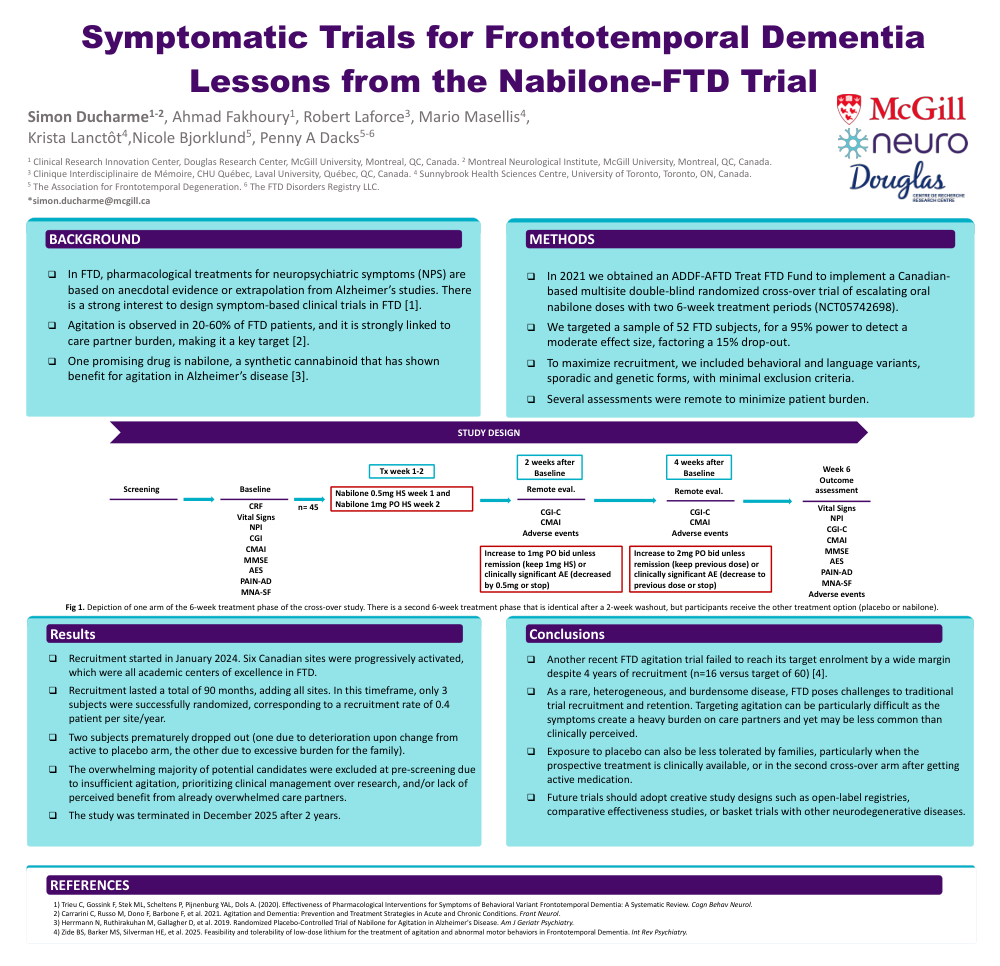
- In 2021 we obtained an ADDF-AFTD Treat FTD Fund to implement a Canadian-based multisite double-blind randomized cross-over trial of escalating oral nabilone doses with two 6-week treatment periods (NCT05742698).
- We targeted a sample of 52 FTD subjects, for a 95% power to detect a moderate effect size, factoring a 15% drop-out.
- To maximize recruitment, we included behavioral and language variants, sporadic and genetic forms, with minimal exclusion criteria.
- Several assessments were remote to minimize patient burden.
Results:
- Recruitment started in January 2024. Six Canadian sites were progressively activated, which were all academic centers of excellence in FTD.
- Recruitment lasted a total of 90 months, adding all sites. In this timeframe, only 3 subjects were successfully randomized, corresponding to a recruitment rate of 0.4 patient per site/year.
- Two subjects prematurely dropped out (one due to deterioration upon change from active to placebo arm, the other due to excessive burden for the family).
- The overwhelming majority of potential candidates were excluded at pre-screening due to insufficient agitation, prioritizing clinical management over research, and/or lack of perceived benefit from already overwhelmed care partners.
- The study was terminated in December 2025 after 2 years.
Conclusions:
- Another recent FTD agitation trial failed to reach its target enrolment by a wide margin despite 4 years of recruitment (n=16 versus target of 60)4
- As a rare, heterogeneous, and burdensome disease, FTD poses challenges to traditional trial recruitment and retention. Targeting agitation can be particularly difficult as the symptoms create a heavy burden on care partners and yet may be less common than clinically perceived.
Comments
Email is required but is not shown publicly.
Loading comments...