4,068 posters, 219 videos, 101 topics, 69 sessions, 14,365 authors, 6,128 institutions
ePostersLive by SciGen Technologies S.A. All rights reserved.
Alzheimer's Association International Conference 2026
July 12-15, 2026 | London, United Kingdom, and Online

6397
Real-world Safety And Early Cognitive Outcomes Of Lecanemab In Asian Patients With Early Alzheimer’S Disease
Poster Presenter
Authors
Sung Hoon Kang, Yu Jeong Park, Jaemin Shin, Eun Seong Lee, Hye Na Jung, Jae Seon Eo, Sang-Il Suh
Affiliations
Department of Neurology, Korea University Guro Hospital, Korea University College of Medicine, Seoul, South Korea, Department of Nuclear Medicine, Korea University Guro Hospital, Korea University College of Medicine, Seoul, South Korea, Department of Radiology, Korea University Guro Hospital, Korea University College of Medicine, Seoul, South Korea
Part of Topic
Background
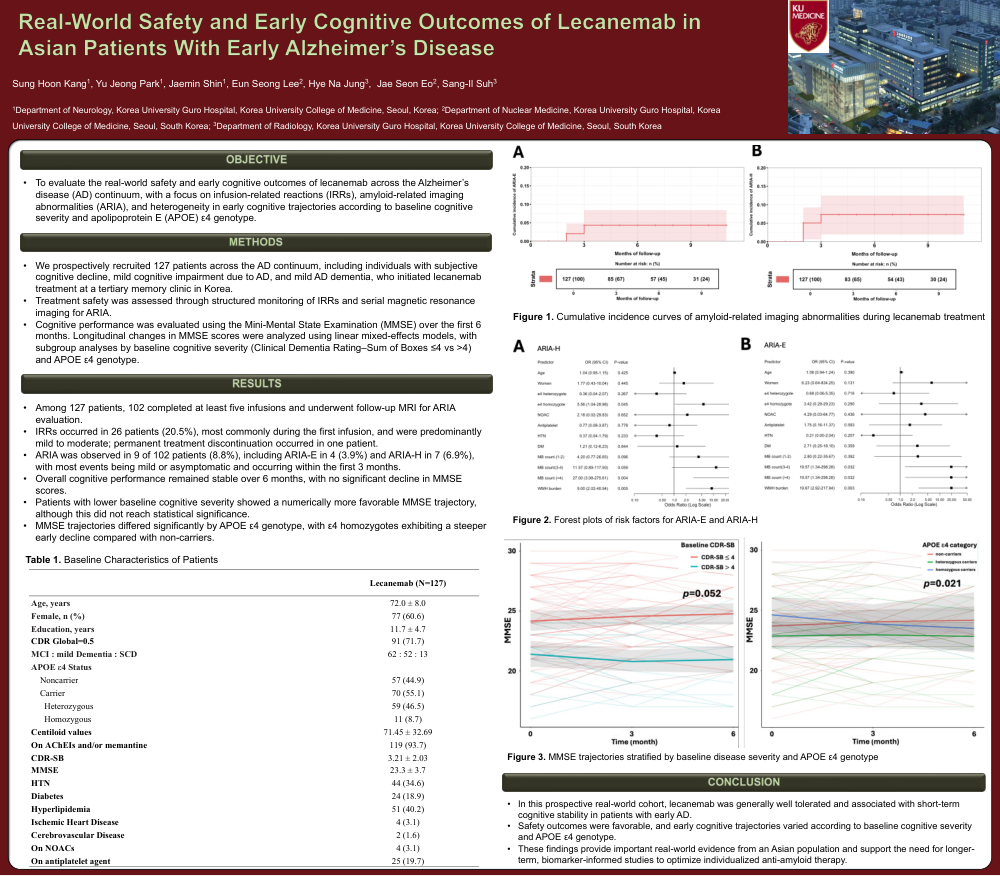
To evaluate the real-world safety and early cognitive outcomes of lecanemab across the Alzheimer’s disease (AD) continuum, with a focus on infusion-related reactions (IRRs), amyloid-related imaging abnormalities (ARIA), and heterogeneity in early cognitive trajectories according to baseline cognitive severity and apolipoprotein E (APOE) ε4 genotype.
Methods
We prospectively recruited 127 patients across the AD continuum, including individuals with subjective cognitive decline, mild cognitive impairment due to AD, and mild AD dementia, who initiated lecanemab treatment at a tertiary memory clinic in Korea. Treatment safety was assessed through structured monitoring of IRRs and serial magnetic resonance imaging for ARIA. Cognitive performance was evaluated using the Mini-Mental State Examination (MMSE) over the first 6 months. Longitudinal changes in MMSE scores were analyzed using linear mixed-effects models, with subgroup analyses by baseline cognitive severity (Clinical Dementia Rating–Sum of Boxes ≤4 vs >4) and APOE ε4 genotype.
Results
Among 127 patients, 102 completed at least five infusions and underwent follow-up MRI for ARIA evaluation. IRRs occurred in 26 patients (20.5%), most commonly during the first infusion, and were predominantly mild to moderate; permanent treatment discontinuation occurred in one patient. ARIA was observed in 9 of 102 patients (8.8%), including ARIA-E in 4 (3.9%) and ARIA-H in 7 (6.9%), with most events being mild or asymptomatic and occurring within the first 3 months. Overall cognitive performance remained stable over 6 months, with no significant decline in MMSE scores. Patients with lower baseline cognitive severity showed a numerically more favorable MMSE trajectory, although this did not reach statistical significance. MMSE trajectories differed significantly by APOE ε4 genotype, with ε4 homozygotes exhibiting a steeper early decline compared with non-carriers.
Conclusion
In this prospective real-world cohort, lecanemab was generally well tolerated and associated with short-term cognitive stability in patients with early AD. Safety outcomes were favorable, and early cognitive trajectories varied according to baseline cognitive severity and APOE ε4 genotype. These findings provide important real-world evidence from an Asian population and support the need for longer-term, biomarker-informed studies to optimize individualized anti-amyloid therapy.
Comments
Email is required but is not shown publicly.
Loading comments...