4,068 posters, 219 videos, 101 topics, 69 sessions, 14,365 authors, 6,128 institutions
ePostersLive by SciGen Technologies S.A. All rights reserved.
Alzheimer's Association International Conference 2026
July 12-15, 2026 | London, United Kingdom, and Online

7042
Neuropsychiatric Features Of Imaging-defined Concomitant LATE And Alzheimer’S Disease
Poster Presenter
Authors
Emma Rhodes, Ashlyn O’Halloran, Nidhi Mundada, Katheryn Cousins, Christopher Brown, Paul Yushkevic, Sandhitsu Das, David Wolk, Corey McMillan
Affiliations
Department of Neurology, University of Pennsylvania, Frontotemporal Degeneration Center, University of Pennsylvania, Department of Bioengineering, University of Pennsylvania, Alzheimer’s Disease Research Center, University of Pennsylvania, Department of Radiology, University of Pennsylvania
Part of Topic
Title: Neuropsychiatric features of imaging-defined concomitant LATE and Alzheimer’s disease
Authors: Emma Rhodes1, Ashlyn O’Halloran1, Nidhi S. Mundada2, Katheryn A.Q. Cousins1, Christopher A. Brown3, Paul A. Yushkevich4, Sandhitsu R. Das5, David A. Wolk3 & Corey T. McMillan1
Author Affiliations: 1Frontotemporal Degeneration Center, University of Pennsylvania; 2Department of Bioengineering, University of Pennsylvania; 3Alzheimer’s Disease Research Center, University of Pennsylvania; 4Department of Radiology, University of Pennsylvania, 5Department of Neurology, University of Pennsylvania
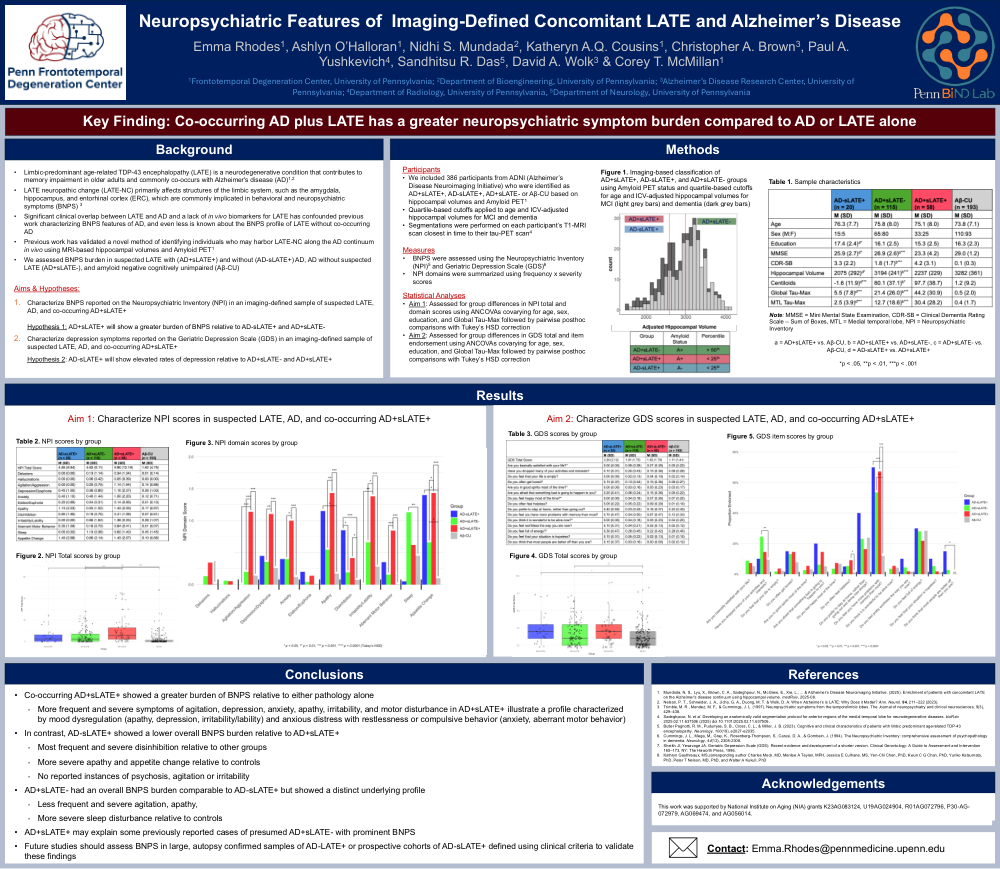
Background: Limbic-predominant age-related TDP-43 encephalopathy (LATE) frequently co-occurs with Alzheimer's disease (AD) and contributes to accelerated cognitive decline and greater neurodegeneration compared to AD alone. LATE neuropathic change affects structures of the limbic system commonly implicated in neuropsychiatric symptoms (NPS) of AD. The role of LATE copathology in NPS profiles of AD has been understudied in part due to a lack of in vivo LATE biomarkers, and even less is known about the NPS profile of LATE without concomitant AD. We assessed NPS burden in suspected LATE with (AD+sLATE+) and without AD (AD-sLATE+) and AD without suspected LATE (AD+sLATE-) identified using in vivo neuroimaging.
Methods: We included 386 participants from the Alzheimer’s Disease Neuroimaging Initiative (ADNI) classified as AD+sLATE+, AD-sLATE+, AD+sLATE-, or amyloid negative cognitively unimpaired (Aβ-CU) based on T1-MRI hippocampal volumes and Amyloid PET status (Figure 1). NPS were measured using Neuropsychiatric Inventory (NPI) scores collected closest to MRI date. Group differences in severity of NPS were assessed using ANCOVA covarying for age, sex, education, and global Tau-Max, a measure of global tau burden derived from tau-PET, with posthoc pairwise comparisons and Tukey’s correction for multiple comparisons.
Results: NPI total scores were higher in AD+sLATE+ relative to AD+sLATE- (p<.001), AD-sLATE+ (p=.01), and Aβ-CU (p<.001, Table 1). AD+sLATE+ had higher NPI domain scores for Agitation/Aggression, Depression/Dysphoria, Anxiety, Apathy, Irritability/Lability, Motor Behavior, and Appetite relative to other groups (Figure 2, all p-values <.05). AD-sLATE+ had higher Disinhibition scores relative to AD+sLATE- (p=.04) and Aβ-CU (p<.001) and Apathy and Appetite Change scores that were comparable to AD+sLATE+ (p-values >.05). AD+sLATE- showed higher Sleep/Nighttime Behavior scores relative to AD-sLATE+ (p=.04) and Aβ-CU (p<.001).
Conclusions: Concomitant AD+sLATE+ showed a greater burden of NPS relative to either pathology alone with more severe symptoms affecting mood (depression, anxiety, irritability) and behavior (agitation, apathy, aberrant motor behaviors, sleep disturbance, appetite change). In contrast, AD-sLATE+ had a more limited NPS profile characterized by disinhibition, apathy, and appetite change, and AD+sLATE- were elevated primarily on sleep disturbance. Findings suggest that LATE copathology in AD may account for more severe or heterogeneous NPS presentations previously ascribed to AD alone.
Comments
Email is required but is not shown publicly.
Loading comments...