4,068 posters, 219 videos, 101 topics, 69 sessions, 14,365 authors, 6,128 institutions
ePostersLive by SciGen Technologies S.A. All rights reserved.
Alzheimer's Association International Conference 2026
July 12-15, 2026 | London, United Kingdom, and Online

3757
Risk Factors And Structural Imaging Markers Of Anxiety And Depression In Subjective Cognitive Decline
Poster Presenter
Authors
Carolina Boza-Calvo, Karimar Amador-Martínez, Yian Zhang, Lindsey Gurin, Sakina Ouedrago Tall, Evan Schulze, Al Amira Safa Shebab, Arline Faustin, Julia Rao, Alok Vedvyas, Ricardo S. Osorio, Omonigho M. Bubu, Henry Rusinek, Karyn Marsh, Joshua Chodosh, Mary Mittelman, Yongzhao Shao, Arjun V. Masurkar
Affiliations
Alzheimer’s Disease Research Center, Department of Neurology, NYU Grossman School of Medicine, New York, NY., Department of Population Health, NYU Grossman School of Medicine, New York, NY., Department of Neurology, NYU Grossman School of Medicine, New York, NY., Department of Medicine, NYU Grossman School of Medicine, New York, NY., Department of Pathology, NYU Grossman School of Medicine, New York, NY., Department of Psychiatry, NYU Grossman School of Medicine, New York, NY., Department of Radiology, NYU Grossman School of Medicine, New York, NY.
Part of Topic
Risk factors and structural imaging markers of anxiety and depression in subjective cognitive decline
Background:
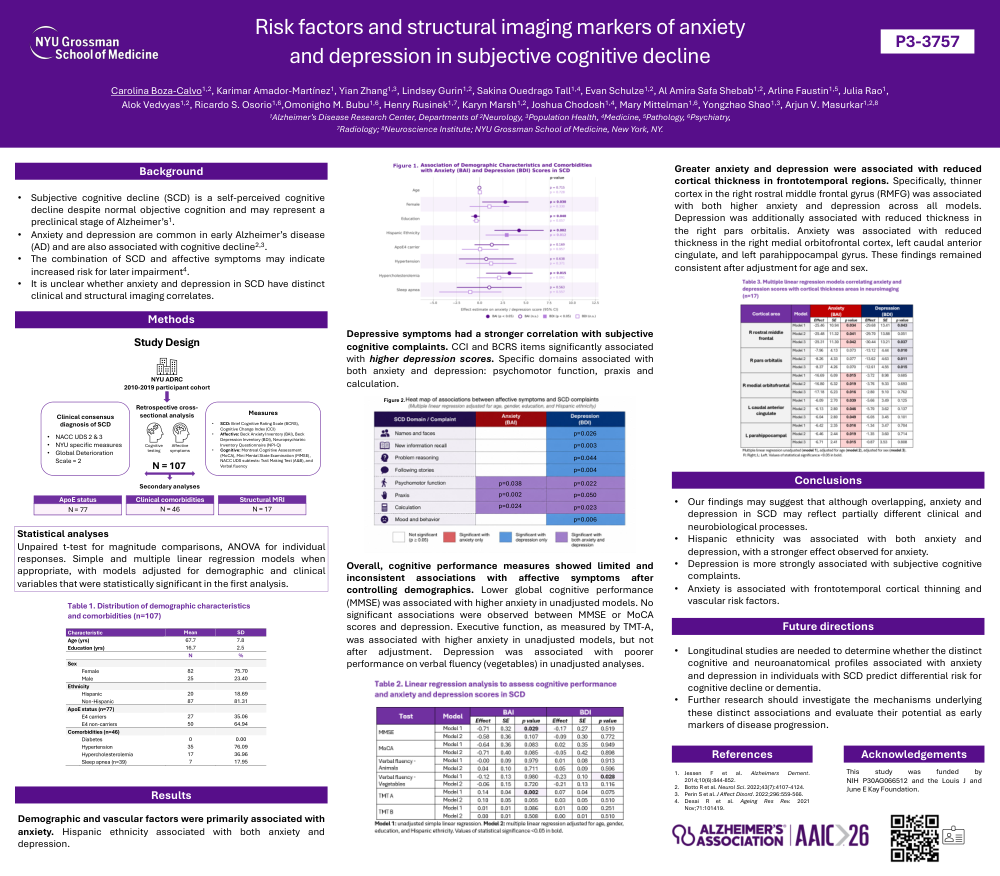
Subjective cognitive decline (SCD) is a self-perceived cognitive decline despite normal objective cognition and may represent apreclinical stage of Alzheimer’s1. Anxiety and depression are common in early Alzheimer’s disease(AD) and are also associated with cognitive decline2,3. The combination of SCD and affective symptoms may indicate increased risk for later impairment4. It is unclear whether anxiety and depression in SCD have distinct clinical and structural imaging correlates.
Methods:
Statistical analyses: Unpaired t-test for magnitude comparisons, ANOVA for individual responses. Simple and multiple linear regression models when appropriate, with models adjusted for demographic and clinical variables that were statistically significant in the first analysis.
Results:
Demographic and vascular factors were primarily associated with anxiety. Hispanic ethnicity associated with both anxiety and depression. Depressive symptoms had a stronger correlation with subjective cognitive complaints. CCI and BCRS items significantly associated with higher depression scores. Specific domains associated with both anxiety and depression: psychomotor function, praxis and calculation. Overall, cognitive performance measures showed limited and inconsistent associations with affective symptoms after controlling demographics. Lower global cognitive performance (MMSE) was associated with higher anxiety in unadjusted models. No significant associations were observed between MMSE or MoCA scores and depression. Executive function, as measured by TMT-A, was associated with higher anxiety in unadjusted models, but not after adjustment. Depression was associated with poorer performance on verbal fluency (vegetables) in unadjusted analyses. Greater anxiety and depression were associated with reduced cortical thickness in frontotemporal regions. Specifically, thinner cortex in the right rostral middle frontal gyrus (RMFG) was associated with both higher anxiety and depression across all models. Depression was additionally associated with reduced thickness in the right pars orbitalis. Anxiety was associated with reduced thickness in the right medial orbitofrontal cortex, left caudal anterior cingulate, and left parahippocampal gyrus. These findings remained consistent after adjustment for age and sex.
Conclusions:
Our findings may suggest that although overlapping, anxiety and depression in SCD may reflect partially different clinical and neurobiological processes. Hispanic ethnicity was associated with both anxiety and depression, with a stronger effect observed for anxiety. Depression is more strongly associated with subjective cognitive complaints. Anxiety is associated with frontotemporal cortical thinning and vascular risk factors.
Future directions:
Longitudinal studies are needed to determine whether the distinct cognitive and neuroanatomical profiles associated with anxiety and depression in individuals with SCD predict differential risk for cognitive decline or dementia. Further research should investigate the mechanisms underlying these distinct associations and evaluate their potential as early markers of disease progression.
References:
1. Jessen F et al. Alzheimers Dement. 2014;10(6):844-852.
2. Botto R et al. Neurol Sci. 2022;43(7):4107-4124.
3. Perin S et al. J Affect Disord. 2022;296:559-566.
4. Desai R et al. Ageing Res Rev. 2021 Nov;71:101419.
Acknowledgements:
This study was funded by NIH P30AG066512 and the Louis J and June E Kay Foundation.
Comments
Email is required but is not shown publicly.
Loading comments...