4,068 posters, 219 videos, 101 topics, 69 sessions, 14,365 authors, 6,128 institutions
ePostersLive by SciGen Technologies S.A. All rights reserved.
Alzheimer's Association International Conference 2026
July 12-15, 2026 | London, United Kingdom, and Online

6099
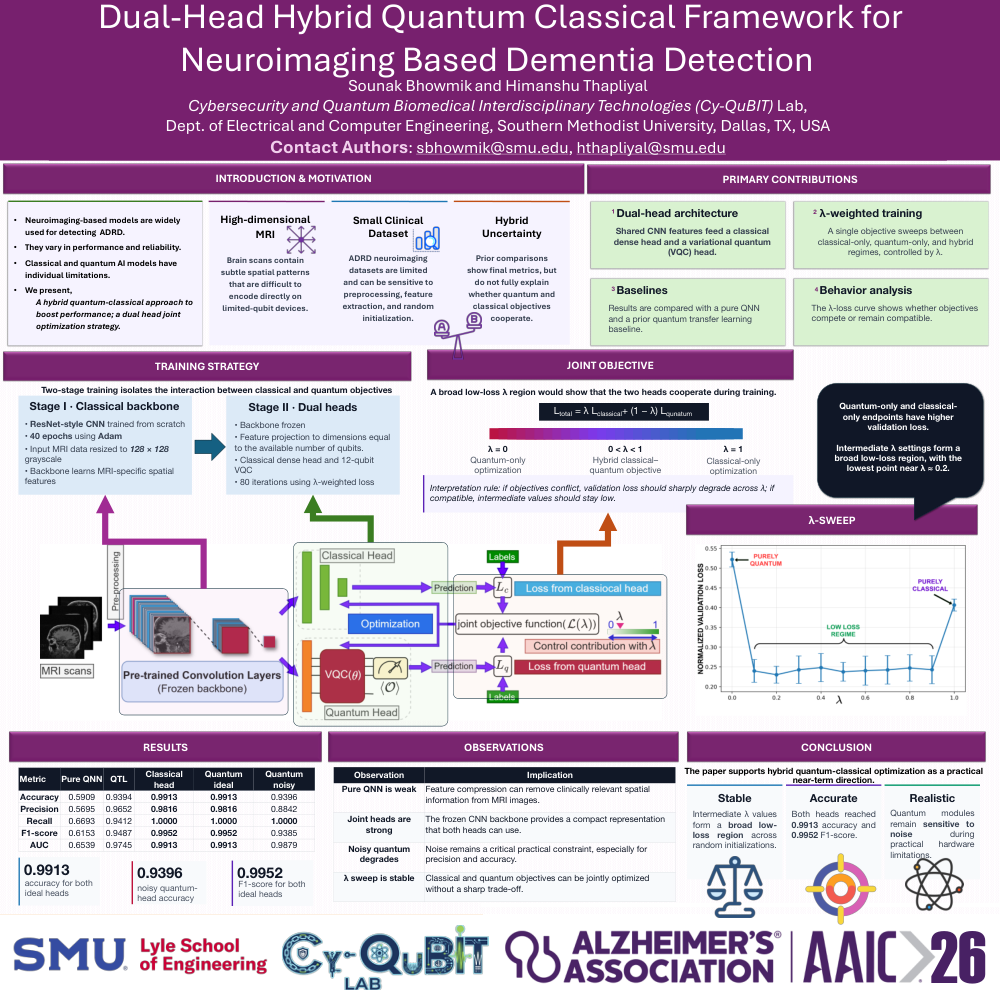
Dual-head Hybrid Quantum Classical Framework For Neuroimaging Based Dementia Detection
Poster Presenter
Authors
Affiliations
Part of Topic
Introduction and Motivation
Neuroimaging-based models are widely used for detecting ADRD.
• They vary in performance and reliability.
• Classical and quantum AI models have individual limitations.
• We present a hybrid quantum-classical approach to boost performance, a dual-head joint optimization strategy.
High-dimensional
MRI Brain scans contain subtle spatial patterns that are difficult to encode directly on limited-qubit devices.
Small Clinical Dataset
ADRD neuroimaging datasets are limited and can be sensitive to preprocessing, feature extraction, and random initialization.
Hybrid Uncertainty
Prior comparisons show final metrics, but do not fully explain whether quantum and classical objectives cooperate.
Primary Contributions
1. Dual-head architecture: Shared CNN features feed a classical dense head and a variational quantum (VQC) head.
2 λ-weighted training: A single objective sweeps between classical-only, quantum-only, and hybrid regimes, controlled by λ.
3 Baselines: Results are compared with a pure QNN and a prior quantum transfer learning baseline.
4 Behavior analysis: The λ-loss curve shows whether objectives compete or remain compatible.
TRAINING STRATEGY
Two-stage training isolates the interaction between classical and quantum objectives
Stage I · Classical backbone
• ResNet-style CNN trained from scratch.
• 40 epochs using Adam.
• Input MRI data resized to 128 × 128 grayscale.
• Backbone learns MRI-specific spatial features.
Stage II · Dual heads
• Backbone frozen
• Feature projection to dimensions equal to the available number of qubits.
• Classical dense head and 12-qubit VQC
• 80 iterations using λ-weighted loss
JOINT OBJECTIVE
A broad low-loss λ region would show that the two heads cooperate during training.
Ltotal = λ Lclassical+ (1 − λ) Lqunatum
Interpretation rule: if objectives conflict, validation loss should sharply degrade across λ; if compatible, intermediate values should stay low.
Observations
Pure QNN is weak: Feature compression can remove clinically relevant spatial information from MRI images.
Joint heads are strong: The frozen CNN backbone provides a compact representation that both heads can use.
Noisy quantum degrades: Noise remains a critical practical constraint, especially for precision and accuracy.
λ sweep is stable: Classical and quantum objectives can be jointly optimized without a sharp trade-off.
CONCLUSION
The paper supports hybrid quantum-classical optimization as a practical near-term direction.
Stable: Intermediate λ values form a broad low-loss region across random initializations.
Accurate: Both heads reached 0.9913 accuracy and 0.9952 F1-score.
Realistic: Quantum modules remain sensitive to noise during practical hardware limitations.
Comments
Email is required but is not shown publicly.
Loading comments...