4,068 posters, 219 videos, 101 topics, 69 sessions, 14,365 authors, 6,128 institutions
ePostersLive by SciGen Technologies S.A. All rights reserved.
Alzheimer's Association International Conference 2026
July 12-15, 2026 | London, United Kingdom, and Online

9991
Blood-Based Biomarkers As Predictors Of Abnormal Entorhinal Cortex Atrophy In The Cog-Aging Cohort
Poster Presenter
Part of Topic
Video
Background: Blood-based biomarkers (BBM) provide high diagnostic accuracy for dementia. However, access remains limited in low- and middle-income countries. In contrast, visual atrophy scales (VAS) derived from magnetic resonance imaging (MRI) are more widely accessible and continue to be used to improve diagnostic accuracy.
Objective: To evaluate the ability of BBM to predict abnormal VAS scores.
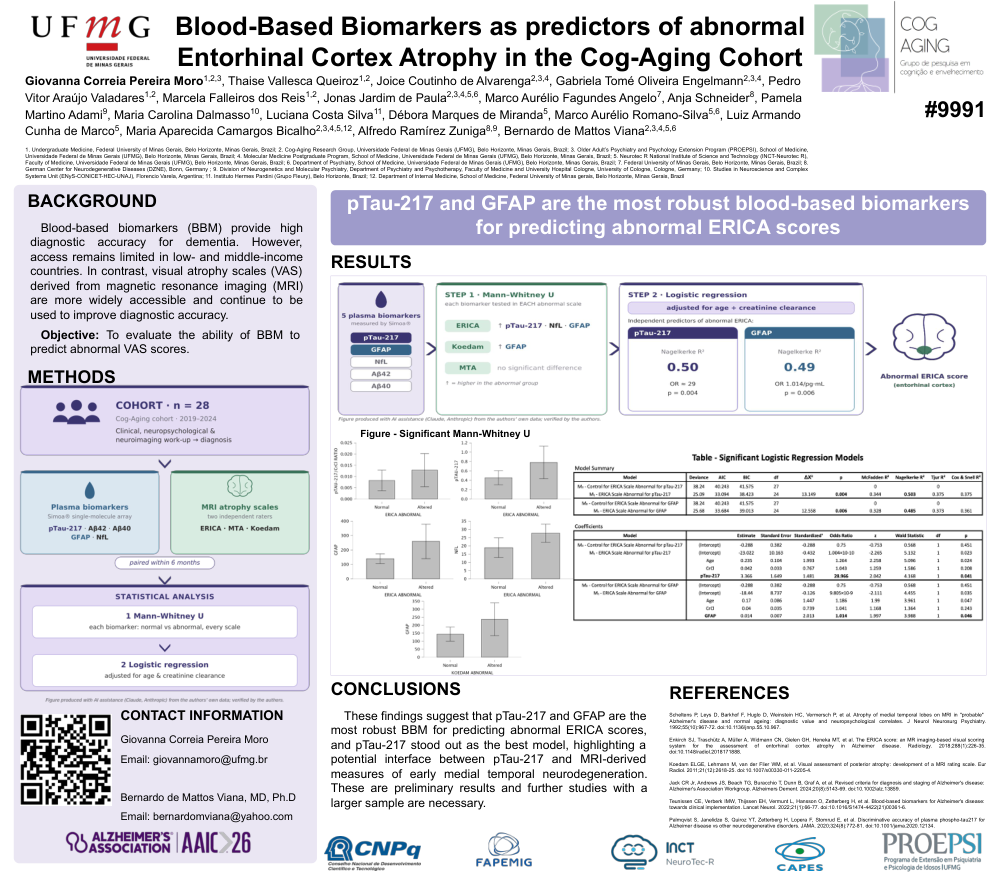
Methods: Cross-sectional study, using data from the Cog-Aging cohort study (2019-2024). Were selected participants (n=28) who underwent a comprehensive clinical, neuropsychological and neuroimaging assessment to determine diagnosis, and had BBM collected within 6 months of MRI. BBM (pTau-217, Aβ42, Aβ40, GFAP, and NfL) were quantified using single-molecule array technology (Simoa®). MRIs were assessed by two independent physicians, using the Entorhinal Cortical Atrophy (ERICA) scale, the Medial Temporal Lobe Atrophy (MTA) scale and Posterior Atrophy Scale (Koedam). BBM levels were compared using the Mann-Whitney U test in each VAS, dichotomized as normal or abnormal. Those with significant differences were further assessed on logistic regression models considering BBM levels, age and creatinine clearance (CrCl). This study was approved by UFMG Ethics Committee.
Results: Participants had a mean of 75.79 (SD 8.49) years of age, 60 (SD 50.26) days between plasma collection and MRI and a median of 7.5 (IQR 5.99) years of formal education. Abnormal scores for ERICA were associated with significantly higher levels of pTau-217 (p=0.043), NfL (p=0.017), GFAP (p=0.017) and pTau-217/CrCl ratio (p=0.043). Abnormal scores for Koedam had only significantly higher levels of GFAP (p=0.05), and MTA showed no significant differences (table 1). The logistic regression models for the significant BBM were assessed to predict each abnormal VAS score adjusted for confounding factors (table 2). Only pTau-217 (Nagelkerke R² 0.503; OR=28.966; p=0.004) and GFAP (Nagelkerke R² 0.485; OR=1.014; p=0.006) remained significant predictors of abnormal ERICA scores.
Conclusion: These findings suggest that pTau-217 and GFAP are the most robust BBM for predicting abnormal ERICA scores, and pTau-217 stood out as the best model, highlighting a potential interface between pTau-217 and MRI-derived measures of early medial temporal neurodegeneration. These are preliminary results and further studies with a larger sample are necessary.
Comments
Email is required but is not shown publicly.
Loading comments...