4,068 posters, 219 videos, 101 topics, 69 sessions, 14,365 authors, 6,128 institutions
ePostersLive by SciGen Technologies S.A. All rights reserved.
Alzheimer's Association International Conference 2026
July 12-15, 2026 | London, United Kingdom, and Online

1197
Trajectory-based Subtyping Of Preclinical Cognitive Decline In Cognitively Normal Aging Using A Machine Learning Approach
Poster Presenter
Authors
Affiliations
Part of Topic
Trajectory-Based Subtyping of Preclinical Cognitive Decline in Cognitively Normal Aging Using a Machine Learning Approach
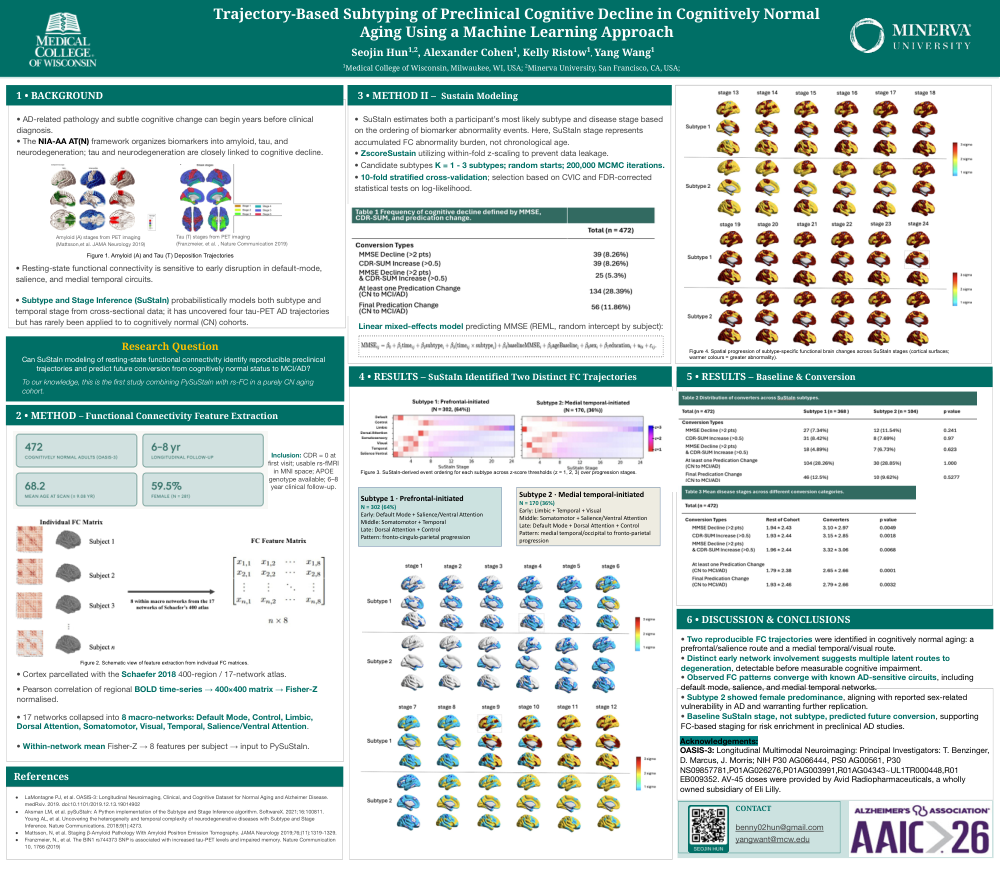
Research Question: Can SuStaIn modeling of resting-state functional connectivity identify reproducible preclinical trajectories and predict future conversion from cognitively normal status to MCI/AD? To our knowledge, this is the first study combining PySuStaIn with rs-FC in a purely CN aging cohort.
Background: AD-related pathology and subtle cognitive change can begin years before clinical diagnosis. The NIA-AA AT(N) framework organizes biomarkers into amyloid, tau, and neurodegeneration; tau and neurodegeneration are closely linked to cognitive decline. Subtype and Stage Inference (SuStaIn) probabilistically models both subtype and temporal stage from cross-sectional data; it has uncovered four tau-PET AD trajectories but has rarely been applied to cognitively normal (CN) cohorts. Resting-state functional connectivity is sensitive to early disruption in default-mode, salience, and medial temporal circuits.
Methods: 472 cognitively normal adults (OASIS-3), 6–8 year longitudinal follow-up, mean age at scan 68.2 (± 9.08 yr), 59.5% female. Inclusion: CDR = 0 at first visit; usable rs-fMRI in MNI space; APOE genotype available; 6–8 year clinical follow-up. Cortex parcellated with the Schaefer 2018 400-region / 17-network atlas. Pearson correlation of regional BOLD time-series produced a 400×400 matrix, Fisher-Z normalized. 17 networks were collapsed into 8 macro-networks (Default Mode, Control, Limbic, Dorsal Attention, Somatomotor, Visual, Temporal, Salience/Ventral Attention); within-network mean Fisher-Z gave 8 features per subject as input to PySuStaIn. ZscoreSustain used within-fold z-scaling to prevent data leakage; candidate subtypes K = 1–3; random starts; 200,000 MCMC iterations; 10-fold stratified cross-validation with selection based on CVIC and FDR-corrected tests on log-likelihood.
Results: SuStaIn identified two distinct, reproducible FC trajectories. Subtype 1 (Prefrontal-initiated, N = 302, 64%): early Default Mode + Salience/Ventral Attention, middle Somatomotor + Temporal, late Dorsal Attention + Control — a fronto-cingulo-parietal progression. Subtype 2 (Medial temporal-initiated, N = 170, 36%): early Limbic + Temporal + Visual, middle Somatomotor + Salience/Ventral Attention, late Default Mode + Dorsal Attention + Control — a medial temporal/occipital to fronto-parietal progression. Baseline SuStaIn stage, not subtype, predicted future conversion to MCI/AD.
Discussion & Conclusions: Two reproducible FC trajectories were identified in cognitively normal aging: a prefrontal/salience route and a medial temporal/visual route. Distinct early network involvement suggests multiple latent routes to degeneration, detectable before measurable cognitive impairment. Observed FC patterns converge with known AD-sensitive circuits. Subtype 2 showed female predominance, aligning with reported sex-related vulnerability in AD. Baseline SuStaIn stage, not subtype, predicted future conversion, supporting FC-based staging for risk enrichment in preclinical AD studies.
Comments
Email is required but is not shown publicly.
Loading comments...