4,068 posters, 219 videos, 101 topics, 69 sessions, 14,365 authors, 6,128 institutions
ePostersLive by SciGen Technologies S.A. All rights reserved.
Alzheimer's Association International Conference 2026
July 12-15, 2026 | London, United Kingdom, and Online

6843
Evidence For Sex-specific Brain Reserve During Progression From Mild Cognitive Impairment To Alzheimer's Dementia
Poster Presenter
Part of Topic
Evidence for Sex-Specific Brain Reserve and Progression from Mild Cognitive Impairment to Alzheimer’s Dementia
Xulin Liu, PhD1,2; Sterre C.M. de Boer, MD, PhD3,4; Maria Carmela Tartaglia, MD1,2
1 Memory Clinic, Krembil Research Institute, University Health Network, Toronto, Canada
2 Tanz Centre for Research in Neurodegenerative Diseases, University of Toronto, Canada
3 Alzheimer Center Amsterdam, Neurology, Vrije Universiteit Amsterdam, Amsterdam UMC location VUmc, Amsterdam, The Netherlands
4 The University of Sydney, School of Psychology and Brain & Mind Centre, Sydney, Australia
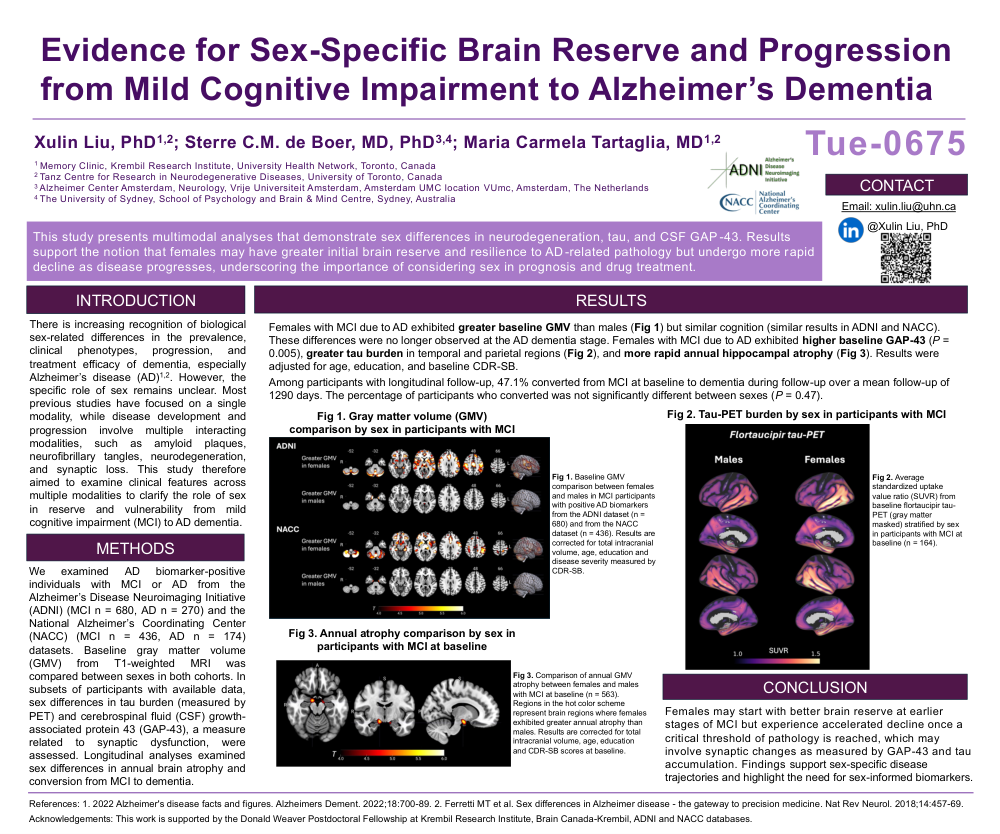
This study presents multimodal analyses that demonstrate sex differences in neurodegeneration, tau, and CSF GAP-43. Results support the notion that females may have greater initial brain reserve and resilience to AD-related pathology but undergo more rapid decline as disease progresses, underscoring the importance of considering sex in prognosis and drug treatment.
There is increasing recognition of biological sex-related differences in the prevalence, clinical phenotypes, progression, and treatment efficacy of dementia, especially Alzheimer’s disease (AD)1,2. However, the specific role of sex remains unclear. Most previous studies have focused on a single modality, while disease development and progression involve multiple interacting modalities, such as amyloid plaques, neurofibrillary tangles, neurodegeneration, and synaptic loss. This study therefore aimed to examine clinical features across multiple modalities to clarify the role of sex in reserve and vulnerability from mild cognitive impairment (MCI) to AD dementia.
We examined AD biomarker-positive individuals with MCI or AD from the Alzheimer’s Disease Neuroimaging Initiative (ADNI) (MCI n = 680, AD n = 270) and the National Alzheimer’s Coordinating Center (NACC) (MCI n = 436, AD n = 174) datasets. Baseline gray matter volume (GMV) from T1-weighted MRI was compared between sexes in both cohorts. In subsets of participants with available data, sex differences in tau burden (measured by PET) and cerebrospinal fluid (CSF) growth-associated protein 43 (GAP-43), a measure related to synaptic dysfunction, were assessed. Longitudinal analyses examined sex differences in annual brain atrophy and conversion from MCI to dementia.
Females with MCI due to AD exhibited greater baseline GMV than males (Fig 1) but similar cognition (similar results in ADNI and NACC). These differences were no longer observed at the AD dementia stage. Females with MCI due to AD exhibited higher baseline GAP-43 (P = 0.005), greater tau burden in temporal and parietal regions (Fig 2), and more rapid annual hippocampal atrophy (Fig 3). Results were adjusted for age, education, and baseline CDR-SB.
Among participants with longitudinal follow-up, 47.1% converted from MCI at baseline to dementia during follow-up over a mean follow-up of 1290 days. The percentage of participants who converted was not significantly different between sexes (P = 0.47).
Females may start with better brain reserve at earlier stages of MCI but experience accelerated decline once a critical threshold of pathology is reached, which may involve synaptic changes as measured by GAP-43 and tau accumulation. Findings support sex-specific disease trajectories and highlight the need for sex-informed biomarkers.
Comments
Email is required but is not shown publicly.
Loading comments...