4,068 posters, 219 videos, 101 topics, 69 sessions, 14,365 authors, 6,128 institutions
ePostersLive by SciGen Technologies S.A. All rights reserved.
Alzheimer's Association International Conference 2026
July 12-15, 2026 | London, United Kingdom, and Online

9866
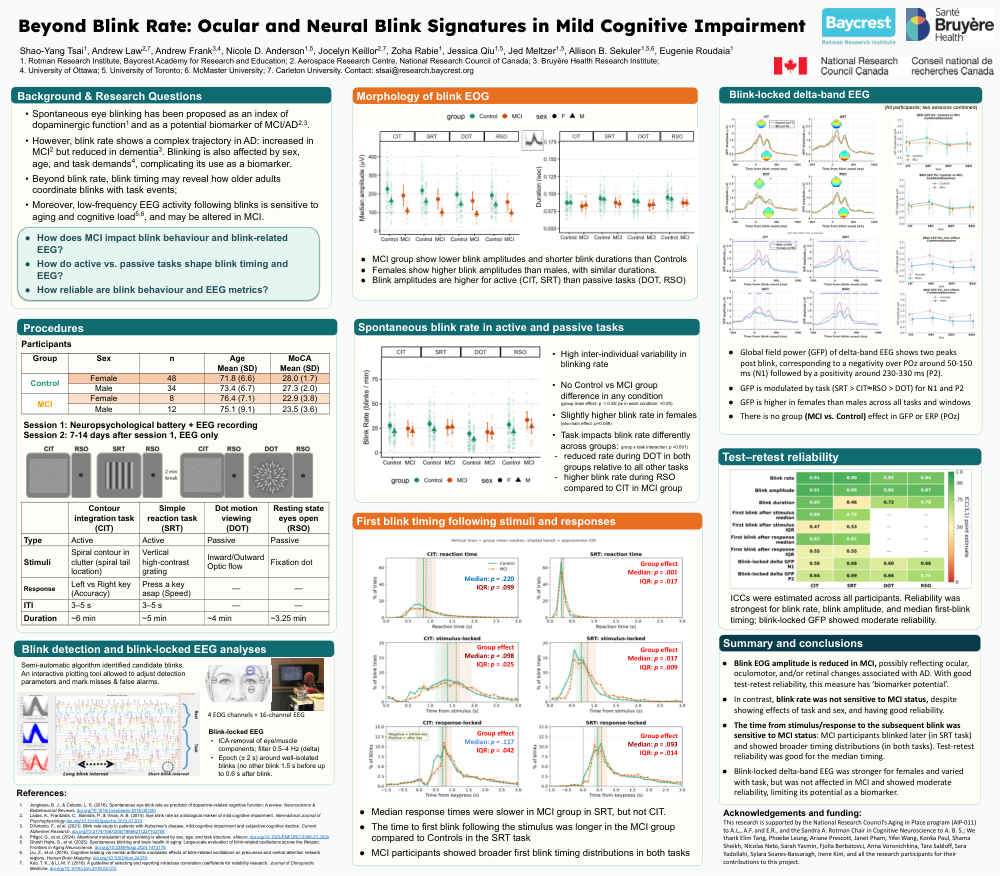
Beyond Blink Rate: Ocular And Neural Blink Signatures In Mild Cognitive Impairment
Poster Presenter
Authors
Shao-Yang Tsai, Andrew Law, Andrew Frank, Nicole Anderson, Jocelyn Keillor, Zoha Rabie, Jessica Qiu, Jed Meltzer, Allison Sekuler, Eugenie Roudaia
Affiliations
Rotman Research Institute, Baycrest Academy for Research and Education, Bruyere Health Research Institute, Aerospace Research Centre, National Research Council of Canada
Part of Topic
Background:
Spontaneous blinking is an automatic process modulated by task demands and attentional state, and may be impacted in cognitive decline. In addition to the large electro-oculographic (EOG) signal, blinks are accompanied by blink-related oscillations (BROs) occurring shortly after the blink that reflect post-blink sensory or attentional processing. BROs have been localized to the precuneus—a region affected early in mild cognitive impairment (MCI)—suggesting that BROs may be altered in MCI. This study examined whether blink rate, blink-related EOG amplitude, and post-blink BROs during rest and active tasks differentiate individuals with MCI from healthy controls.
Methods: Older adults with MCI (n = 24, 45% female) and cognitively normal controls (n = 82, 59% female) completed two sessions 1-2 weeks apart, during which EOG and EEG were recorded across four conditions: (1) visual contour integration task (CIT); (2) simple reaction time (SRT) task; (3) passive viewing of dot motion (DOT); and (4) eyes-open resting state (REST). Median blink-related EOG amplitude was extracted for each condition. Blink-related EOG activity was removed from the EEG, and global field power (GFP) of delta-band (0.5–4 Hz) activity time-locked to blinks was quantified in two time windows (P1: 50-150 ms; P2: 230-330 ms). Effects of Group, Sex, Task, and Session were examined using linear mixed-effects models. Test-retest reliability was assessed using intraclass correlation coefficients.
Results: Blink rates varied across tasks, but did not differ between groups. Blink-related EOG amplitude was reduced in the MCI group compared to controls, and was lower in males than females. EOG amplitude was also higher during active tasks (CIT, SRT) relative to passive conditions. Delta-band BRO GFP did not differ between groups; however, females showed larger GFP and GFP amplitude varied across conditions. Test-retest reliability was good-to-excellent for blink rate and EOG and moderate-to-good for BROs.
Conclusion: While MCI does not affect blink rates, blink-related EOG amplitude is reduced in MCI, possibly reflecting ocular, oculomotor, and/or retinal changes associated with Alzheimer’s disease. Both blink-related EOG and BROs exhibit sex differences, warranting further investigation. Longitudinal follow-up will assess the potential of blink-related metrics as predictors of cognitive change.
Comments
Email is required but is not shown publicly.
Loading comments...