4,068 posters, 219 videos, 101 topics, 69 sessions, 14,365 authors, 6,128 institutions
ePostersLive by SciGen Technologies S.A. All rights reserved.
Alzheimer's Association International Conference 2026
July 12-15, 2026 | London, United Kingdom, and Online

10878
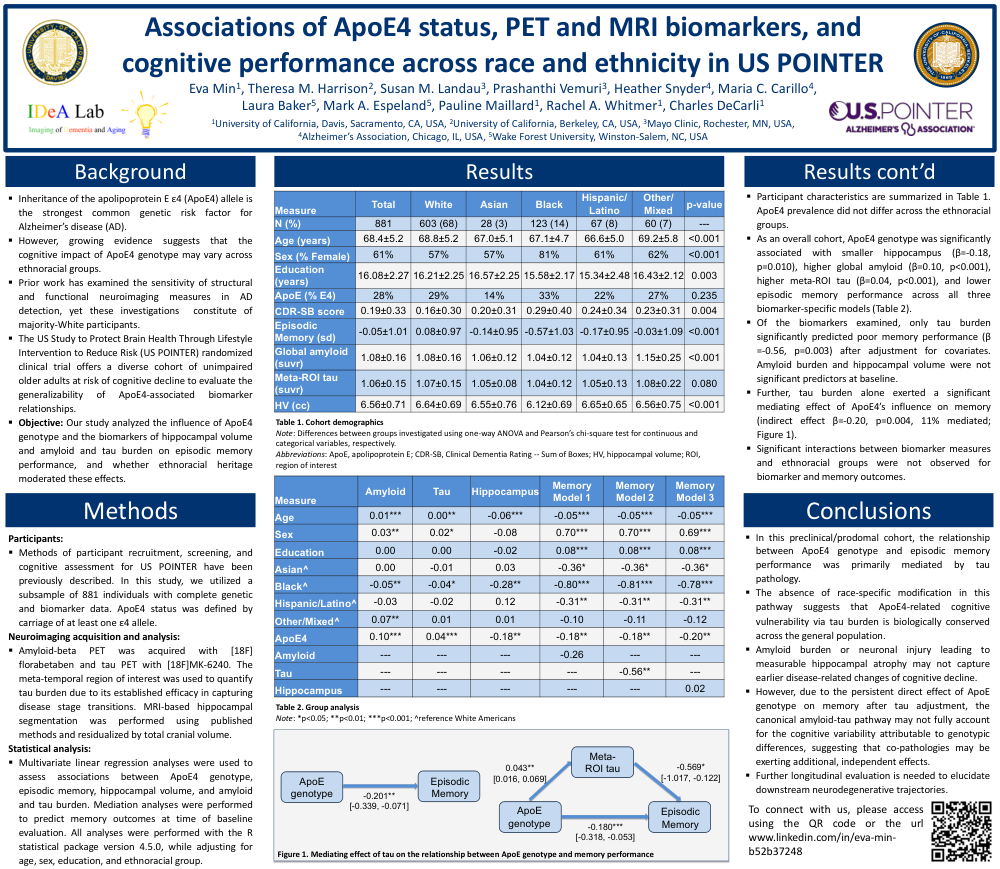
Associations Between Apoe4 Status, Pet And Mri Biomarkers, And Cognitive Performance Across Race And Ethnicity In Us Pointer
Poster Presenter
Authors
Eva Min, Theresa M. Harrison, Susan M. Landau, Prashanthi Vemuri, Heather Snyder, Maria C. Carillo, Laura Baker, Mark A. Espeland, Pauline Maillard, Rachel A. Whitmer, Charles DeCarli
Affiliations
Alzheimer's Association, University of California, Davis, Mayo Clinic, Wake Forest University, University of California, Berkeley
Part of Topic
Title: Associations of ApoE4 status, PET and MRI biomarkers, and cognitive performance across race and ethnicity in US POINTER
Background:
▪ Inheritance of the apolipoprotein E ε4 (ApoE4) allele is the strongest common genetic risk factor for Alzheimer’s disease (AD). However, growing evidence suggests that the cognitive impact of ApoE4 genotype may vary across ethnoracial groups.
▪ Prior work has examined the sensitivity of structural and functional neuroimaging measures in AD detection, yet these investigations constitute of majority-White participants.
▪ The US Study to Protect Brain Health Through Lifestyle Intervention to Reduce Risk (US POINTER) randomized clinical trial offers a diverse cohort of unimpaired older adults at risk of cognitive decline to evaluate the generalizability of ApoE4 associated biomarker relationships.
▪ Objective: Our study analyzed the influence of ApoE4 genotype and the biomarkers of hippocampal volume and amyloid and tau burden on episodic memory performance, and whether ethnoracial heritage moderated these effects.
Methods:
Participants:
▪ Methods of participant recruitment, screening, and cognitive assessment for US POINTER have been previously described. In this study, we utilized a subsample of 881 individuals with complete genetic and biomarker data. ApoE4 status was defined by carriage of at least one ε4 allele.
Neuroimaging acquisition and analysis:
▪ Amyloid-beta PET was acquired with [18F]florabetaben and tau PET with [18F]MK-6240. The meta-temporal region of interest was used to quantify tau burden due to its established efficacy in capturing disease stage transitions. MRI-based hippocampal segmentation was performed using published methods and residualized by total cranial volume.
Statistical analysis:
▪ Multivariate linear regression analyses were used to assess associations between ApoE4 genotype, episodic memory, hippocampal volume, and amyloid and tau burden. Mediation analyses were performed to predict memory outcomes at time of baseline evaluation. All analyses were performed with the R statistical package version 4.5.0, while adjusting for age, sex, education, and ethnoracial group.
Results:
▪ Participant characteristics are summarized in Table 1. ApoE4 prevalence did not differ across the ethnoracial groups.
▪ As an overall cohort, ApoE4 genotype was significantly associated with smaller hippocampus (β=-0.18, p=0.010), higher global amyloid (β=0.10, p<0.001), higher meta-ROI tau (β=0.04, p<0.001), and lower episodic memory performance across all three biomarker-specific models (Table 2).
▪ Of the biomarkers examined, only tau burden significantly predicted poor memory performance (β=-0.56, p=0.003) after adjustment for covariates. Amyloid burden and hippocampal volume were not significant predictors at baseline.
▪ Further, tau burden alone exerted a significant mediating effect of ApoE4’s influence on memory (indirect effect β=-0.20, p=0.004, 11% mediated; Figure 1).
▪ Significant interactions between biomarker measures and ethnoracial groups were not observed for biomarker and memory outcomes.
Conclusions:
▪ In this preclinical/prodomal cohort, the relationship between ApoE4 genotype and episodic memory performance was primarily mediated by tau pathology.
▪ The absence of race-specific modification in this pathway suggests that ApoE4-related cognitive vulnerability via tau burden is biologically conserved across the general population.
▪ Amyloid burden or neuronal injury leading to measurable hippocampal atrophy may not capture earlier disease-related changes of cognitive decline.
▪ However, due to the persistent direct effect of ApoE genotype on memory after tau adjustment, the canonical amyloid-tau pathway may not fully account for the cognitive variability attributable to genotypic differences, suggesting that co-pathologies may be exerting additional, independent effects.
▪ Further longitudinal evaluation is needed to elucidate downstream neurodegenerative trajectories.
Comments
Email is required but is not shown publicly.
Loading comments...