4,068 posters, 219 videos, 101 topics, 69 sessions, 14,365 authors, 6,128 institutions
ePostersLive by SciGen Technologies S.A. All rights reserved.
Alzheimer's Association International Conference 2026
July 12-15, 2026 | London, United Kingdom, and Online

3897
Structural Heterogeneity In Isolated Executive-predominant Cognitive Impairment Across Dementia Etiologies
Poster Presenter
Authors
Part of Topic
Background
Alzheimer’s disease (AD), cerebrovascular disease (VasD), and dementia with Lewy bodies (DLB) can present with overlapping early clinical features, particularly executive dysfunction, making differential diagnosis challenging.
Voxel-based morphometry (VBM) is commonly used to detect group-level differences in gray matter (GM) density. However, standard mean-based VBM comparisons may not fully capture within-diagnosis structural heterogeneity, which may reflect subtype diversity, mixed pathology, or variable disease mechanisms.
Mapping both group-level GM differences and within-group variability may provide complementary imaging biomarkers for characterizing executive-predominant cognitive impairment across dementia etiologies.
Objective
To characterize diagnosis-related gray matter differences and within-group structural heterogeneity among individuals with isolated executive-predominant cognitive impairment due to AD, VasD, or DLB.
Methods
We included 54 participants from the National Alzheimer’s Coordinating Center database with isolated mild executive-predominant cognitive impairment and available T1-weighted brain MRI.
Participants were grouped by clinical diagnosis:
- AD: n = 6; age 74.0 ± 6.5 years; 4F/2M
- VasD: n = 36; age 75.6 ± 6.9 years; 12F/24M
- DLB: n = 12; age 69.9 ± 7.9 years; 9F/3M
Cognitive impairment was defined using:
- Clinical Dementia Rating: CDR = 0.5–1
- MMSE: 17–29 or MoCA: 17–26
T1-weighted MRI scans were processed using CAT12/SPM12 VBM.
A one-way ANOVA was performed to test the main effect of diagnosis on voxel-wise GM density, with total intracranial volume included as a covariate. Post-hoc pairwise t-tests were then conducted to evaluate diagnosis-specific GM differences.
Statistical threshold: p < 0.001, uncorrected
To evaluate within-group structural heterogeneity, voxel-wise maps of the following metrics were generated separately for each diagnostic group:
- Mean GM density
- GM variance
- Coefficient of variation
Results
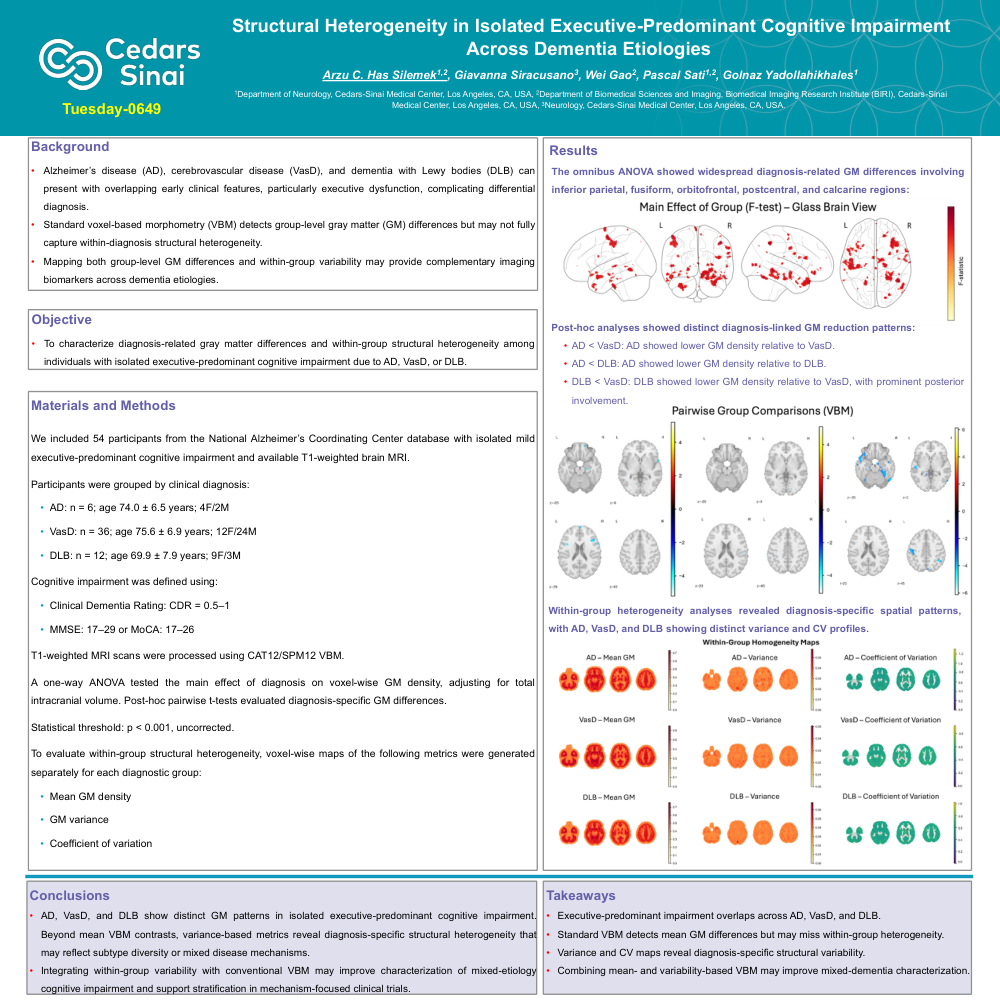
The omnibus ANOVA demonstrated widespread diagnosis-related differences in GM density, involving inferior parietal, fusiform, orbitofrontal, postcentral, and calcarine cortical regions.
Post-hoc analyses showed distinct diagnosis-linked GM reduction patterns:
- AD < VasD: AD showed lower GM density relative to VasD.
- AD < DLB: AD showed lower GM density relative to DLB.
- DLB < VasD: DLB showed lower GM density relative to VasD, with prominent posterior involvement.
Within-group heterogeneity analyses revealed diagnosis-specific spatial patterns:
- AD: showed relatively greater structural consistency in some spared regions, with increased variability in temporo-parietal areas.
- VasD: demonstrated a distinct spatial pattern of GM variability, consistent with heterogeneous vascular-related structural involvement.
- DLB: showed increased posterior variability, differing from the variability pattern observed in VasD.
Together, these findings suggest that dementia etiologies differ not only in mean GM atrophy patterns but also in the spatial organization of within-group structural heterogeneity.
Conclusions
AD, VasD, and DLB show distinct gray matter patterns among individuals with isolated executive-predominant cognitive impairment.
Beyond standard mean-based VBM contrasts, variance-based metrics reveal diagnosis-specific structural heterogeneity that may reflect subtype diversity or mixed disease mechanisms.
Integrating within-group variability measures with conventional VBM may improve characterization of mixed-etiology cognitive impairment cohorts and support better stratification in mechanism-focused clinical trials.
Key Takeaways
- Executive-predominant cognitive impairment can occur across AD, VasD, and DLB, complicating differential diagnosis.
- Standard VBM detects diagnosis-related mean GM differences, but may miss within-group heterogeneity.
- Variance and coefficient-of-variation maps reveal diagnosis-specific structural variability patterns.
- Combining mean-based and variability-based VBM metrics may improve imaging-based characterization of mixed dementia populations.
Comments
Email is required but is not shown publicly.
Loading comments...