4,068 posters, 219 videos, 101 topics, 69 sessions, 14,365 authors, 6,128 institutions
ePostersLive by SciGen Technologies S.A. All rights reserved.
Alzheimer's Association International Conference 2026
July 12-15, 2026 | London, United Kingdom, and Online

5383
Multimodal AI Prediction In Pre-symptomatic Alzheimer’s Disease Enriches For Clinical Progression Over Four Years
Poster Presenter
Authors
Luca Villa, Ayoub Gueddou, Mathilde Borrot, Zi Hui Su, Nicolas Guizard, Elizabeth Gordon
Affiliations
Part of Topic
Video
Background
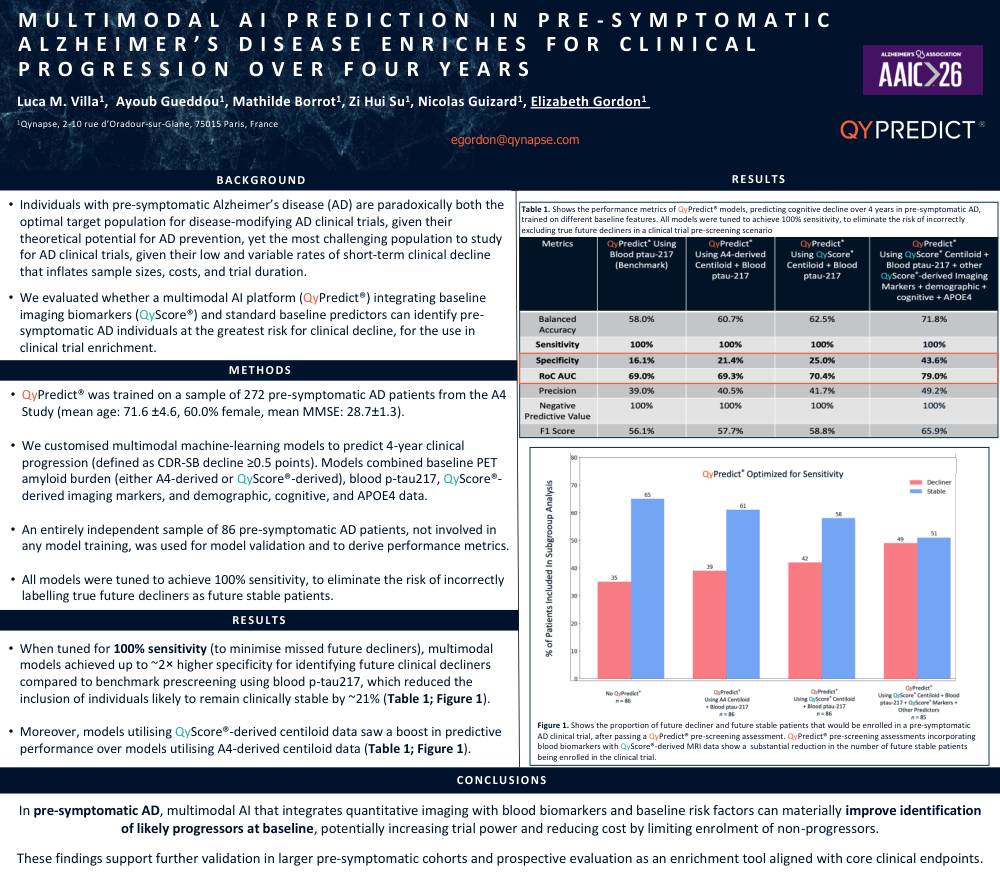
Individuals with pre-symptomatic Alzheimer’s disease (AD) are paradoxically both the optimal target population for disease-modifying AD clinical trials, given their theoretical potential for AD prevention, yet the most challenging population to study for AD clinical trials, given their low and variable rates of short-term clinical decline that inflates sample sizes, costs, and trial duration. We evaluated whether a multimodal AI platform (QyPredict®) integrating baseline imaging biomarkers (QyScore®) and standard baseline predictors can identify pre-symptomatic AD individuals at the greatest risk for clinical decline, for the use in clinical trial enrichment.
Methods
QyPredict® was trained on a sample of 272 pre-symptomatic AD patients from the A4 Study (mean age: 71.6 ±4.6, 60.0% female, mean MMSE: 28.7±1.3). We customised multimodal machine-learning models to predict 4-year clinical progression (defined as CDR-SB decline ≥0.5 points). Models combined baseline PET amyloid burden (either A4-derived or QyScore®-derived), blood p-tau217, QyScore®-derived imaging markers, and demographic, cognitive, and APOE4 data. An entirely independent sample of 86 pre-symptomatic AD patients, not involved in any model training, was used for model validation and to derive performance metrics. All models were tuned to achieve 100% sensitivity, to eliminate the risk of incorrectly labelling true future decliners as future stable patients.
Results
When tuned for 100% sensitivity (to minimise missed future decliners), multimodal models achieved up to ~2× higher specificity for identifying future clinical decliners compared to benchmark prescreening using blood p-tau217, which reduced the inclusion of individuals likely to remain clinically stable by ~21% (Table 1; Figure 1). Moreover, models utilising QyScore®-derived centiloid data saw a boost in predictive performance over models utilising A4-derived centiloid data (Table 1; Figure 1).
Conclusions
In presymptomatic AD, multimodal AI that integrates quantitative imaging with blood biomarkers and baseline risk factors can materially improve identification of likely progressors at baseline, potentially increasing trial power and reducing cost by limiting enrolment of non-progressors. These findings support further validation in larger pre-symptomatic cohorts and prospective evaluation as an enrichment tool aligned with core clinical endpoints.
Comments
Email is required but is not shown publicly.
Loading comments...