4,068 posters, 219 videos, 101 topics, 69 sessions, 14,365 authors, 6,128 institutions
ePostersLive by SciGen Technologies S.A. All rights reserved.
Alzheimer's Association International Conference 2026
July 12-15, 2026 | London, United Kingdom, and Online

7139
ERP Differences In Auditory And Visual Memory Processing Between MCI And Long COVID Cognitive Complaints
Poster Presenter
Part of Topic
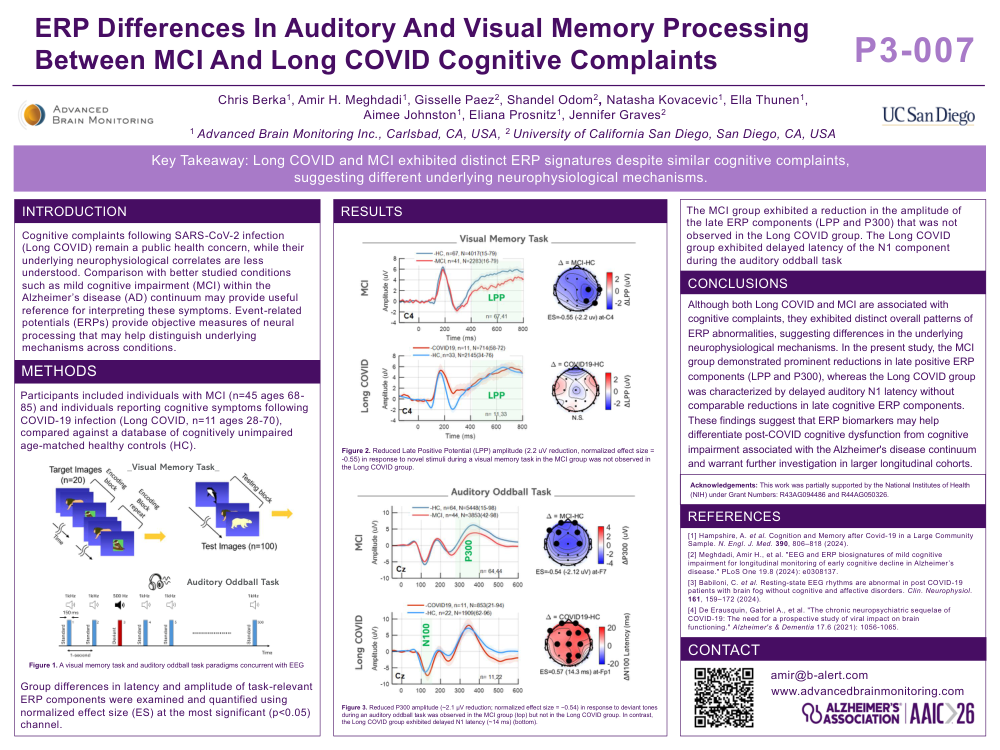
Background: Cognitive complaints following SARS-CoV-2 infection (Long COVID) remain a public health concern, while their underlying neurophysiological correlates are less understood. Comparison with better studied conditions such as mild cognitive impairment (MCI) within the Alzheimer’s disease (AD) continuum may provide useful reference for interpreting these symptoms. Event-related potentials (ERPs) provide objective measures of neural processing that may help distinguish underlying mechanisms across conditions.
Methods: ERPs were recorded during both an auditory oddball task and a visual memory task in individuals with MCI (n=45 ages 68-85) and individuals reporting cognitive symptoms following COVID-19 infection (Long COVID, n=11 ages 28-70), compared against a database of cognitively unimpaired age-matched healthy controls (HC). Group differences in latency and amplitude of task-relevant ERP components were examined and quantified using normalized effect size (ES) at the most significant (p<0.05) channel.
Results: Consistent with prior studies, the MCI group exhibited reduced amplitude of the P300 component during the auditory oddball task (ES=-0.54) and reduced amplitude of the late positive component (LPP) during the memory task (ES=-0.55). In contrast, the Long COVID group did not exhibit significant differences during the visual memory task but showed delayed latency of the N1 component during the auditory oddball task (ES=+0.57), a finding that has also been reported in some other studies of MCI and AD.
Conclusion: The observed dissociation between memory-related ERP alterations in MCI and auditory processing latency differences in Long COVID suggests that cognitive complaints in these groups may be associated with partially distinct patterns of deficits in neural processing. ERP measures may therefore support differentiation of post-COVID cognitive symptoms from memory-related changes associated with the AD continuum.
Comments
Email is required but is not shown publicly.
Loading comments...