4,068 posters, 219 videos, 101 topics, 69 sessions, 14,365 authors, 6,128 institutions
ePostersLive by SciGen Technologies S.A. All rights reserved.
Alzheimer's Association International Conference 2026
July 12-15, 2026 | London, United Kingdom, and Online

9545
Clinical-biological Stage Concordance In Sporadic Alzheimer Disease
Poster Presenter
Authors
Part of Topic
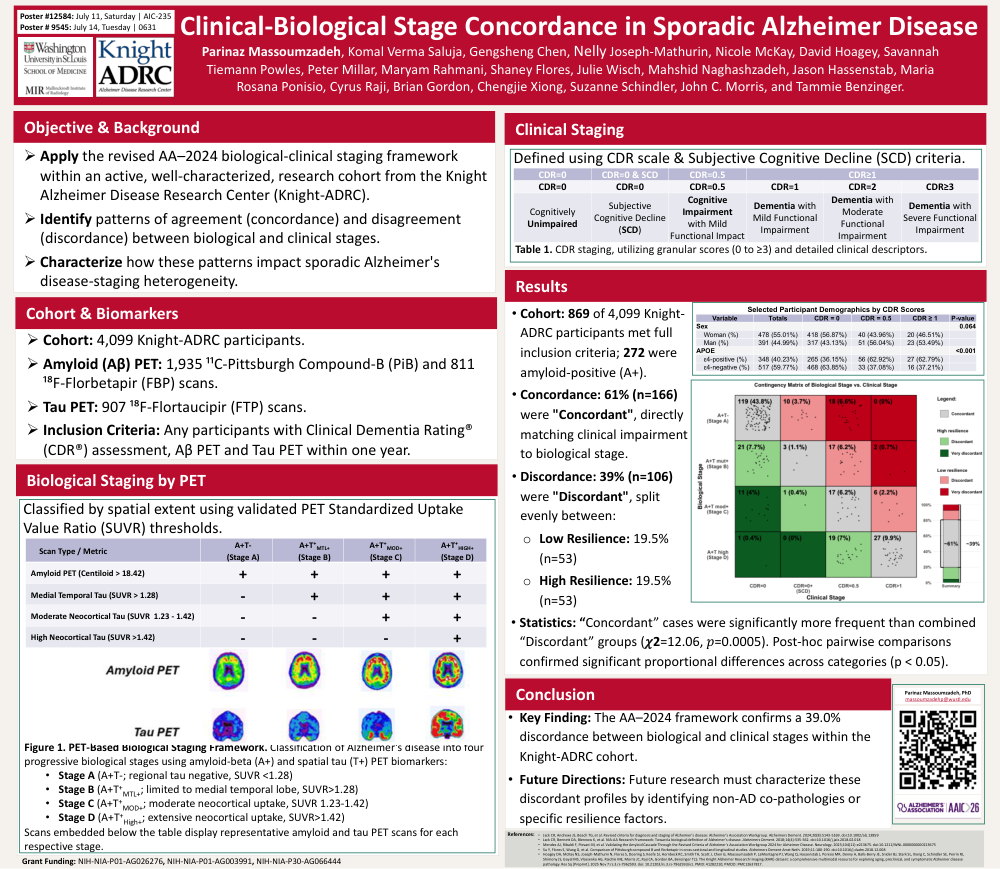
Clinical-Biological Stage Concordance in Sporadic Alzheimer Disease
Parinaz Massoumzadeh, Komal Verma Saluja, Gengsheng Chen, Nelly Joseph-Mathurin, Nicole McKay, David Hoagey, Savannah Tiemann Powles, Peter Millar, Maryam Rahmani, Shaney Flores, Julie Wisch, Mahshid Naghashzadeh, Jason Hassenstab, Maria Rosana Ponisio, Cyrus Raji, Brian Gordon, Chengjie Xiong, Suzanne Schindler, John C. Morris, and Tammie Benzinger.
Grant Funding: NIH-NIA-P01-AG026276, NIH-NIA-P01-AG003991, NIH-NIA-P30-AG066444
Objective & Background
- Apply the revised AA–2024 biological-clinical staging framework within an active, well-characterized, research cohort from the Knight Alzheimer Disease Research Center (Knight-ADRC).
- Identify patterns of agreement (concordance) and disagreement (discordance) between biological and clinical stages.
- Characterize how these patterns impact sporadic Alzheimer's disease-staging heterogeneity.
Cohort & Biomarkers
- Cohort: 4,099 Knight-ADRC participants.
- Amyloid (Aβ) PET: 1,935 ¹¹C-Pittsburgh Compound-B (PiB) and 811 ¹⁸F-Florbetapir (FBP) scans.
- Tau PET: 907 ¹⁸F-Flortaucipir (FTP) scans.
- Inclusion Criteria: Any participants with Clinical Dementia Rating® (CDR®) assessment, Aβ PET and Tau PET within one year.
Biological Staging by PET
Classified by spatial extent using validated PET Standardized Uptake Value Ratio (SUVR) thresholds.
Figure 1. PET-Based Biological Staging Framework. Classification of Alzheimer's disease into four progressive biological stages using amyloid-beta (A+) and spatial tau (T+) PET biomarkers:
- Stage A (A+T-; regional tau negative, SUVR <1.28)
- Stage B (A+T+MTL+; limited to medial temporal lobe, SUVR>1.28)
- Stage C (A+T+MOD+; moderate neocortical uptake, SUVR 1.23-1.42)
- Stage D (A+T+High+; extensive neocortical uptake, SUVR>1.42)
Scans embedded below the table display representative amyloid and tau PET scans for each respective stage.
Clinical Staging
Defined using CDR scale & Subjective Cognitive Decline (SCD) criteria.
- CDR=0 Cognitively Unimpaired
- CDR=0 & SCD Subjective Cognitive Decline (SCD)
- CDR=0.5 Cognitive Impairment with Mild Functional Impact
- CDR=1 Dementia with Mild Functional Impairment
- CDR=2 Dementia with Moderate Functional Impairment
- CDR≥3 Dementia with Severe Functional Impairment
Table 1. CDR staging, utilizing granular scores (0 to ≥3) and detailed clinical descriptors.
Results
- Cohort: 869 of 4,099 Knight-ADRC participants met full inclusion criteria; 272 were amyloid-positive (A+).
- Concordance: 61% (n=166) were "Concordant", directly matching clinical impairment to biological stage.
- Discordance: 39% (n=106) were "Discordant", split evenly between:
- Low Resilience: 19.5% (n=53)
- High Resilience: 19.5% (n=53)
Statistics: “Concordant” cases were significantly more frequent than combined “Discordant” groups (��2=12.06, ��=0.0005). Post-hoc pairwise comparisons confirmed significant proportional differences across categories (p < 0.05).
Conclusion
Key Finding: The AA–2024 framework confirms a 39.0% discordance between biological and clinical stages within the Knight-ADRC cohort.
Future Directions: Future research must characterize these discordant profiles by identifying non-AD co-pathologies or specific resilience factors.
References:
- Jack CR, Andrews JS, Beach TG, et al. Revised criteria for diagnosis and staging of Alzheimer’s disease: Alzheimer’s Association Workgroup. Alzheimers Dement. 2024;20(8):5143-5169. doi:10.1002/alz.13859
- Jack CR, Bennett DA, Blennow K, et al. NIA‐AA Research Framework: Toward a biological definition of Alzheimer’s disease. Alzheimers Dement. 2018;14(4):535-562. doi:10.1016/j.jalz.2018.02.018
- Mendes AJ, Ribaldi F, Pievani M, et al. Validating the Amyloid Cascade Through the Revised Criteria of Alzheimer’s Association Workgroup 2024 for Alzheimer Disease. Neurology. 2025;104(11):e213675. doi:10.1212/WNL.0000000000213675
- Su Y, Flores S, Wang G, et al. Comparison of Pittsburgh compound B and florbetapir in cross-sectional and longitudinal studies. Alzheimers Dement Amst Neth. 2019;11:180-190. doi:10.1016/j.dadm.2018.12.008
- Hoagey DA, McKay NS, Joseph-Mathurin N, Flores S, Doering S, Keefe SJ, Hornbeck RC, Smith TH, Scott J, Chen G, Massoumzadeh P, LaMontagne PJ, Wang Q, Hassenstab J, Ponisio MR, Denny A, Balls-Berry JE, Snider BJ, Stark SL, Xiong C, Schindler SE, Perrin RJ, Shimony JS, Goyal MS, Vlassenko AG, Raichle ME, Morris JC, Raji CA, Gordon BA, Benzinger TLS. The Knight Alzheimer Research Imaging (KARI) dataset: a comprehensive multimodal resource for exploring aging, preclinical, and symptomatic Alzheimer disease pathology. Res Sq [Preprint]. 2025 Nov 7:rs.3.rs-7962593. doi: 10.21203/rs.3.rs-7962593/v1. PMID: 41282210; PMCID: PMC12637817.
Comments
Email is required but is not shown publicly.
Loading comments...