4,068 posters, 219 videos, 101 topics, 69 sessions, 14,365 authors, 6,128 institutions
ePostersLive by SciGen Technologies S.A. All rights reserved.
Alzheimer's Association International Conference 2026
July 12-15, 2026 | London, United Kingdom, and Online

6235
The Mediating Effect Of Glymphatic Efficiency On The Relationship Between Choroid Plexus Volume And Cognition In Alzheimer’s Disease
Poster Presenter
Authors
Nicole Isabella Tan, Yi Jayne Tan, Seyed Ehsan Saffari, Elenor Morgenroth, Thomas Welton, Sarah Jiayi Foo, Zi Rou Kwok, Yu Chin Lim, Hui Jin Chiew, Kok Pin Ng, Simon Kang Seng Ting, Sumeet Kumar, Nicole Chwee Har Keong, Adeline Su Lyn Ng
Affiliations
Department of Neurology, National Neuroscience Institute, Tan Tock Seng Hospital, Singapore, Center for Quantitative Medicine, Duke-NUS Medical School, Singapore, Department of Neuroradiology, National Neuroscience Institute, Tan Tock Seng Hospital, Singapore, Department of Neurosurgery, National Neuroscience Institute, Singapore General Hospital, Singapore
Part of Topic
Background
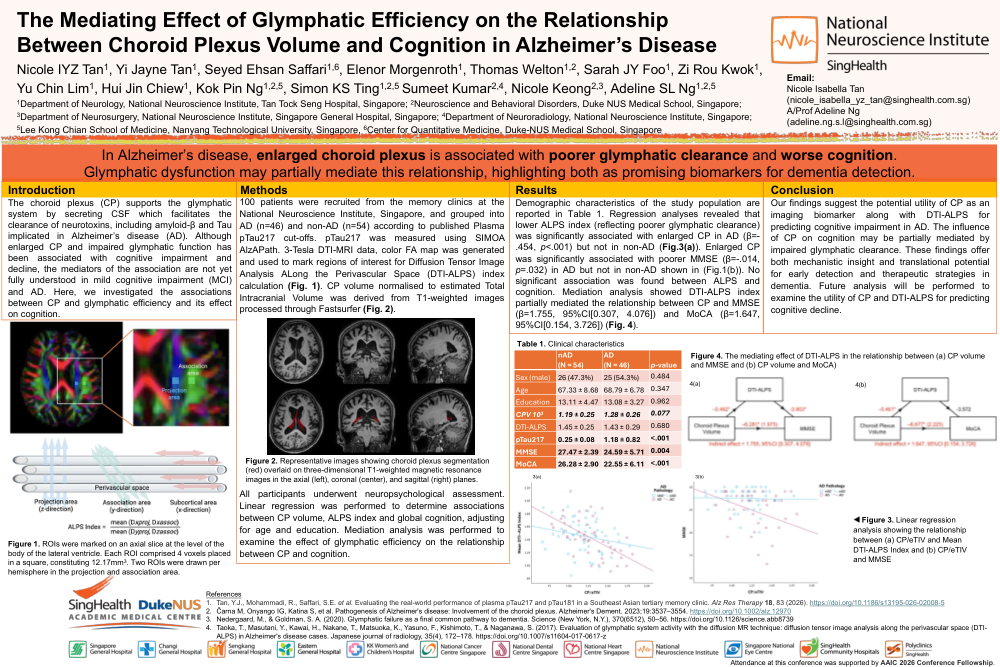
The choroid plexus (CP) supports the glymphatic system by secreting CSF which facilitates the clearance of neurotoxins, including amyloid-β and Tau implicated in Alzheimer’s disease (AD). Although enlarged CP and impaired glymphatic function has been associated with cognitive impairment and decline, the mediators of the association are not yet fully understood in mild cognitive impairment (MCI) and AD. Here, we investigated the associations between CP and glymphatic efficiency and its effect on cognition.
Method
Plasma pTau217 concentrations determined by ultrasensitive single molecule array (SIMOA) technology were used to distinguish patients with AD (n=46) and non-AD (n=54) pathology from the memory clinics at the National Neuroscience Institute, Singapore. 3-Tesla DTI-MRI data, color fractional anisotropy (FA) map was generated and used to mark regions of interest for Diffusion Tensor Image Analysis ALong the Perivascular Space (DTI-ALPS) index calculation. All participants underwent neuropsychological assessment. Linear regression was performed to determine associations between CP volume, ALPS index and global cognition, adjusting for age and education. Mediation analysis was performed to examine the effect of glymphatic efficiency on the relationship between CP and cognition.
Results
Demographic characteristics of the study population are reported in Table 1. Regression analyses revealed that lower ALPS index (reflecting poorer glymphatic clearance) was significantly associated with enlarged CP in AD (β=-.454, p<.001) but not in non-AD. Enlarged CP was significantly associated with poorer MMSE (β=-.014, p=.032) in AD but not in non-AD. No significant association was found between ALPS and cognition. Mediation analysis showed DTI-ALPS index partially mediated the relationship between CP and MMSE (β=1.755, 95%CI[0.307, 4.076]) and MoCA (β=1.647, 95%CI[0.154, 3.726]).
Conclusion
Our findings suggest the potential utility of CP as an imaging biomarker along with DTI-ALPS to predict cognitive decline or resilience, and that impaired glymphatic clearance is one mechanism linking enlarged CP to poorer cognition in AD, in support that impaired clearance of neurotoxins such as amyloid-β contributes to cognitive impairment. These findings connects anatomical changes, brain clearance efficiency, and cognition, offering both mechanistic insight and translational potential for early detection and therapeutic strategies in dementia. Further studies in a larger, longitudinal cohort will be performed, including PET imaging.
Comments
Email is required but is not shown publicly.
Loading comments...