4,068 posters, 219 videos, 101 topics, 69 sessions, 14,365 authors, 6,128 institutions
ePostersLive by SciGen Technologies S.A. All rights reserved.
Alzheimer's Association International Conference 2026
July 12-15, 2026 | London, United Kingdom, and Online

2912
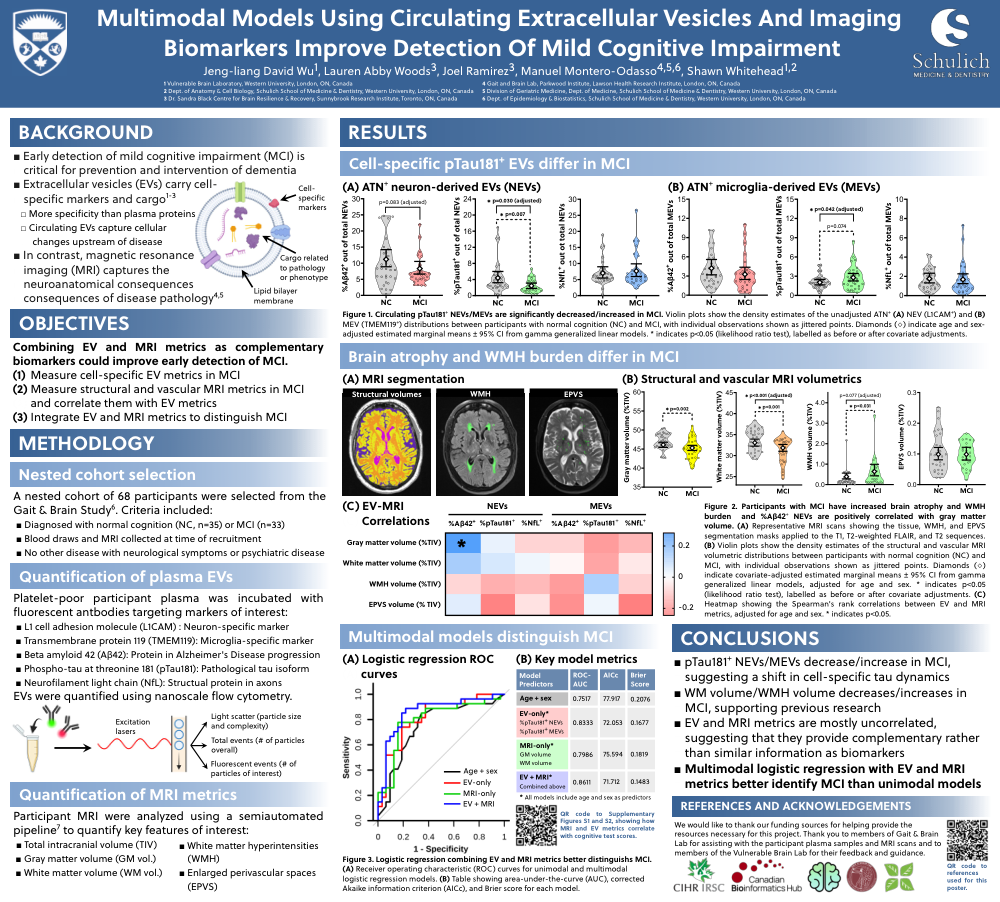
Multimodal Models Using Circulating Extracellular Vesicles And Imaging Biomarkers Improve Detection Of Mild Cognitive Impairment
Poster Presenter
Authors
Jeng-liang Wu, Lauren Woods, Joel Ramirez, Manuel Montero-Odasso, Shawn Whitehead
Affiliations
Vulnerable Brain Laboratory, Western University, London, ON, Canada, Dr. Sandra Black Centre of Brain Reslience & Recovery, Sunnybrook Research Institute, London, ON, Canada, Gait and Brain Lab, Parkwood Institute, Lawson Health Research Institute, London, ON, Canada
Part of Topic
Background: Early detection of mild cognitive impairment (MCI) is critical as global dementia burden grows. Extracellular vesicles (EVs) are promising biomarkers; these particles carry components indicative of their cell of origin and its physiological state, providing insight into brain cell interactions with amyloid, tau, and neurodegeneration (ATN) markers. Magnetic resonance imaging (MRI) can provide complementary anatomical brain measures for a more holistic understanding of patient conditions. This project explores the potential of multimodal models integrating blood EV and MRI markers to improve MCI detection.
Methods: 68 participants were selected from the Gait & Brain Cohort Study (mean age(SD)=70.66(7.187), M/F=27/41), diagnosed with normal cognition (n=35) or MCI (n=33). Blood collection, cognitive testing, and MRI were performed at time of recruitment. EVs in blood were co-labelled for neuron- or microglia-specific markers, amyloid beta (Aβ42), pTau181, and neurofilament light chain (NfL) and quantified using nanoscale flow cytometry. MRI scans were analyzed using a semi-automated pipeline to quantify structural features, white matter hyperintensities (WMH), and enlarged perivascular spaces. Logistic regression models were trained to query the performance of EV and MRI biomarkers to identify MCI either alone or in combination.
Results: Neuron- and microglia-specific EVs colabelled with pTau181 are significantly decreased and increased in MCI respectively, suggesting changes and cell-specific tau dynamics as MCI progresses. Correspondingly, pTau181+ neuronal and microglial EVs positively and negatively correlate with verbal working memory respectively as measured by Backwards Digit Span. White matter volume significantly decreased in MCI while WMH burden significantly increased. White matter volume is positively correlated with the visual search and processing speed as measured by the TMT-A. Multimodal logistic regression models trained using both EV and MRI metrics better distinguished identifying participants with MCI than models trained on either biomarker modality alone, with improved
ROC-AUC, corrected AIC, and Brier Score.
Conclusion: Multimodal models integrating circulating blood EV and MRI markers identify MCI better than either modality alone, while also providing complementary information for clinical decisions. Future work with larger sample sizes and more diverse populations is needed to confirm findings.
Comments
Email is required but is not shown publicly.
Loading comments...