4,068 posters, 219 videos, 101 topics, 69 sessions, 14,365 authors, 6,128 institutions
ePostersLive by SciGen Technologies S.A. All rights reserved.
Alzheimer's Association International Conference 2026
July 12-15, 2026 | London, United Kingdom, and Online

1562
Cognitive Testing, Visual Mri, And Automated Morphometry For Dementia In A Low-resource Setting
Poster Presenter
Authors
Rita Nassanga, Mark Kaddumukasa, Stephen. E Jones, Martha Sajatovic, Ajay Nemani, Roy Clark Basiimwa, Michael Grace Kawooya, James K Tumwine, Kamada Lwere, Joy Louise Gumikiriza-Onoria, Aloysius Gonzaga Mubuuke, Noeline Nakasujja
Affiliations
Department of Radiology, Makerere University, College of Health Sciences, Kampala, Uganda, Department of Medicine, Makerere University, College of Health Sciences, Kampala, Uganda, 3Department of Neuroradiology, Cleveland Clinic, Lerner College of Medicine, Cleveland, Ohio, USA, 4Department of Psychiatry, Case Western Reserve University School of Medicine, Cleveland, Ohio, USA, Department of Radiology, Imaging Institute, Cleveland Clinic, Mellen Center, Cleveland, Ohio, USA., Department of Radiology, St Francis Hospital Nsambya, Kampala, Uganda, Department of Radiology, Ernest Cook University, Kampala, Uganda, Department of Paediatrics and Child Health, Kabale University, School of Medicine, Kabale , Uganda, Department of Microbiology, Soroti University, Faculty of Health Sciences, Soroti, Uganda, Department of Psychiatry, Makerere University, College of Health Sciences, Kampala, Uganda
Part of Topic
Agreement and Comparative Performance of Cognitive Testing, Visual MRI Rating, and Automated Brain Morphometry in Older Adults with Suspected Dementia in Uganda
Rita Nassanga, Mark Kaddumukasa, Stephen E. Jones, Martha Sajatovic, Agya Nemani, Roy Clark Basiimwa, Michael Grace Kawooya, James K. Tumwine, Kamada Lwere, Joy Louise Gumikiriza-Onoria, Aloysius Gonzaga Mubuuke, Noeline Nakasujja
Affiliations:
Makerere University College of Health Sciences, Kampala, Uganda; Cleveland Clinic, Cleveland, OH, USA; Case Western Reserve University School of Medicine, Cleveland, OH, USA; St. Francis Hospital Nsambya, Kampala, Uganda; Ernest Cook University, Kampala, Uganda; Kabale University, Uganda; Soroti University, Uganda.
Introduction:
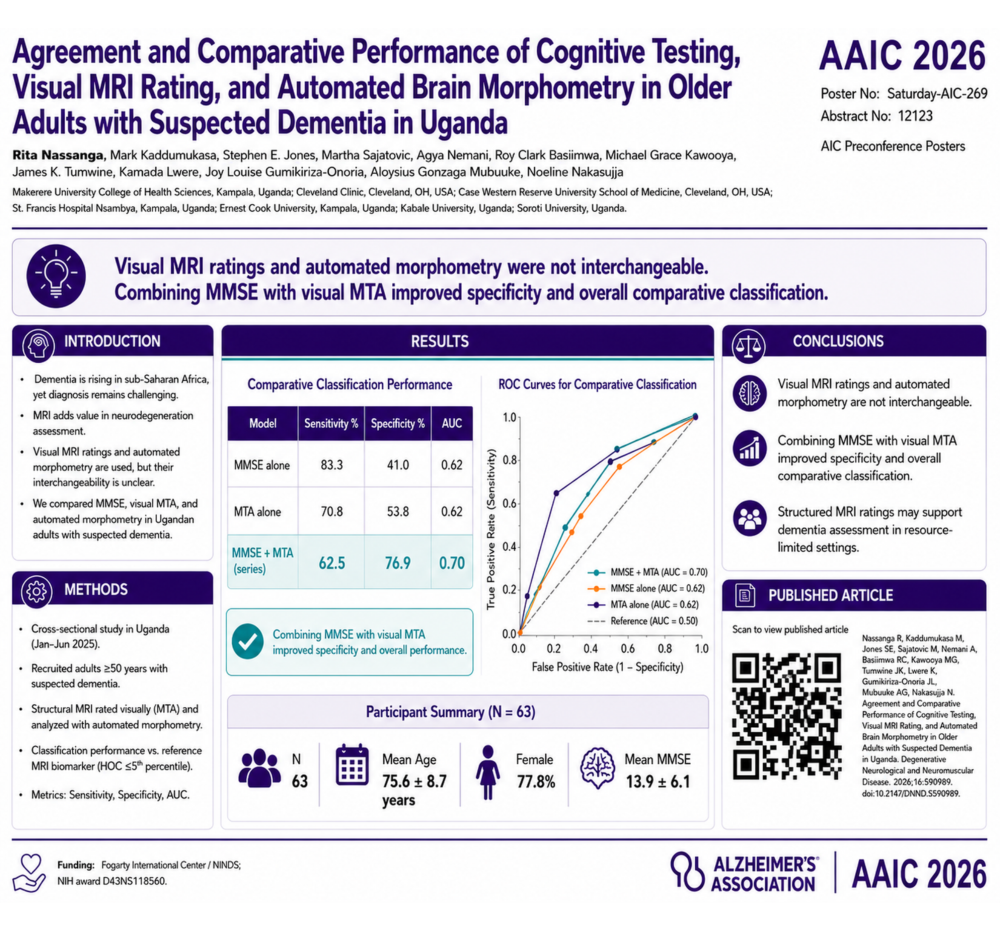
Dementia is rising in sub-Saharan Africa, yet diagnosis remains challenging. MRI adds value in neurodegeneration assessment. Visual MRI ratings and automated brain morphometry are used, but their interchangeability is unclear. This study compared cognitive testing, visual medial temporal atrophy rating, and automated brain morphometry in Ugandan older adults with suspected dementia.
Methods:
This was a cross-sectional study in Uganda conducted from January to June 2025. Adults aged 50 years and above with suspected dementia were recruited. Structural MRI was rated visually using medial temporal atrophy rating and analysed using automated morphometry. Classification performance was assessed against a reference MRI biomarker defined as hippocampal occupancy score at or below the 5th percentile. Metrics included sensitivity, specificity, and area under the receiver operating characteristic curve.
Results:
The study included 63 participants. Mean age was 75.6 ± 8.7 years, 77.8% were female, and mean MMSE score was 13.9 ± 6.1. MMSE alone had sensitivity of 83.3%, specificity of 41.0%, and AUC of 0.62. MTA alone had sensitivity of 70.8%, specificity of 53.8%, and AUC of 0.62. Combining MMSE with visual MTA in series improved specificity to 76.9% and overall comparative classification, with sensitivity of 62.5% and AUC of 0.70.
Conclusions:
Visual MRI ratings and automated morphometry were not interchangeable. Combining MMSE with visual MTA improved specificity and overall comparative classification. Structured MRI ratings may support dementia assessment in resource-limited settings.
Funding:
Fogarty International Center / NINDS; NIH award D43NS118560.
Published article:
Nassanga R, Kaddumukasa M, Jones SE, Sajatovic M, Nemani A, Basiimwa RC, Kawooya MG, Tumwine JK, Lwere K, Gumikiriza-Onoria JL, Mubuuke AG, Nakasujja N. Agreement and Comparative Performance of Cognitive Testing, Visual MRI Rating, and Automated Brain Morphometry in Older Adults with Suspected Dementia in Uganda. Degenerative Neurological and Neuromuscular Disease. 2026;16:590989. doi:10.2147/DNND.S590989.
Comments
Email is required but is not shown publicly.
Loading comments...