4,068 posters, 219 videos, 101 topics, 69 sessions, 14,365 authors, 6,128 institutions
ePostersLive by SciGen Technologies S.A. All rights reserved.
Alzheimer's Association International Conference 2026
July 12-15, 2026 | London, United Kingdom, and Online

2082
Source-Separated Quantitative Susceptibility Mapping Of Olfactory And Medial Temporal Regions Across Alzheimer’s Disease
Poster Presenter
Authors
Reese Dunne, Hossein Moein Taghavi, Mahta Karimpoor, Eric van Staalduinen, Christina Young, Marios Georgiadis, America Romero, Alexandra Trelle, Hillary Vossler, Maya Yutsis, Pascal Spincemaille, Yi Wang, Alexey Dimov, Guido Davidzon, Greg Zaharchuk, Kathleen Poston, Anthony Wagner, Victor Henderson, Elizabeth Mormino, Michael Zeineh
Affiliations
Department of Mechanical Engineering, Stanford University, Stanford, CA, USA, Department of Radiology, Stanford University School of Medicine, Stanford, CA, USA, Department of Neurology and Neurological Sciences, Stanford University School of Medicine, Stanford, CA, USA, Department of Radiology, Weill Cornell Medicine, New York, NY, USA, Department of Psychology, Stanford University, Stanford, CA, USA, Department of Epidemiology and Population Health, Stanford University, Stanford, CA, USA, Wu Tsai Neuroscience Institute, Stanford University, Stanford, CA, USA
Part of Topic
INTRODUCTION
Motivation:
- Olfactory and memory-related regions (i.e., the entorhinal cortex, piriform cortex, amygdala, and hippocampus) are among the earliest affected regions in Alzheimer's disease (AD).
- Iron accumulation and myelin alteration within these regions may contribute to AD progression.
Challenge:
- Few studies have examined these regions together, and conventional MRI cannot separately evaluate iron accumulation from myelin degeneration in vivo.
Solution:
- Use source-separated quantitative susceptibility mapping (QSM) to independently quantify iron- and myelin-sensitive susceptibility changes throughout olfactory and memory-related regions across the AD spectrum.
MRI ACQUISITION
Cohort:
66 ADRC human volunteers
- 7 Alzheimer's disease (AD)
- 5 mild cognitive impairment (MCI)
- 21 amyloid-positive healthy controls (A+HC)
- 24 amyloid-negative healthy controls (A−HC)
- 9 Parkinson's disease (PD)
MRI sequences analyzed:
- Sagittal T1-weighted → anatomical reference, amygdala segmentation
- Coronal T2-weighted → hippocampal, entorhinal-perirhinal segmentation
- Multi-echo gradient echo → QSM, source separation
MRI PROCESSING
Anatomical segmentations:
- Registered QSM maps to T2 segmentation space
Regions of interest:
- Entorhinal-perirhinal cortices
- Piriform-periamygdaloid cortex (PAC)
- Amygdala
- Whole hippocampus
Source-separated QSM:
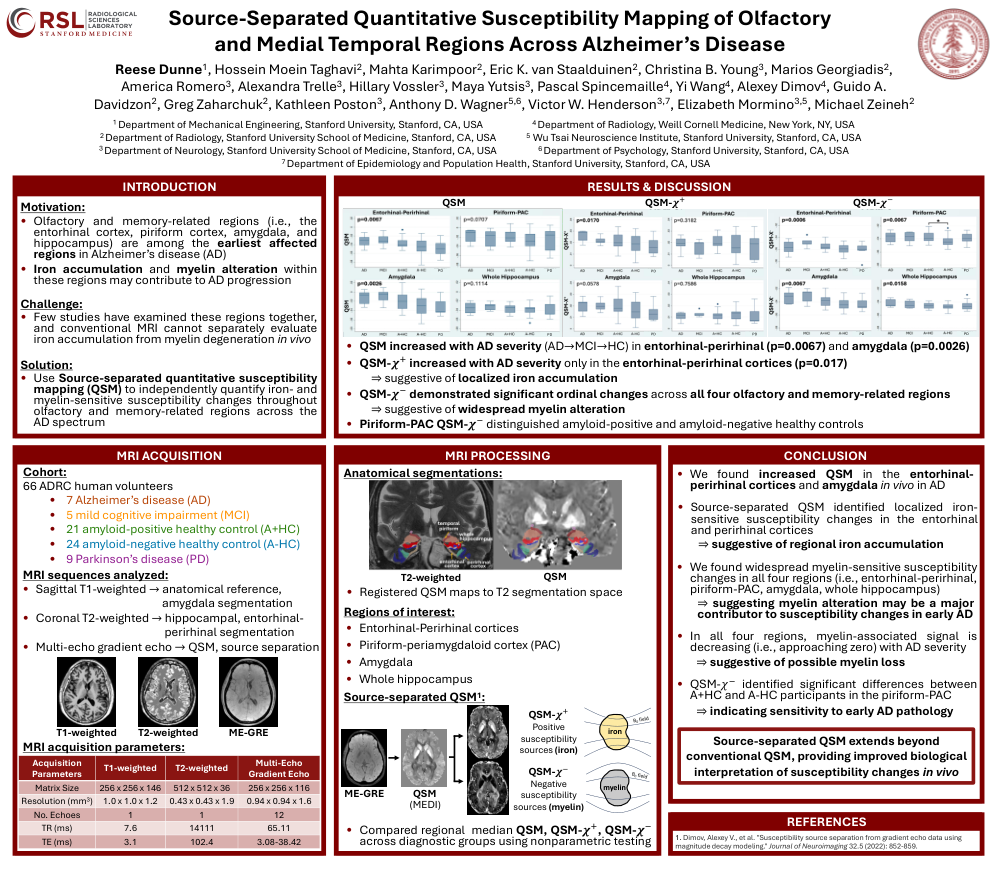
- Compared regional median QSM, QSM-χ⁺, and QSM-χ⁻ across diagnostic groups using nonparametric testing.
RESULTS & DISCUSSION
- QSM increased with AD severity (AD→MCI→HC) in the entorhinal-perirhinal (p=0.0067) and amygdala (p=0.0026).
- QSM-χ⁺ increased with AD severity only in the entorhinal-perirhinal cortices (p=0.017).
- ⇒ suggestive of localized iron accumulation
- QSM-χ⁻ demonstrated significant ordinal changesacross all four olfactory- and memory-related regions.
- ⇒ suggestive of widespread myelin alteration
- Piriform-PAC QSM-χ⁻ distinguished amyloid-positive and amyloid-negative healthy controls.
CONCLUSION
- We found increased QSM in the entorhinal-perirhinal cortices and amygdala in vivo in AD.
- Source-separated QSM identified localized iron-sensitive susceptibility changes in the entorhinal and perirhinal cortices.
- ⇒ suggestive of regional iron accumulation
- We found widespread myelin-sensitive susceptibility changes in all four regions (i.e., entorhinal-perirhinal, piriform-PAC, amygdala, whole hippocampus).
- ⇒ suggesting myelin alteration may be a major contributor to susceptibility changes in early AD
- In all four regions, myelin-associated signal is decreasing (i.e., approaching zero) with AD severity.
- ⇒ suggestive of possible myelin loss
- QSM-χ⁻ identified significant differences between A+HC and A−HC participants in the piriform-PAC.
- ⇒ indicating sensitivity to early AD pathology
- Source-separated QSM extends beyond conventional QSM, providing improved biological interpretation of susceptibility changes in vivo.
Comments
Email is required but is not shown publicly.
Loading comments...