4,068 posters, 219 videos, 101 topics, 69 sessions, 14,365 authors, 6,128 institutions
ePostersLive by SciGen Technologies S.A. All rights reserved.
Alzheimer's Association International Conference 2026
July 12-15, 2026 | London, United Kingdom, and Online

9679
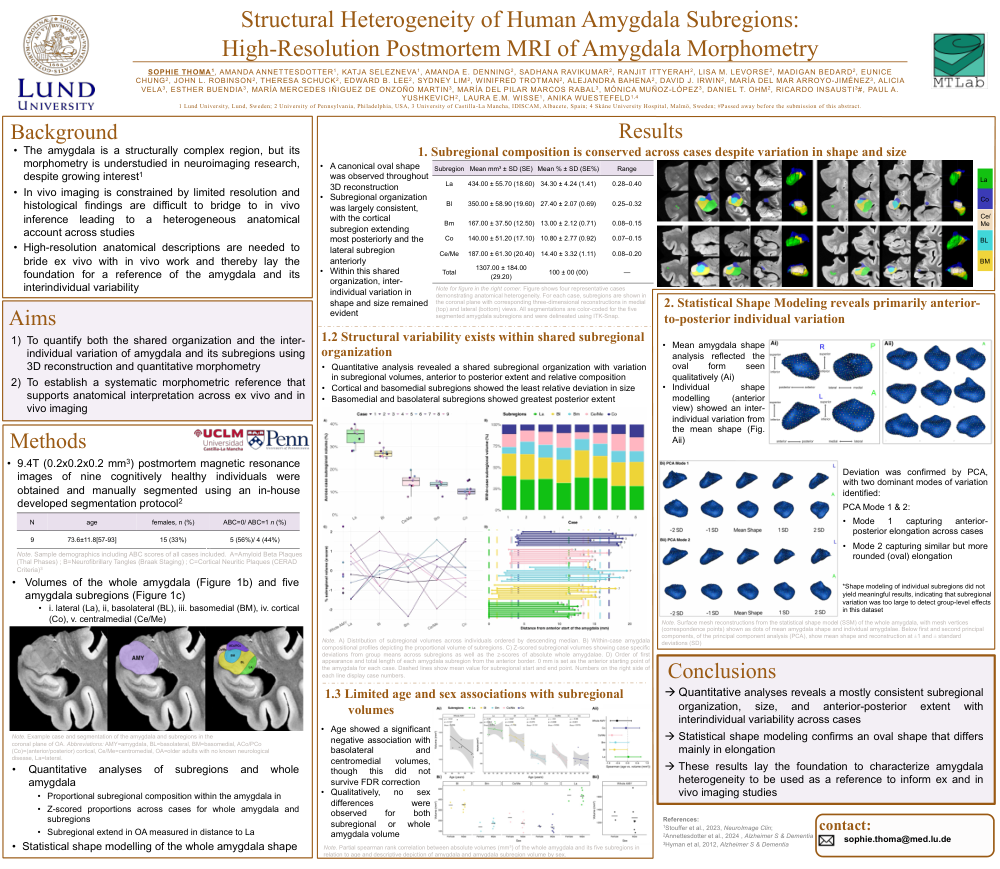
Structural Heterogeneity Of Human Amygdala Subregions: High-resolution Postmortem Mri Of Normative And Neurodegenerative Morphometry
Poster Presenter
Authors
Sophie Thoma, Amanda Annettesdotter, Katja Selezneva, Amanda E. Denning, Sadhana Ravikumar, Ranjit Ittyerah, Lisa M. Levorse, Madigan Bedard, Eunice Chung, John L. Robinson, Theresa Schuck, Edward B. Lee, Sydney Lim, Winifred Trotman, Alejandra Bahena, David J. Irwin, Maria Del Mar Arroyo-Jimenez, Alicia Vela, Esther Buendia, Maria Mercedes Íñiguez de Onzono Martin, Maria Del Pilar Marcos Rabal, Monica Munoz-Lopez, Daniel T. Ohm, Ricardo Insausti, Paul Yushkevich, Laura E.M. Wisse, Anika Wuestefeld
Affiliations
University of Pennsylvania, Lund University, University of Castilla-La Mancha, Skåne Hospital
Part of Topic
The amygdala and amygdala subregional organization remains not fully understood in neuroimaging. In vivo imaging is limited by resolution, and histology is hard to bridge to in vivo inference thus, leaving a fragmented anatomical account across studies. This study aims to quantify the shared organization and inter-individual variation of the amygdala and its subregions, using 3D reconstruction and quantitative morphometry.
Results reveal that subregional composition is broadly shared across individuals, even as overall shape and size vary. Cortical and basomedial subregions deviate least in relative raw volumetric size, while basomedial and basolateral subregions extend furthest posteriorly. Age is negatively associated with basolateral and centromedial volumes (uncorrected; not surviving FDR). Statistical Shape Modeling reveals variation primarily along the anterior to posterior axis, around a consistent oval form.
In conclusion, a stable compositional blueprint underlies a variable amygdala. By quantifying both size and composition across individuals, this work offers a quantitative reference for amygdala heterogeneity that can inform both ex vivo and in vivo imaging.
Comments
Email is required but is not shown publicly.
Loading comments...