4,068 posters, 219 videos, 101 topics, 69 sessions, 14,365 authors, 6,128 institutions
ePostersLive by SciGen Technologies S.A. All rights reserved.
Alzheimer's Association International Conference 2026
July 12-15, 2026 | London, United Kingdom, and Online

5285
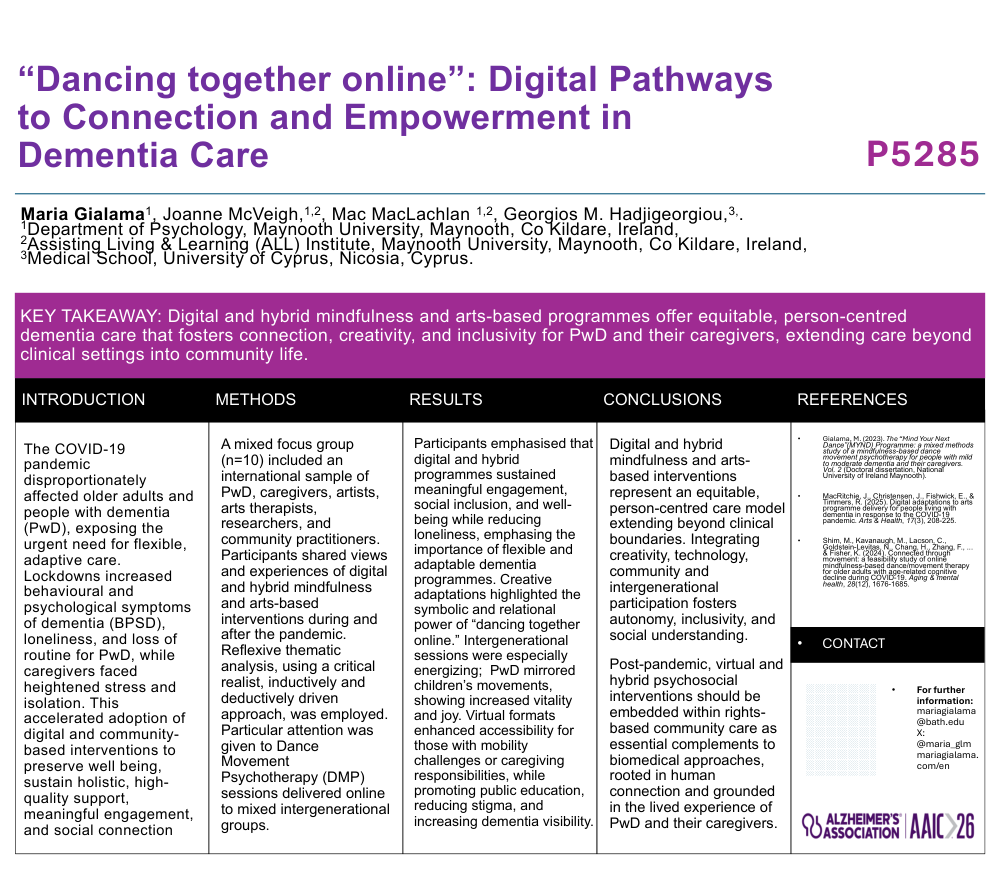
“Dancing Together Online”: Digital Pathways To Connection And Empowerment In Dementia Care
Poster Presenter
Authors
Affiliations
Part of Topic
INTRODUCTION
The COVID
19
pandemic
disproportionately
affected older adults and
people with dementia
PwD ), exposing the
urgent need for flexible,
adaptive care.
Lockdowns increased
behavioural and
psychological symptoms
of dementia (BPSD),
loneliness, and loss of
routine for PwD , while
caregivers faced
heightened stress and
isolation. This
accelerated adoption of
digital and community
based interventions to
preserve well being,
sustain holistic, high
quality support,
meaningful engagement,
and social connection
METHODS
A mixed focus group
(n=10) included an
international sample of
PwD , caregivers, artists,
arts therapists,
researchers, and
community practitioners.
Participants shared views
and experiences of digital
and hybrid mindfulness
and arts based
interventions during and
after the pandemic.
Reflexive thematic
analysis, using a critical
realist, inductively and
deductively driven
approach, was employed.
Particular attention was
given to Dance
Movement
Psychotherapy (DMP)
sessions delivered online
to mixed intergenerational
groups
RESULTS
Participants
emphasised that
digital and hybrid
programmes sustained
meaningful engagement,
social inclusion, and well
being while reducing
loneliness, emphasing the
importance of flexible and
adaptable dementia
programmes . Creative
adaptations highlighted the
symbolic and relational
power of “dancing together
online.” Intergenerational
sessions were especially
energizing; PwD mirrored
children’s movements,
showing increased vitality
and joy. Virtual formats
enhanced accessibility for
those with mobility
challenges or caregiving
responsibilities, while
promoting public education,
reducing stigma, and
increasing dementia visibility.
CONCLUSIONS
Digital and hybrid
mindfulness and arts
based interventions
represent an equitable,
person centred care model
extending beyond clinical
boundaries. Integrating
creativity, technology,
community and
intergenerational
participation fosters
autonomy, inclusivity, and
social understanding.
Post
pandemic, virtual and
hybrid psychosocial
interventions should be
embedded within rights
based community care as
essential complements to
biomedical approaches,
rooted in human
connection and grounded
in the lived experience of
PwD and their caregivers.
REFERENCES
Gialama, M. (2023). The “Mind Your
Next Dance”(MYND) Programme: a mixed
methods study of a mindfulness based dance
movement psychotherapy for people with mild
to moderate dementia and their caregivers.
Vol. 2 (Doctoral dissertation, National
University of Ireland Maynooth).
•
MacRitchie, J., Christensen, J., Fishwick, E., &
Timmers , R. (2025). Digital adaptations to arts
programme delivery for people living with
dementia in response to the COVID 19
pandemic. Arts & Health 17 (3), 208 225.
•
Shim, M., Kavanaugh, M., Lacson, C.,
Goldstein Levitas, N., Chang, H., Zhang, F., ...
& Fisher, K. (2024). Connected through
movement: a feasibility study of online
mindfulness based dance/movement therapy
for older adults with age related cognitive
decline during COVID 19. Aging & mental
health 28 (12), 1676 1685.
Comments
Email is required but is not shown publicly.
Loading comments...