4,068 posters, 219 videos, 101 topics, 69 sessions, 14,365 authors, 6,128 institutions
ePostersLive by SciGen Technologies S.A. All rights reserved.
Alzheimer's Association International Conference 2026
July 12-15, 2026 | London, United Kingdom, and Online

8693
The Hallucinatory Trait In The Prodromal Phase Of Dementia With Lewy Bodies: Alterations In Resting-state Functional Connectivity
Poster Presenter
Authors
Desirée Conti, Anna Giulia Barletta, Giulia Zazzaro, Massimiliano Panigutti, Giulia Bechi Gabrielli, Marco Serrentino, Micaela Sepe Monti, Giuseppina Talarico, Marco Canevelli, Giuseppe Bruno, Gaspare Galati, Fabrizia D'Antonio
Affiliations
a. Cognitive and Motor Rehabilitation and Neuroimaging Unit, IRCCS Santa Lucia Foundation, Rome, Italy; b. Department of Psychology, Sapienza University of Rome, Rome, Italy; c. PhD Program in Behavioral Neuroscience, Sapienza University of Rome, Rome, Italy, b. Department of Psychology, Sapienza University of Rome, Rome, Italy, a. Cognitive and Motor Rehabilitation and Neuroimaging Unit, IRCCS Santa Lucia Foundation, Rome, Italy; b. Department of Psychology, Sapienza University of Rome, Rome, Italy, d. Department of Human Neuroscience, Sapienza University of Rome, Rome, Italy; e. Giustino Fortunato University, Benevento, Italy, d. Department of Human Neuroscience, Sapienza University of Rome, Rome, Italy, a. Cognitive and Motor Rehabilitation and Neuroimaging Unit, IRCCS Santa Lucia Foundation, Rome, Italy
Part of Topic
The hallucinatory trait in the prodromal phase of dementia with Lewy bodies: alterations in resting-state functional connectivity
Background. Visual hallucinations (VH) are a hallmark symptom of dementia with Lewy bodies (DLB), often occurring early in the disease course, including its prodromal phase (pro-DLB). Despite their prominence, the underlying mechanisms responsible for the onset of VH and the factors that predispose individuals to experience them (hallucination trait) remain poorly understood. Within the hodotopic framework, the aim of this study was to investigate alterations in functional connectivity (FC) in pro-DLB patients using resting-state (rs) fMRI data.
Methods. We recruited 44 patients with pro-DLB from the Department of Human Neuroscience of Sapienza University Hospital of Rome. Patients were divided into two groups based on their clinical history of VH, as assessed through the North-East Visual Hallucination Interview (NEVHI): 20 pro-DLB patients had experienced VH (pro-VH), and 24 had not (pro-NoVH). All participants underwent a 3T structural and functional MRI examination. We applied a Multivariate Pattern Analysis (fc-MVPA), a seed-to-voxel method that detects clusters/regions-of-interest (ROIs) with altered rsFC in one group relative to another. A post-hoc seed-based analysis was performed to examine the direction of connectivity from the MVPA-identified cluster, used as the seed.
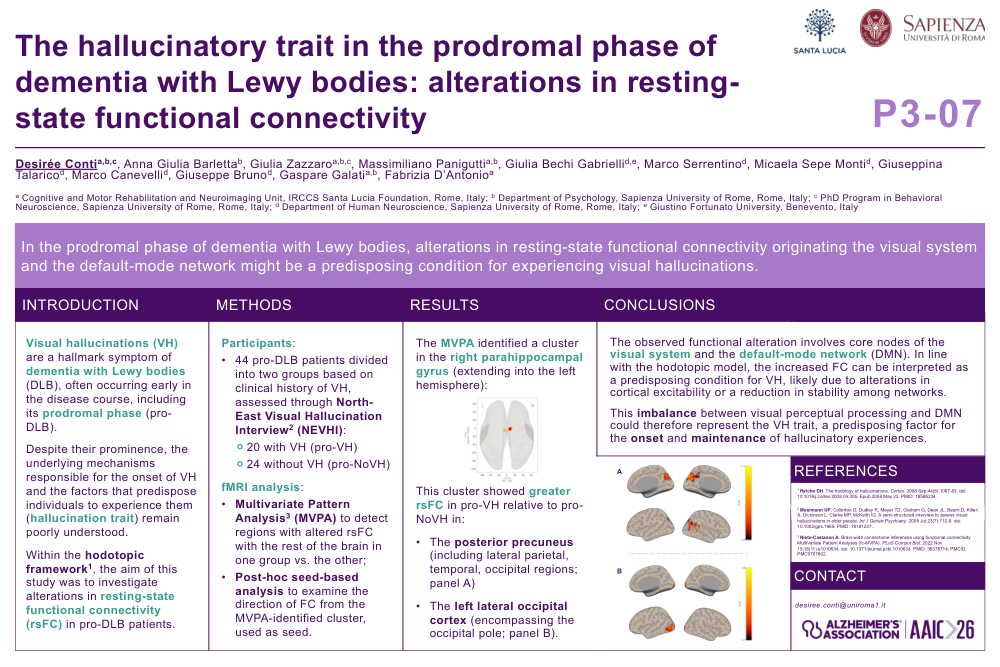
Results. The pro-VH and pro-NoVH groups were matched for demographic (age, gender, education) and clinical (MMSE, UPDRS, sleep, and cognitive fluctuation scores) variables. The MVPA analysis identified a cluster in the right parahippocampal gyrus (extending into the left hemisphere) with higher rsFC in pro-VH patients compared to pro-NoVH patients. The post-hoc analysis revealed that the parahippocampal gyrus had greater rsFC in pro-VH patients with two clusters: the precuneus (including lateral parietal, temporal, and occipital regions) and the left lateral occipital cortex (encompassing the occipital pole).
Conclusions. The observed functional alteration involves core nodes of the visual system and the default-mode network (DMN). In line with the hodotopic model, the increased FC can be interpreted as a predisposing condition for VH, likely due to alterations in cortical excitability or a reduction in stability among networks. This imbalance between visual perceptual processing and DMN could therefore represent the VH trait, a predisposing factor for the onset and maintenance of hallucinatory experiences.
Comments
Email is required but is not shown publicly.
Loading comments...