4,068 posters, 219 videos, 101 topics, 69 sessions, 14,365 authors, 6,128 institutions
ePostersLive by SciGen Technologies S.A. All rights reserved.
Alzheimer's Association International Conference 2026
July 12-15, 2026 | London, United Kingdom, and Online

9922
Mapping Amyloid-PET Uptake in the White Matter in Alzheimer’s Disease
Poster Presenter
Authors
Elif Harput, Cecilia Boccalini, Max Scheffler, Karl-Olof Lovblad, Nicholas J. Ashton, Henrik Zetterberg, Oskar Hansson, Hadrien M. Lalive, Aurelien Lathuiliere, Giovanni B. Frisoni, Valentina Garibotto
Affiliations
Laboratory of Neuroimaging and Innovative Molecular Tracers (NIMTlab), Geneva University Neurocenter and Faculty of Medicine, University of Geneva, Geneva, Switzerland, Division of Radiology, Geneva University Hospitals, Geneva, Switzerland, Department of Psychiatry and Neurochemistry, Institute of Neuroscience and Physiology, the Sahlgrenska Academy at the University of Gothenburg, Mölndal, Sweden, Clinical Memory Research Unit, Department of Clinical Sciences Malmö, Lund University, Lund, Sweden, Geneva Memory Center, Department of Rehabilitation and Geriatrics, Geneva University Hospitals, Geneva, Switzerland, Division of Nuclear Medicine and Molecular Imaging, Geneva University Hospitals, Geneva, Switzerland
Part of Topic
Introduction
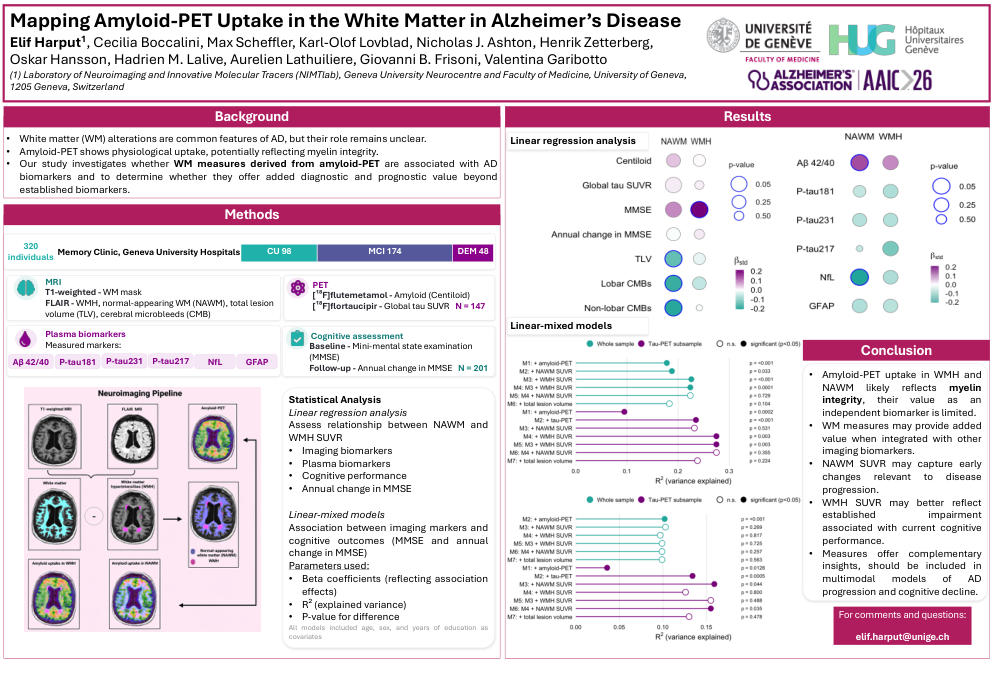
Alzheimer’s disease (AD) is pathologically defined by amyloid-beta plaques and tau neurofibrillary tangles, but white matter (WM) alterations are also a consistent feature whose contribution to the disease process remains poorly understood. Although, amyloid-PET tracers are validated for amyloid detection in the gray matter, they also show physiological WM uptake, possibly associated to myelin integrity, although its interpretations remain controversial. In this study we aim to investigate whether WM measures derived from amyloid-PET are associated with AD biomarkers and to determine whether they offer added diagnostic and prognostic value beyond established biomarkers.
Methods
We conducted this study including 320 individuals, either cognitively unimpaired or with mild cognitive impairment (MCI) and dementia, with available [18F]flutemetamol amyloid-PET, T1-weighted and T2-FLAIR MRI and mini-mental state examination (MMSE) at baseline. A subset of 147 individuals underwent tau-PET imaging, and 201 individuals had a follow-up cognitive assessment at 21.26 ± 16.15 months. White matter hyperintensity (WMH) and normal-appearing white matter (NAWM) masks, total lesion volume (TLV), and cerebral microbleeds (CMB) were derived from FLAIR; standardized uptake value ratios (SUVR) in WMH and NAWM were calculated from amyloid-PET images, and they are regressed out for global amyloid in the gray matter and transformed to z-scores. Linear regression analysis assessed the association between NAWM and WMH SUVR and imaging measures, blood biomarkers, cognitive performance and longitudinal cognitive decline. We performed comparison between different linear-mixed models evaluating associations between imaging modalities and cognitive outcomes.
Results
Majority of subjects were MCI (54%) and were female (54%). No significant differences were observed across diagnostic groups for NAWM or WMH SUVR. No significant associations were found between NAWM, WMH SUVR and AD-specific biomarkers. However, WMH SUVR was positively associated with MMSE (P= 0.0001) and NAWM SUVR was negatively associated with TLV (P=0.005) and with neurofilament light chain (P=0.001). Lower NAWM SUVR was associated with higher lobar (P= 0.025) and non-lobar CMB (P= 0.016). When models to predict baseline MMSE were compared, inclusion of NAWM SUVR improved the model (Akaike information criterion [AIC]= 1624; P= 0.003), but when WMH SUVR was included, it led to an additional improvement (AIC= 1608; P < 0.001). When both measures were included in the same model, only WMH SUVR remained a significant predictor. In models predicting annual cognitive decline in the tau subsample adding NAWM SUVR to models including both amyloid and tau improved model fit significantly (AIC= 417; P= 0.044).
Conclusion
Results suggest that amyloid-PET uptake in WMH and NAWM reflects myelin integrity and that NAWM SUVR may capture early disease-related changes, while WMH SUVR may suggest damage linked to baseline cognition. Despite their limited value as standalone biomarkers, both WM indices improve models of AD progression, supporting their integration in a multimodal assessment.
Comments
Email is required but is not shown publicly.
Loading comments...