4,068 posters, 219 videos, 101 topics, 69 sessions, 14,365 authors, 6,128 institutions
ePostersLive by SciGen Technologies S.A. All rights reserved.
Alzheimer's Association International Conference 2026
July 12-15, 2026 | London, United Kingdom, and Online

865
Association Of Education With Cognitive And Neurodegeneration Trajectories In Superagers And Typical Agers
Poster Presenter
Authors
Affiliations
Part of Topic
Association of education with cognitive and neurodegeneration trajectories in superagers and typical agers
Ellis Spindola Ludtke, Natalia Gomes Gonçalves
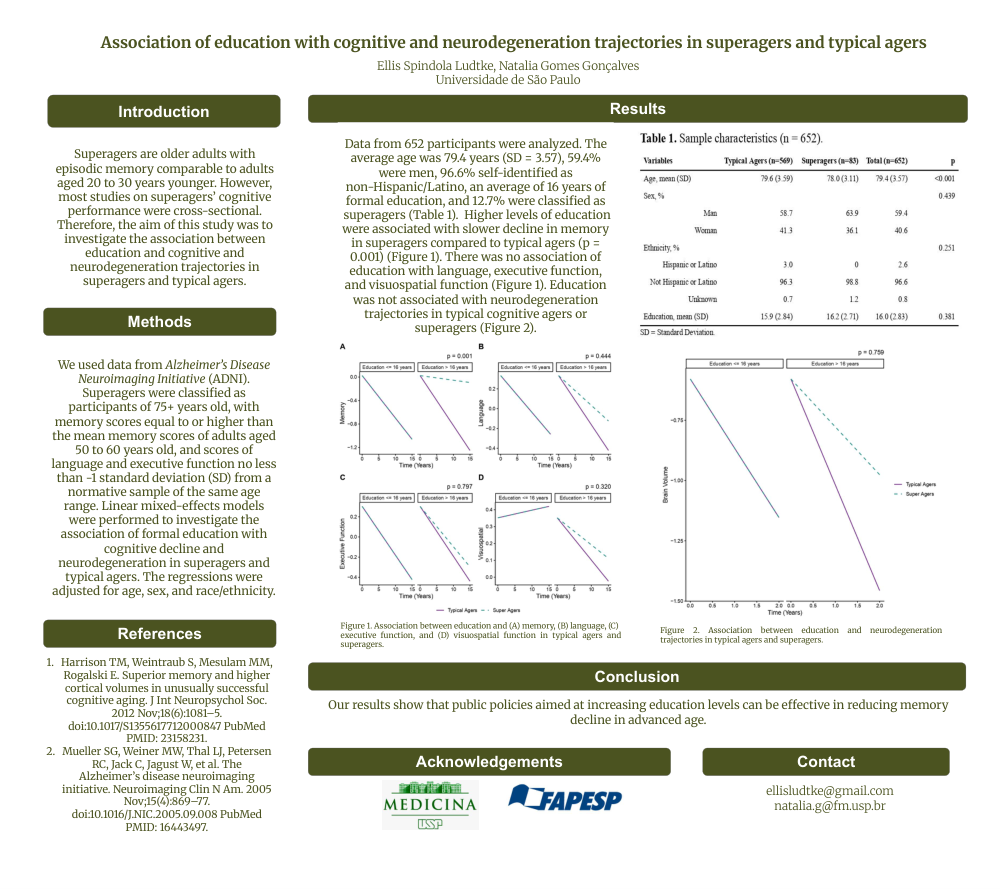
Background: Superagers are older adults with episodic memory comparable to adults aged 20 to 30 years younger. However, most studies on superagers’ cognitive performance were cross-sectional. Therefore, the aim of this study was to investigate the association between education and cognitive and neurodegeneration trajectories in superagers and typical agers.
Methods: We used data from Alzheimer’s Disease Neuroimaging Initiative (ADNI). Superagers were classified as participants of 75+ years old, with memory scores equal to or higher than the mean memory scores of adults aged 50 to 60 years old, and scores of language and executive function no less than -1 standard deviation (SD) from a normative sample of the same age range. Linear mixed-effects models were performed to investigate the association of formal education with cognitive decline and neurodegeneration in superagers and typical agers. The regressions were adjusted for age, sex, and race/ethnicity.
Results: Data from 652 participants were analyzed. The average age was 79.4 years (SD = 3.57), 59.4% were men, 96.6% self-identified as non-Hispanic/Latino, an average of 16 years of formal education, and 12.7% were classified as superagers (Table 1). Higher levels of education were associated with slower decline in memory in superagers compared to typical agers (p = 0.001) (Figure 1). There was no association of education with language, executive function, and visuospatial function (Figure 1). Education was not associated with neurodegeneration trajectories in typical cognitive agers or superagers (Figure 2).
Discussion: Our results show that public policies aimed at increasing education levels can be effective in reducing memory decline in advanced age.
Comments
Email is required but is not shown publicly.
Loading comments...