4,068 posters, 219 videos, 101 topics, 69 sessions, 14,365 authors, 6,128 institutions
ePostersLive by SciGen Technologies S.A. All rights reserved.
Alzheimer's Association International Conference 2026
July 12-15, 2026 | London, United Kingdom, and Online

3580
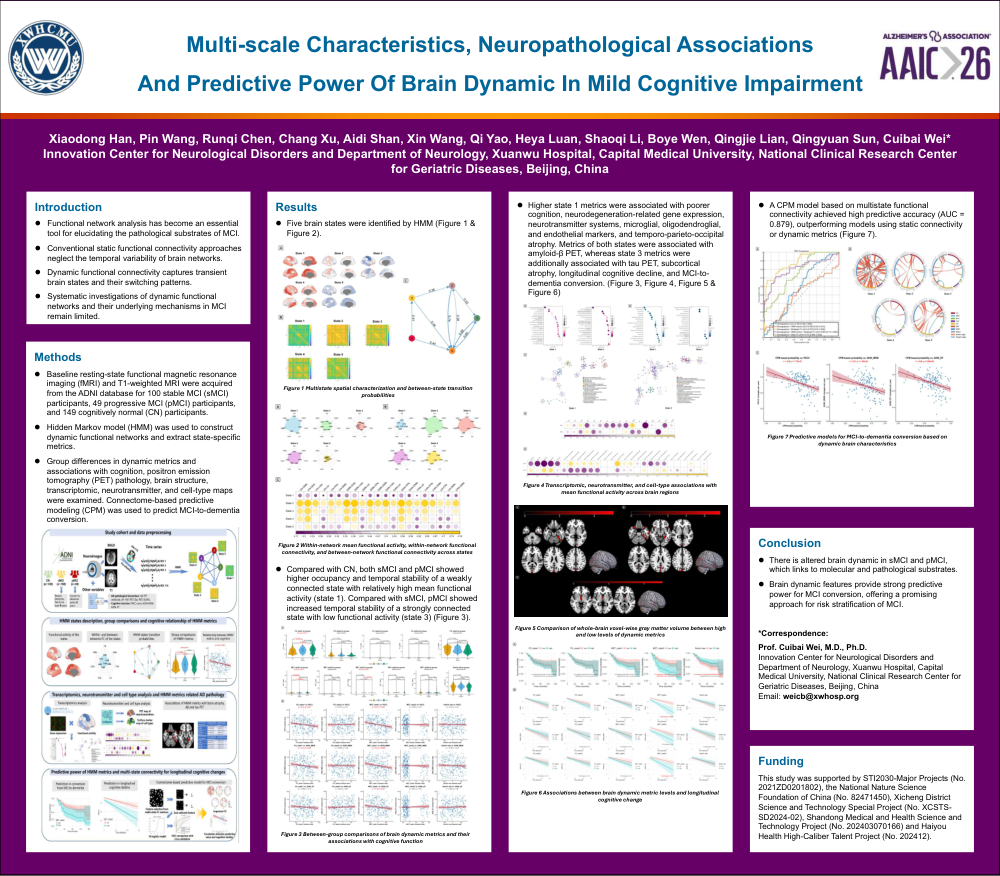
Multi-scale Characteristics, Neuropathological Associations And Predictive Power Of Brain Dynamic In Mild Cognitive Impairment
Poster Presenter
Authors
Xiaodong Han, Pin Wang, Runqi Chen, Chang Xu, Aidi Shan, Xin Wang, Qi Yao, Heye Luan, Shaoqi Li, Boye Wen, Qingjie Lian, Qingyuan Sun, Cuibai Wei
Affiliations
nullInnovation Center for Neurological Disorders and Department of Neurology, Xuanwu Hospital, Capital Medical University, National Clinical Research Center for Geriatric Diseases, Beijing, China, Department of Neurology, Beijing Friendship Hospital, Capital Medical University, Beijing, China, School of Biological Science and Medical Engineering, Beihang University, Beijing, China, Innovation Center for Neurological Disorders and Department of Neurology, Xuanwu Hospital, Capital Medical University, National Clinical Research Center for Geriatric Diseases, Beijing, China, College of Integrated Traditional Chinese and Western Medicine, Changchun University of Chinese Medicine, Changchun, China, School of Chinese Materia Medica, Beijing University of Chinese Medicine, Beijing, China
Part of Topic
Abstract:
Background: Static functional network omit temporal variability of brain states, whereas dynamic approaches capture transient brain states, which were closely related to cognition. However, comprehensive investigations of brain dynamic in mild cognitive impairment (MCI) remain lacking.
Methods: Baseline resting-state functional MRI and T1-MRI from ADNI were acquired for 100 stable MCI (sMCI), 49 progressive MCI (pMCI), and 149 cognitively normal (CN) participants. Hidden Markov model (HMM) was used to characterize brain states. Group differences of state metrics (description for time proportion and temporal stability) were tested with analysis of covariance. The relationship between state metrics with cognition, PET pathology and regional atrophy were examined by partial correlation, linear mixed model, logistic and cox regression, and voxel-based morphometry. Transcriptomic, neurotransmitter, and cell-type associations were assessed using the Allen Human Brain Atlas and JuSpace toolbox. Finally, connectome-based predictive modeling (CPM) was used for prediction of MCI conversion.
Results: Five brain states were identified by HMM. Compared with CN, sMCI and pMCI exhibited higher time proportion of a state characterized by weak within- and between-network connectivity and relatively strong mean functional activity (state1), and only sMCI showed an increased switching rate between states. In comparison with sMCI, pMCI showed elevated time proportion of a state characterized by relatively strong connectivity and weak functional activity (state3). Increased state1 metrics were associated with poorer global and domain-specific cognition. Functional activity of state1 were spatially correlated with neurological disease-related gene expression, neurotransmitter distribution, and surface markers of microglia, oligodendroglia and endothelial cells. Structurally, state1 metrics were associated with regional atrophy in temporo-occipital cortex, while state3 metrics were related to subcortical atrophy. Metrics of both states were correlated with Aβ-PET, and state3 metrics were additionally associated with Tau-PET. State3 metrics were associated with longitudinal cognitive decline and MCI conversion. A CPM based on multi-state connectivity achieved high predictive accuracy for MCI conversion (AUC = 0.879), outperforming models using static connectivity or state metrics.
Conclusion: There is altered brain dynamic in sMCI and pMCI, which links to molecular and pathological substrates, and provides strong predictive power for MCI conversion, offering a promising approach for risk stratification of MCI.
Comments
Email is required but is not shown publicly.
Loading comments...