4,068 posters, 219 videos, 101 topics, 69 sessions, 14,365 authors, 6,128 institutions
ePostersLive by SciGen Technologies S.A. All rights reserved.
Alzheimer's Association International Conference 2026
July 12-15, 2026 | London, United Kingdom, and Online

3657
A Multimodal Study Of Brain Glutamate Levels, Hyperactivation And Neurodegeneration In Prodromal Alzheimer’s Disease
Poster Presenter
Authors
Arsenii Prozorov, Samira Mellah, Habib Benali, Consortium for the Early Identification of Alzheimer's Disease‐Quebec (CIMA‐Q), Sylvie Belleville
Affiliations
CRIUGM, Montreal, QC, Canada, CRIUGM, Montreal, QC, Canada; Department of Psychology, Université de Montréal, Montreal, QC, Canada, CRIUGM, Montreal, QC, Canada; Department of Electrical and Computer Engineering, Concordia University, Montreal, QC, Canada
Part of Topic
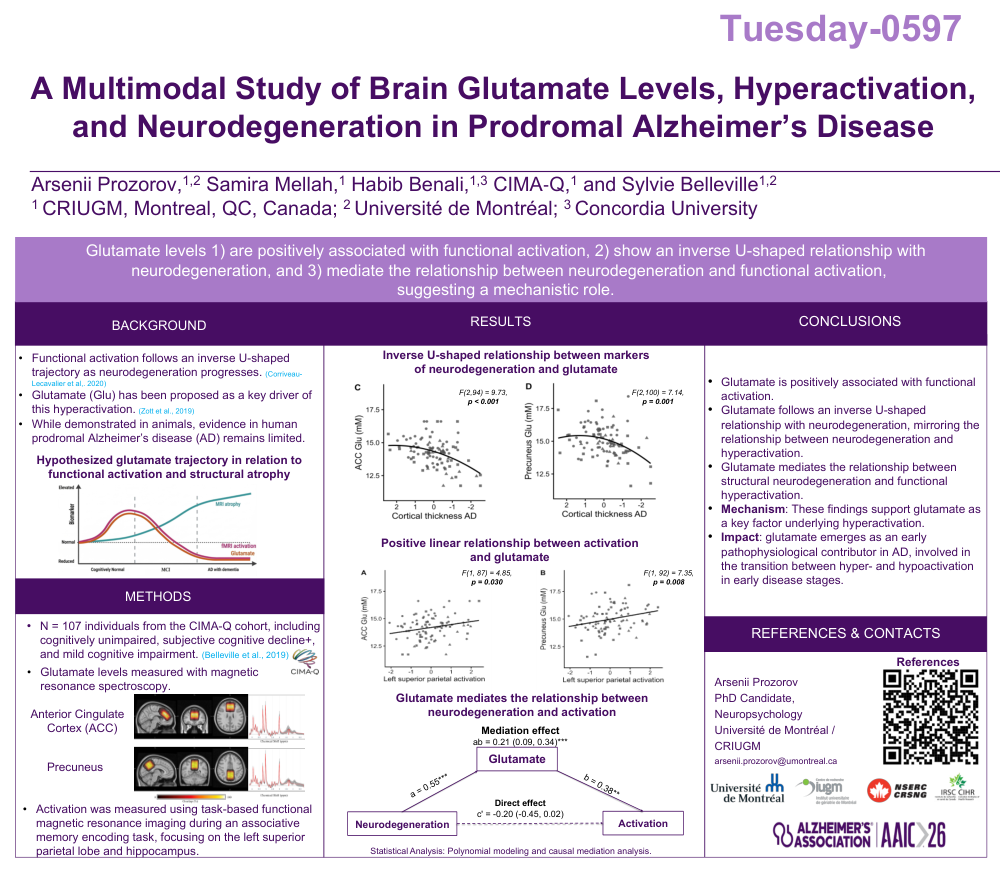
Background: An increasing number of studies indicate hyperactivation in the prodrome of Alzheimer’s disease (AD), defined as greater brain activation in patients than in control participants. Functional activation is thought to vary nonlinearly with disease severity, characterized by early hyperactivation followed by hypoactivation as neurodegeneration advances, consistent with an inverse U-shaped relationship. Glutamate (Glu) dysregulation has been proposed as a neurochemical mechanism underlying early hyperactivation, given that glutamate is the brain’s primary excitatory neurotransmitter. If so, glutamate should also show an inverse U-shaped relationship with neurodegeneration, and a positive linear relationship with activation. Accordingly, our goal was to use magnetic resonance imaging (MRI) to model the relationship between functional activation, neurodegeneration and Glu levels.
Methods: The study included 107 older adults with mild cognitive impairment, subjective cognitive decline, or cognitively unimpaired from the CIMA-Q cohort who underwent magnetic resonance spectroscopy (MRS) to quantify glutamate levels in the anterior cingulate cortex (ACC) and precuneus, as well as a structural and task-related functional MRI examination. We used polynomial and linear regression, alongside causal mediation analysis, to model the relationship between glutamate (Glu) levels and neurodegeneration (hippocampal volume and cortical thickness), as well as the relationship between Glu levels and task-related brain activation within Alzheimer’s disease signature regions.
Results: Polynomial models indicated that the relationship between markers of neurodegeneration (hippocampal volume, cortical thickness) and Glu levels followed an inverse U-shaped function (ACC: F(2, 94) = 9.73, p < 0.001; Precuneus: F(2, 100) = 7.14, p = 0.001). In contrast, the relationship between parietal and hippocampal task-related activation and Glu levels was linear and positive (ACC: F(1, 87) = 4.85, p = 0.030; Precuneus: F(1, 92) = 7.35, p = 0.008). Furthermore, causal mediation analysis revealed that glutamate fully mediates the relationship between structural neurodegeneration and functional hyperactivation.
Conclusion: As expected, glutamate showed an inverse U-shaped relationship with markers of neurodegeneration consistent with an early elevation followed by a later decline. This pattern parallels prior reports for neurodegeneration and brain activation. Glutamate also showed a positive linear relationship with activation indicating close coupling between glutamate and activation. These results are consistent with the glutamatergic dysregulation model, which posits that Glu elevation contributes to hyperactivation early in the disease process, and supports glutamate as a key factor underlying this progression.
Comments
Email is required but is not shown publicly.
Loading comments...