4,068 posters, 219 videos, 101 topics, 69 sessions, 14,365 authors, 6,128 institutions
ePostersLive by SciGen Technologies S.A. All rights reserved.
Alzheimer's Association International Conference 2026
July 12-15, 2026 | London, United Kingdom, and Online

9400
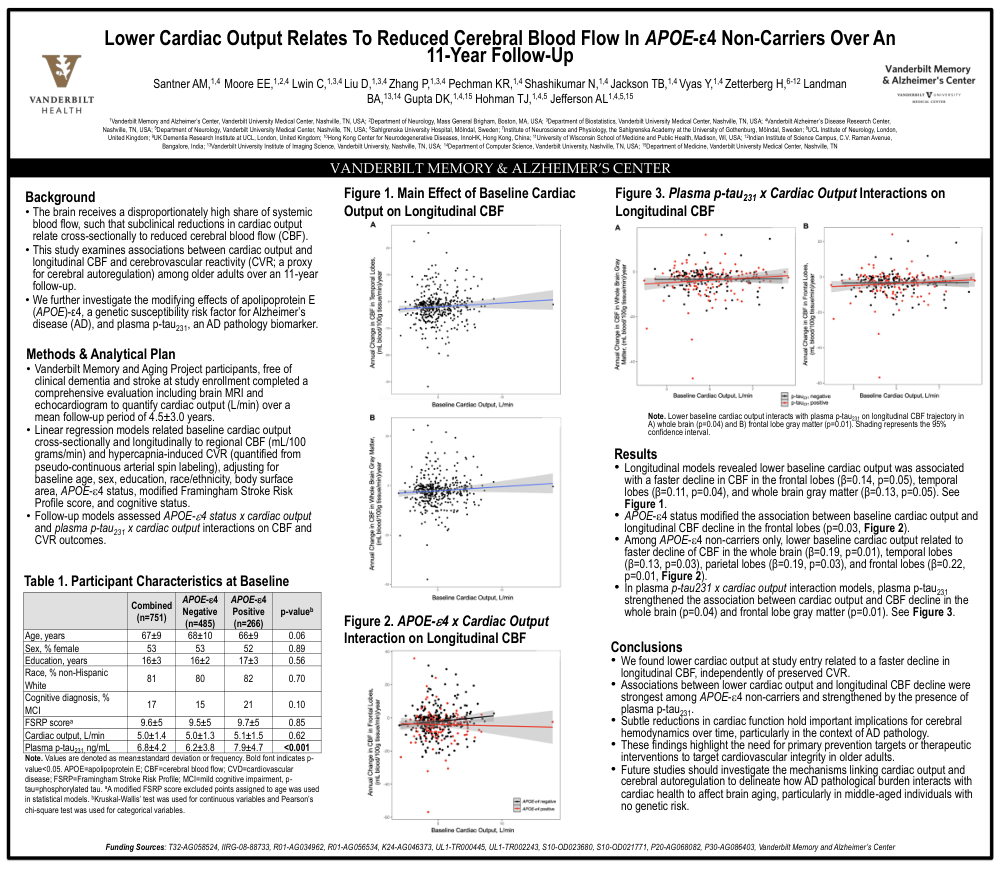
Lower Cardiac Output Relates To Reduced Cerebral Blood Flow In Apoe-e4 Non-carriers Over An 11-year Follow-up
Poster Presenter
Authors
Affiliations
Part of Topic
Background: The brain receives a disproportionately high share of systemic blood flow, such that subclinical reductions in cardiac output relate to reduced cerebral blood flow (CBF). We extend prior cross-sectional findings by examining associations between cardiac output and longitudinal CBF and cerebrovascular reactivity (CVR) among middle-aged and older adults over 11 years. We further examine the modifying effects of apolipoprotein E (APOE)-ε4, a genetic susceptibility risk factor for Alzheimer’s disease (AD), and plasma p-tau231, an AD biomarker.
Methods: Vanderbilt Memory and Aging Project participants free of dementia, stroke, and heart failure (n=751, 67±9 years, 53% female, 35% APOE-ε4 positive, 4.5±3.0 years follow-up) underwent baseline echocardiography to quantify cardiac output (L/min). Resting CBF (mL/100 grams/min) and hypercapnia-induced CVR were quantified from pseudo-continuous arterial spin labeling. Linear regression (cross-sectional) and linear mixed effects (longitudinal) models with follow-up time interaction terms related baseline cardiac output to regional CBF and CVR, adjusting for baseline age, sex, education, race/ethnicity, body surface area, APOE-ε4 status, modified Framingham Stroke Risk Profile score, and cognitive status. Secondary models tested cardiac output x APOE-ε4 status and cardiac output x plasma p-tau231interactions.
Results: Longitudinal models revealed lower baseline cardiac output related to faster decline in CBF over time in the temporal lobes (β=0.11, p=0.04), frontal lobes (β=0.14, p=0.05), and whole brain gray matter (β=0.13, p=0.05). APOE-ε4 status modified the association between lower baseline cardiac output and faster decline in CBF over time in the frontal lobes (β=-0.32, p=0.03) and whole brain (β=-0.22, p=0.09), with associations present in APOE-ε4 non-carriers only (p-values<0.01). However, post-hoc age stratification revealed this association was driven by younger participants (under the median age). Plasma p-tau231 modified the association between cardiac output and CBF decline in the frontal lobes (β=-0.02, p=0.01) and whole brain (β=-0.01, p=0.04). All associations were null with CVR (p-values>0.05).
Conclusion: Among middle-aged and older adults, lower baseline cardiac output is associated with a faster decline in longitudinal CBF, particularly in middle-aged individuals with no genetic predisposition to AD. Results suggest that subtle changes in cardiac function interact with AD pathological burden to affect brain health over time, independently of severe vascular risk.
Comments
Email is required but is not shown publicly.
Loading comments...