4,068 posters, 219 videos, 101 topics, 69 sessions, 14,365 authors, 6,128 institutions
ePostersLive by SciGen Technologies S.A. All rights reserved.
Alzheimer's Association International Conference 2026
July 12-15, 2026 | London, United Kingdom, and Online

5150
Longitudinal Associations Between Mild Behavioral Impairment And White Matter Hyperintensity Progression
Part of Topic
Longitudinal Associations between Mild Behavioral Impairment and White Matter Hyperintensity Progression
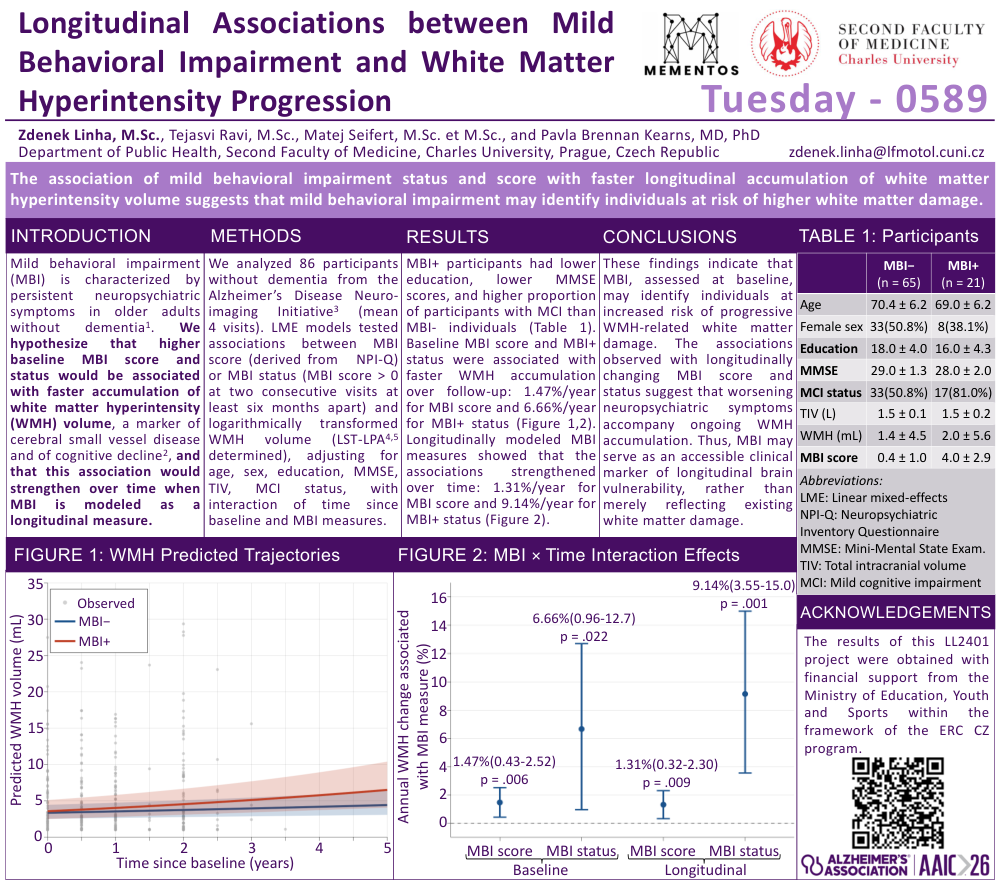
The association of mild behavioral impairment status and score with faster longitudinal accumulation of white matter hyperintensity volume suggests that mild behavioral impairment may identify individuals at risk of higher white matter damage.
Mild behavioral impairment (MBI) is characterized by persistent neuropsychiatric symptoms in older adults without dementia1. We hypothesize that higher baseline MBI score and status would be associated with faster accumulation of white matter hyperintensity (WMH) volume, a marker of cerebral small vessel disease and of cognitive decline2, and that this association would strengthen over time when MBI is modeled as a longitudinal measure.
We analyzed 86 participants without dementia from the Alzheimer’s Disease Neuro-imaging Initiative3 (mean 4 visits). LME models tested associations between MBI score (derived from NPI-Q) or MBI status (MBI score > 0 at two consecutive visits at least six months apart) and logarithmically transformed WMH volume (LST-LPA4,5 determined), adjusting for age, sex, education, MMSE, TIV, MCI status, with interaction of time since baseline and MBI measures.
MBI+ participants had lower education, lower MMSE scores, and higher proportion of participants with MCI than MBI- individuals (Table 1). Baseline MBI score and MBI+ status were associated with faster WMH accumulation over follow-up: 1.47%/year for MBI score and 6.66%/year for MBI+ status (Figure 1,2). Longitudinally modeled MBI measures showed that the associations strengthened over time: 1.31%/year for MBI score and 9.14%/year for MBI+ status (Figure 2).
These findings indicate that MBI, assessed at baseline, may identify individuals at increased risk of progressive WMH-related white matter damage. The associations observed with longitudinally changing MBI score and status suggest that worsening neuropsychiatric symptoms accompany ongoing WMH accumulation. Thus, MBI may serve as an accessible clinical marker of longitudinal brain vulnerability, rather than merely reflecting existing white matter damage.
The results of this LL2401 project were obtained with financial support from the Ministry of Education, Youth and Sports within the framework of the ERC CZ program.
Comments
Email is required but is not shown publicly.
Loading comments...