4,068 posters, 219 videos, 101 topics, 69 sessions, 14,365 authors, 6,128 institutions
ePostersLive by SciGen Technologies S.A. All rights reserved.
Alzheimer's Association International Conference 2026
July 12-15, 2026 | London, United Kingdom, and Online

3603
Child Maltreatment, Adulthood Adversity, And Grey Matter Volume Loss By Biological Sex And Age In The Uk Biobank
Poster Presenter
Authors
Marie-Céline Schulte, Nicholas Magill, Charlotte Warren-Gash, Karen Devries
Affiliations
London School of Hygiene and Tropical Medicine, Faculty of Epidemiology and Population Health, Department of Medical Statistics, London School of Hygiene and Tropical Medicine, Faculty of Epidemiology and Population Health, Department of Non-communicable Disease Epidemiology, Brain Health Group, Electronic Health Records Group, London School of Hygiene and Tropical Medicine, Faculty of Epidemiology and Population Health, Department of Population Health, Child Protection Group; Department of Non-communicable Disease Epidemiology, Brain Health Group, London School of Hygiene and Tropical Medicine, Faculty of Epidemiology and Population Health, Department of Population Health, Child Protection Group
Part of Topic
Child maltreatment, adulthood adversities, and grey matter volume by biological sex and age in the UK Biobank
Marie-Céline Schulte, PhD¹,³, Nicholas Magill, PhD², Charlotte Warren-Gash, PhD³, Karen Devries, PhD¹
Faculty of Epidemiology & Population Health, London School of Hygiene & Tropical Medicine, UK
¹Department of Population Health, Child Protection Research Group ²Department of Medical Statistics
³Department of Non-communicable Diseases Epidemiology, Brain Health Group, Electronic Health Records Research Group
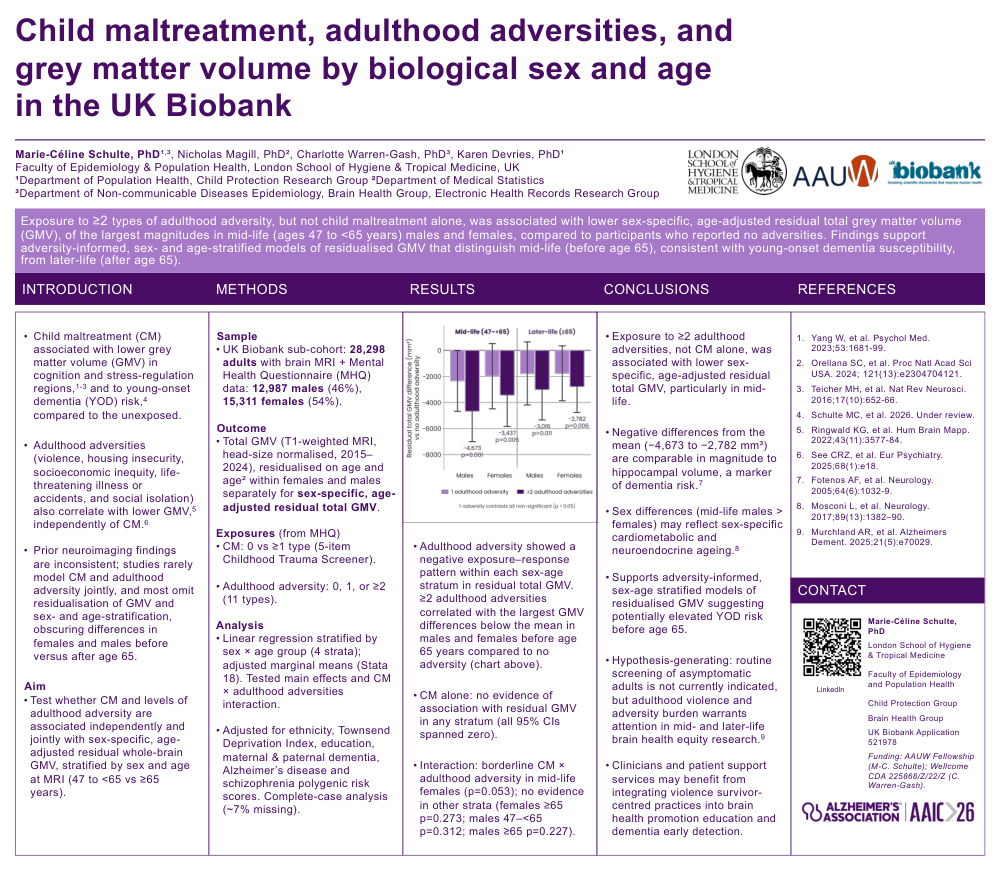
Exposure to ≥2 types of adulthood adversity, but not child maltreatment alone, was associated with lower sex-specific, age-adjusted residual total grey matter volume (GMV), of the largest magnitudes in mid-life (ages 47 to <65 years) males and females, compared to participants who reported no adversities. Findings support adversity-informed, sex- and age-stratified models of residualised GMV that distinguish mid-life (before age 65), consistent with young-onset dementia susceptibility, from later-life (after age 65).
INTRODUCTION
Child maltreatment (CM) associated with lower grey matter volume (GMV) in cognition and stress-regulation regions,1-3 and to young-onset dementia (YOD) risk,4 compared to the unexposed.
Adulthood adversities (violence, housing insecurity, socioeconomic inequity, life-threatening illness or accidents, and social isolation) also correlate with lower GMV,5 independently of CM.6
Prior neuroimaging findings are inconsistent; studies rarely model CM and adulthood adversity jointly, and most omit residualisation of GMV and sex- and age-stratification, obscuring differences in females and males before versus after age 65.
Aim
Test whether CM and levels of adulthood adversity are associated independently and jointly with sex-specific, age-adjusted residual whole-brain GMV, stratified by sex and age at MRI (47 to <65 vs ≥65 years).
METHODS
Sample
UK Biobank sub-cohort: 28,298 adults with brain MRI + Mental Health Questionnaire (MHQ) data: 12,987 males (46%), 15,311 females (54%).
Outcome
Total GMV (T1-weighted MRI, head-size normalised, 2015–2024), residualised on age and age² within females and males separately for sex-specific, age-adjusted residual total GMV.
Exposures (from MHQ)
CM: 0 vs ≥1 type (5-item Childhood Trauma Screener).
Adulthood adversity: 0, 1, or ≥2 (11 types).
Analysis
Linear regression stratified by sex × age group (4 strata); adjusted marginal means (Stata 18). Tested main effects and CM × adulthood adversities interaction.
Adjusted for ethnicity, Townsend Deprivation Index, education, maternal & paternal dementia, Alzheimer’s disease and schizophrenia polygenic risk scores. Complete-case analysis (~7% missing).
RESULTS
Adulthood adversity showed a negative exposure–response pattern within each sex-age stratum in residual total GMV. ≥2 adulthood adversities correlated with the largest GMV differences below the mean in males and females before age 65 years compared to no adversity (chart above).
CM alone: no evidence of association with residual GMV in any stratum (all 95% CIs spanned zero).
Interaction: borderline CM × adulthood adversity in mid-life females (p=0.053); no evidence in other strata (females ≥65 p=0.273; males 47–<65 p=0.312; males ≥65 p=0.227).
CONCLUSIONS
Exposure to ≥2 adulthood adversities, not CM alone, was associated with lower sex-specific, age-adjusted residual total GMV, particularly in mid-life.
Negative differences from the mean (−4,673 to −2,782 mm³) are comparable in magnitude to hippocampal volume, a marker of dementia risk.7
Sex differences (mid-life males > females) may reflect sex-specific cardiometabolic and neuroendocrine ageing.8
Supports adversity-informed, sex-age stratified models of residualised GMV suggesting potentially elevated YOD risk before age 65.
Hypothesis-generating: routine screening of asymptomatic adults is not currently indicated, but adulthood violence and adversity burden warrants attention in mid- and later-life brain health equity research.9
Clinicians and patient support services may benefit from integrating violence survivor-centred practices into brain health promotion education and dementia early detection.
REFERENCES
1. Yang W, et al. Psychol Med. 2023;53:1681-99.
2. Orellana SC, et al. Proc Natl Acad Sci USA. 2024; 121(13):e2304704121.
3. Teicher MH, et al. Nat Rev Neurosci. 2016;17(10):652-66.
4. Schulte MC, et al. 2026. Under review.
5. Ringwald KG, et al. Hum Brain Mapp. 2022;43(11):3577-84.
6. See CRZ, et al. Eur Psychiatry. 2025;68(1):e18.
7. Fotenos AF, et al. Neurology. 2005;64(6):1032-9.
8. Mosconi L, et al. Neurology. 2017;89(13):1382–90.
9. Murchland AR, et al. Alzheimers Dement. 2025;21(5):e70029.
CONTACT
Marie-Céline Schulte, PhD (LinkedIn)
London School of Hygiene & Tropical Medicine
Faculty of Epidemiology and Population Health
Child Protection Group
Brain Health Group
UK Biobank Application 521978
Funding: AAUW Fellowship (M-C. Schulte); Wellcome CDA 225868/Z/22/Z (C. Warren-Gash).
Comments
Email is required but is not shown publicly.
Loading comments...