4,068 posters, 219 videos, 101 topics, 69 sessions, 14,365 authors, 6,128 institutions
ePostersLive by SciGen Technologies S.A. All rights reserved.
Alzheimer's Association International Conference 2026
July 12-15, 2026 | London, United Kingdom, and Online

7104
Cannabidiol Modulates Microglial Morphology And Attenuates Neurodegenerative Changes During Aging In The Ts65dn Mouse Model
Poster Presenter
Authors
Part of Topic
Cannabidiol Modulates Microglial Morphology and Attenuates Neurodegenerative Changes During Aging in the Ts65Dn Mouse Model
Abstract:
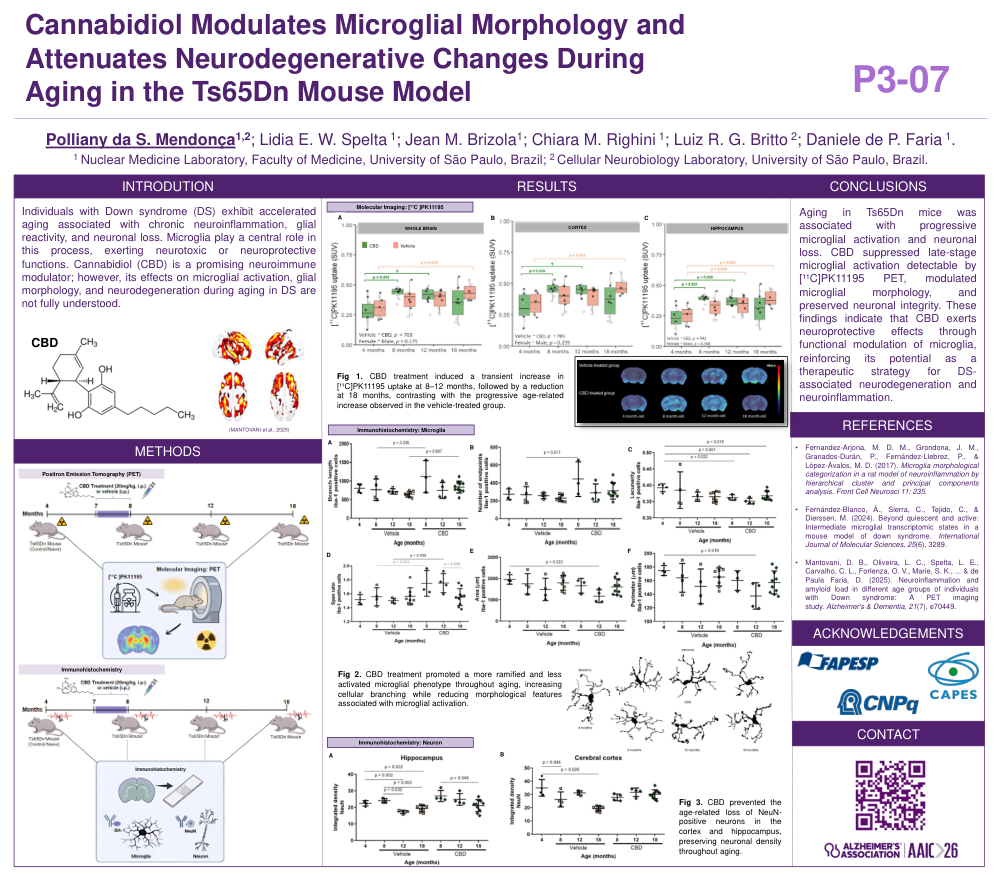
Background: Individuals with Down syndrome (DS) exhibit accelerated aging associated with chronic neuroinflammation, glial reactivity, and neuronal loss. Microglia play a central role in this process, exerting neurotoxic or neuroprotective functions. Cannabidiol (CBD) is a promising neuroimmune modulator; however, its effects on microglial activation, glial morphology, and neurodegeneration during aging in DS are not fully understood. In this study, we investigated the effects of CBD on neuroinflammation and neurodegeneration in the Ts65Dn mouse model.
Methods: Male and female trisomic Ts65Dn mice received CBD (20 mg/kg, i.p.) or vehicle at 7 months of age, for 30 days. Glial reactivity was assessed by Positron Emission Tomography (PET) using [¹¹C]PK11195 in the whole brain, cortex, and hippocampus at 4, 8, 12, and 18 months . Brain tissue was collected for immunohistochemical analyses using NeuN and Iba-1 at the same time points (CEUA: 1811/2022).
Results: The vehicle-treated group showed increased [¹¹C]PK11195 uptake at advanced ages (12 > 4 months: hippocampus, p=0.035; 18 > 4 months: whole brain, cortex, and hippocampus, p=0.034, p=0.034, and p=0.002, respectively). In contrast, CBD increased uptake at 8 (whole brain: p=0.001; cortex: p=0.034; hippocampus: p<0.001) and 12 months (hippocampus: p=0.025), followed by a reduction at 18 months. NeuN density decreased with aging in the cortex (8 months: p=0.044; 18 months: p=0.026) and hippocampus (12 months: p=0.002; 18 months: p=0.032) in the vehicle group, whereas CBD prevented this neuronal loss. Regarding microglia, CBD increased the number of endpoints (8 months: p=0.017) and branch length (8 months: p=0.026; 18 months: p=0.047) compared with the vehicle group, reduced lacunarity relative to the 4-month group (8 months: p=0.022; 12 months: p=0.001; 18 months: p=0.016), and modulated the span ratio. In addition, CBD reduced microglial area and perimeter at 12 months (p=0.022 and p=0.019, respectively) compared with the 4-month group.
Conclusion: Aging in Ts65Dn mice was associated with progressive microglial activation and neuronal loss. CBD suppressed late-stage microglial activation detectable by [¹¹C]PK11195 PET, modulated microglial morphology, and preserved neuronal integrity. These findings indicate that CBD exerts neuroprotective effects through functional modulation of microglia, reinforcing its potential as a therapeutic strategy for DS-associated neurodegeneration and neuroinflammation.
Comments
Email is required but is not shown publicly.
Loading comments...