4,068 posters, 219 videos, 101 topics, 69 sessions, 14,365 authors, 6,128 institutions
ePostersLive by SciGen Technologies S.A. All rights reserved.
Alzheimer's Association International Conference 2026
July 12-15, 2026 | London, United Kingdom, and Online

10202
The Impact Of Frailty And Sex On Polypharmacy In Older Adults With And Without Neurodegenerative Disease: A COMPASS-ND Study
Part of Topic
Key Finding:
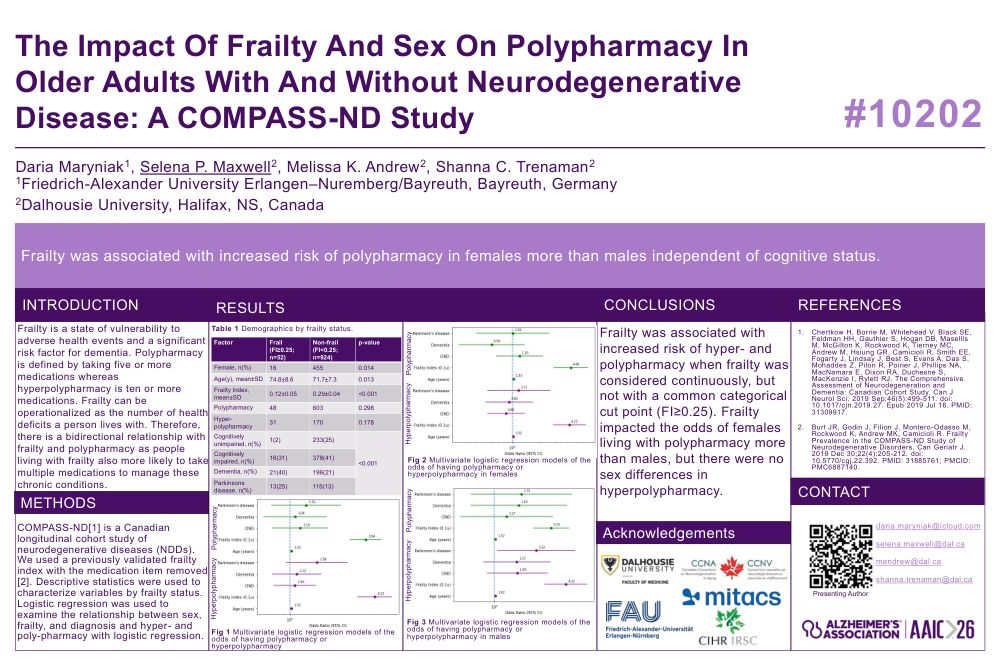
Frailty was associated with increased risk of polypharmacy in females more than males independent of cognitive status.
Introduction:
Frailty is a state of vulnerability to adverse health events and a significant risk factor for dementia. Polypharmacy is defined by taking five or more medications whereas hyperpolypharmacy is ten or more medications. Frailty can be operationalized as the number of health deficits a person lives with. Therefore, there is a bidirectional relationship with frailty and polypharmacy as people living with frailty also more likely to take multiple medications to manage these chronic conditions.
Methods:
COMPASS-ND[1] is a Canadian longitudinal cohort study of neurodegenerative diseases (NDDs). We used a previously validated frailty index with the medication item removed [2]. Descriptive statistics were used to characterize variables by frailty status. Logistic regression was used to examine the relationship between sex, frailty, and diagnosis and hyper- and poly-pharmacy with logistic regression.
Results:
Table 1 Demographics by frailty status
Fig 1 Multivariate logistic regression models of the odds of having polypharmacy or hyperpolypharmacy
Fig 2 Multivariate logistic regression models of the odds of having polypharmacy or hyperpolypharmacy in females
Fig 3 Multivariate logistic regression models of the odds of having polypharmacy or hyperpolypharmacy in males
Conclusions:
Frailty was associated with increased risk of hyper- and polypharmacy when frailty was considered continuously, but not with a common categorical cut point (FI≥0.25). Frailty impacted the odds of females living with polypharmacy more than males, but there were no sex differences in hyperpolypharmacy.
References:
Comments
Email is required but is not shown publicly.
Loading comments...