4,068 posters, 219 videos, 101 topics, 69 sessions, 14,365 authors, 6,128 institutions
ePostersLive by SciGen Technologies S.A. All rights reserved.
Alzheimer's Association International Conference 2026
July 12-15, 2026 | London, United Kingdom, and Online

9023
Heterogeneous Hypermetabolism And Immune Dysregulation In Long Covid: A Multicentre FDG-PET And Cytokine Study
Poster Presenter
Authors
Martín Belzunce, Micaela Hernandez, Juan Casabona, Sol Cataldo, Andrea Micciulli, Laura Margulis, Lorenzo Campanelli, Laura Morelli, Berenice Silva, Ismael Calandri, Lucía Crivelli, Gustavo Sevlever, Ricardo Allegri, Fernando Pitossi
Affiliations
CEUNIM, ICIFI UNSAM-CONICET, Escuela de Ciencia y Tecnología, Universidad Nacional de San Martín, Argentina, Cognitive Neurology, Neuropsychiatry & Neuropsychology, Fleni, Buenos Aires, Argentina, Fundación Instituto Leloir – IIBBA-CONICET, Buenos Aires, Argentina, Unidad de Neuropsicología, HIGA Eva Perón, San Martín, Buenos Aires, Argentina
Part of Topic
BACKGROUND
Long COVID (LC) is characterised by persistent cognitive symptoms beyond 12 weeks after the acute phase, yet its biological underpinnings remain unclear. Sustained inflammation has been hypothesized as a potential underlying mechanism. This study investigated peripheral inflammatory markers and brain glucose metabolism in LC patients to explore underlying pathophysiological processes.
METHODS
This cross-sectional study included individuals from two LC cohorts in Argentina with persistent cognitive complaints and no prior neurological conditions. All participants underwent clinical evaluation, global cognition was screened using the Montreal Cognitive Assessment (MoCA), brain FDG-PET imaging, and blood sampling for peripheral inflammatory marker analysis. MoCA scores were normalised using UDS3 reference data. FDG-PET images were analysed using two independent pipelines (in-house and Neurocloud), each with separate healthy control databases and intensity normalisation strategies. Site-related differences were harmonised using ComBat. Regions showing consistent hyper- or hypometabolism across pipelines were selected. Peripheral blood levels of eotaxin, IFN-γ, IL-1β, IL-4, IL-6, IL-10, IL-17A, MCP-1, and TNF-α were quantified using multiplex ELISA in LC participants and unrelated healthy controls. Exploratory correlations were conducted between MoCA scores and cytokine levels.
RESULTS
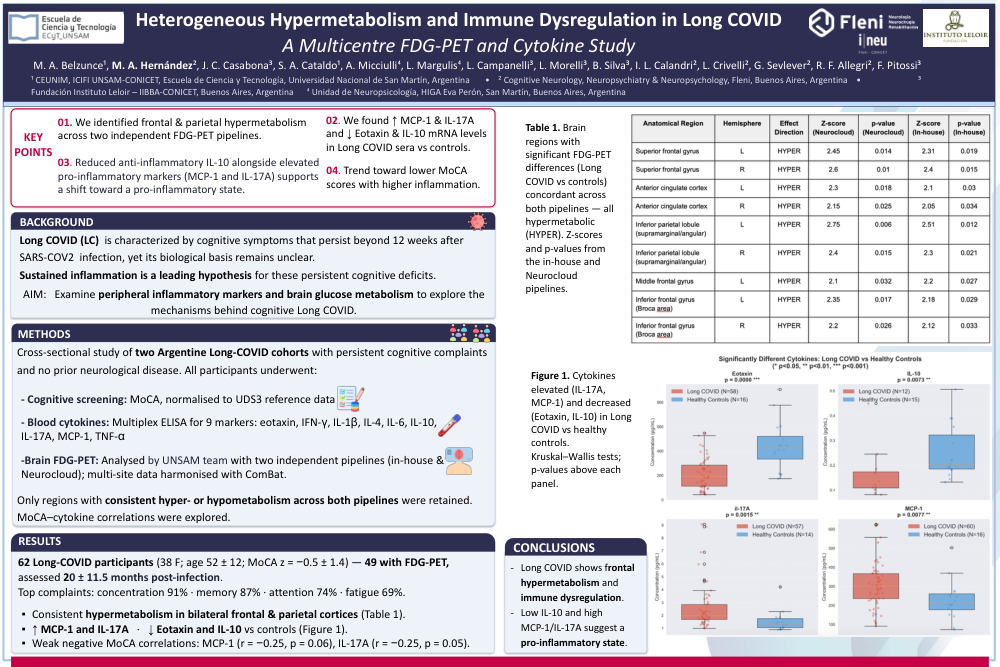
Sixty-two LC participants were recruited (38 female, age 52 ± 12 years, MoCA z-score -0.5 ± 1.4), of which 49 had a FDG-PET scan. Evaluations were performed 20 ± 11.5 months post infection. Memory, concentration, fatigue, and attention complaints were reported by 87%, 91%, 69%, and 74% of participants, respectively. Compared with healthy controls, LC participants exhibited consistent hypermetabolism in bilateral frontal and parietal cortices (Table 1). Group comparisons revealed significantly increased levels of MCP-1 and IL-17A, and reduced levels of Eotaxin and IL-10 in LC vs controls (Figure 1). Exploratory correlations showed weak negative associations between MoCA scores and MCP-1 (r =0.25,p=0.06) and IL-17A (r =0.25,p=0.05).
CONCLUSIONS
Long COVID patients with persistent cognitive symptoms showed a pattern of frontal-dominant hypermetabolism and peripheral immune dysregulation. The reduced anti-inflammatory IL-10 and elevated pro-inflammatory markers support the hypothesis of immune dysregulation with a shift toward a pro-inflammatory state. Further studies are needed to determine whether these metabolic findings reflect chronic neuroinflammation, or a compensatory mechanism.
Comments
Email is required but is not shown publicly.
Loading comments...