4,068 posters, 219 videos, 101 topics, 69 sessions, 14,365 authors, 6,128 institutions
ePostersLive by SciGen Technologies S.A. All rights reserved.
Alzheimer's Association International Conference 2026
July 12-15, 2026 | London, United Kingdom, and Online

5524
Diagnosis-agnostic Representation Learning Reveals Stable Functional Connectivity Signatures Of Alzheimer’S Disease From Fmri
Poster Presenter
Authors
Affiliations
Instituto de Matemática Aplicada del Litoral (IMAL-CONICET-UNL), CCT CONICET, Santa Fe, Argentina., Centro Universitario de Imágenes Médicas (CEUNIM), Instituto de Ciencias Físicas (ICIFI UNSAM-CONICET), Escuela de Ciencia y Tecnología, Universidad Nacional de San Martín (UNSAM), San Martín, Argentina.
Part of Topic
Resting-state fMRI can reveal network alterations in Alzheimer’s disease, but connectivity-based classification is challenged by high dimensionality, acquisition heterogeneity, and unstable interpretation.
Objective: To evaluate a leakage-controlled latent-modelling framework for CN–AD classification and the identification of stable, anatomically interpretable connectivity signatures.
rs-fMRI acquisition (ADNI): 3T EPI · TR 3 s · TE 30 ms · 7–10 min (140/200 volumes) · Philips / Siemens / GE.
Preprocessing: DPARSF with motion correction, MNI normalisation, 4-mm smoothing, 0.01–0.10 Hz band-pass, nuisance regression.
Parcellation: AAL3 → 131 ROIs, Yeo-17 ordered, 140 z-scored timepoints.
External validation: OASIS, N=180 (90 CN / 90 AD), TR 2.5 s, 164 volumes.
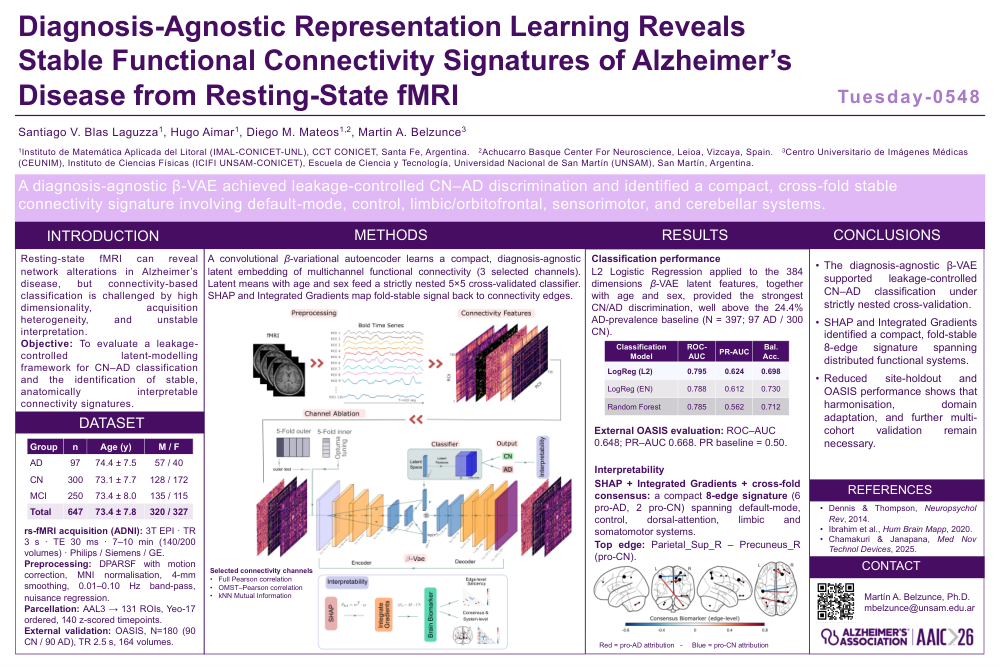
A convolutional β-variational autoencoder learns a compact, diagnosis-agnostic latent embedding of multichannel functional connectivity (3 selected channels). Latent means with age and sex feed a strictly nested 5×5 cross-validated classifier. SHAP and Integrated Gradients map fold-stable signal back to connectivity edges.
Classification performance
L2 Logistic Regression applied to the 384 dimensions β-VAE latent features, together with age and sex, provided the strongest CN/AD discrimination, well above the 24.4% AD-prevalence baseline (N = 397; 97 AD / 300 CN).
External OASIS evaluation: ROC–AUC 0.648; PR–AUC 0.668. PR baseline = 0.50.
Interpretability
SHAP + Integrated Gradients + cross-fold consensus: a compact 8-edge signature (6 pro-AD, 2 pro-CN) spanning default-mode, control, dorsal-attention, limbic and somatomotor systems.
Top edge: Parietal_Sup_R – Precuneus_R (pro-CN).
Conclusions
Comments
Email is required but is not shown publicly.
Loading comments...