4,068 posters, 219 videos, 101 topics, 69 sessions, 14,365 authors, 6,128 institutions
ePostersLive by SciGen Technologies S.A. All rights reserved.
Alzheimer's Association International Conference 2026
July 12-15, 2026 | London, United Kingdom, and Online

9729
Modifiable Risk Factors And 10-year Dementia Incidence: Evidence From The Health And Retirement Study
Poster Presenter
Authors
Ingryd Mayara Nascimento Martins de Pais, Claudia Kimie Suemoto
Affiliations
Part of Topic
Modifiable Risk Factors And 10-year Dementia Incidence: Evidence From The Health And Retirement Study
Ingryd Mayara Nascimento Martins de Pais1, Claudia K. Suemoto, MD PhD2.
1Medical Science, University of Sao Paulo Medical School, Sao Paulo, Brazil, 2University of Sao Paulo Medical School, Sao Paulo, Brazil.
Abstract:
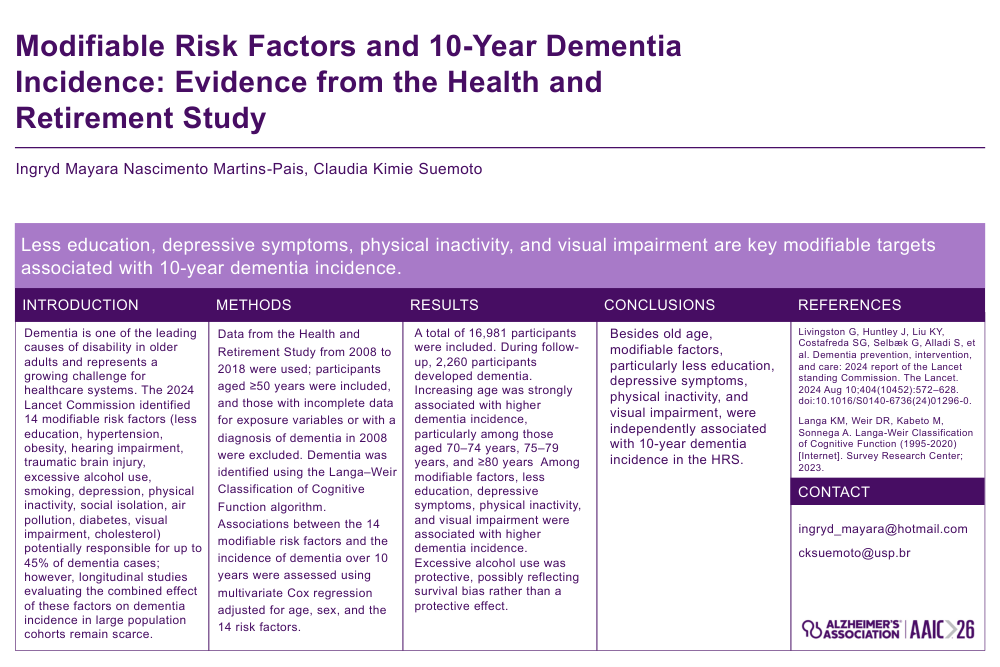
Background: Dementia is one of the leading causes of disability in older adults and represents a growing challenge for healthcare systems. The 2024 Lancet Commission identified 14 modifiable risk factors (less education, hypertension, obesity, hearing impairment, traumatic brain injury, excessive alcohol use, smoking, depression, physical inactivity, social isolation, air pollution, diabetes, visual impairment, cholesterol) potentially responsible for up to 45% of dementia cases; however, longitudinal studies evaluating the combined effect of these factors on dementia incidence in large population cohorts remain scarce.
Methods: In this longitudinal cohort study using data from the Health and Retirement Study from 2008 to 2018 participants aged ≥50 years were included, and those with incomplete data for exposure variables or a diagnosis of dementia at baseline were excluded. Dementia was ascertained using the Langa-Weir Classification of Cognitive Function algorithm. Associations between the 14 modifiable risk factors and 10-year dementia incidence were evaluated using multivariable Cox regression adjusted for age, sex, less education, hypertension, obesity, hearing impairment, traumatic brain injury, excessive alcohol use, smoking, depression, physical inactivity, social isolation, air pollution, diabetes, visual impairment, cholesterol.
Results: A total of 16,981 participants were included. During follow-up, 2,260 participants developed dementia. Increasing age was strongly associated with higher dementia incidence, particularly among those aged 70-74 years (HR=2.01; 95% CI=1.41-2.85; p < 0.001), 75-79 years (HR=2.40; 95% CI=1.69-3.39; p <0.001), and ≥80 years (HR=4.36; 95% CI 3.11-6.11; p <0.001). Among modifiable factors, less education (HR=1.43; 95% CI=1.17-1.75; p <0.001), depressive symptoms (HR=1.24; 95% CI=1.03-1.51; p = 0.023), physical inactivity (HR=1.29; 95% CI 1.10-1.51; p = 0.001), and visual impairment (HR=1.25; 95% CI=1.07-1.46; p=0.004) were associated with higher dementia incidence. Excessive alcohol use was protective (HR=0.63; 95% CI=0.48-0.83; p=0.001), possibly reflecting survival bias rather than a protective effect.
Conclusion: Besides old age, modifiable factors, particularly less education, depressive symptoms, physical inactivity, and visual impairment, were independently associated with 10-year dementia incidence in the HRS.
Comments
Email is required but is not shown publicly.
Loading comments...