4,068 posters, 219 videos, 101 topics, 69 sessions, 14,365 authors, 6,128 institutions
ePostersLive by SciGen Technologies S.A. All rights reserved.
Alzheimer's Association International Conference 2026
July 12-15, 2026 | London, United Kingdom, and Online

2324
Structural And Functional Hypothalamic Changes As Early Features Of Neurodegeneration
Poster Presenter
Authors
Axel AS Laurell, Elijah Mak, Maria-Eleni Dounavi, Yuankai He, Mark Gurnell, Varun Warrier, Richard AI Bethlehem, John T O’Brien, Benjamin R Underwood
Affiliations
Department of Psychiatry, University of Cambridge, Cambridge, UK., Mayo Clinic, Rochester, USA., Institute of Metabolic Science, University of Cambridge, Cambridge, UK., Department of Psychology, University of Cambridge, Cambridge, UK.
Part of Topic
Background
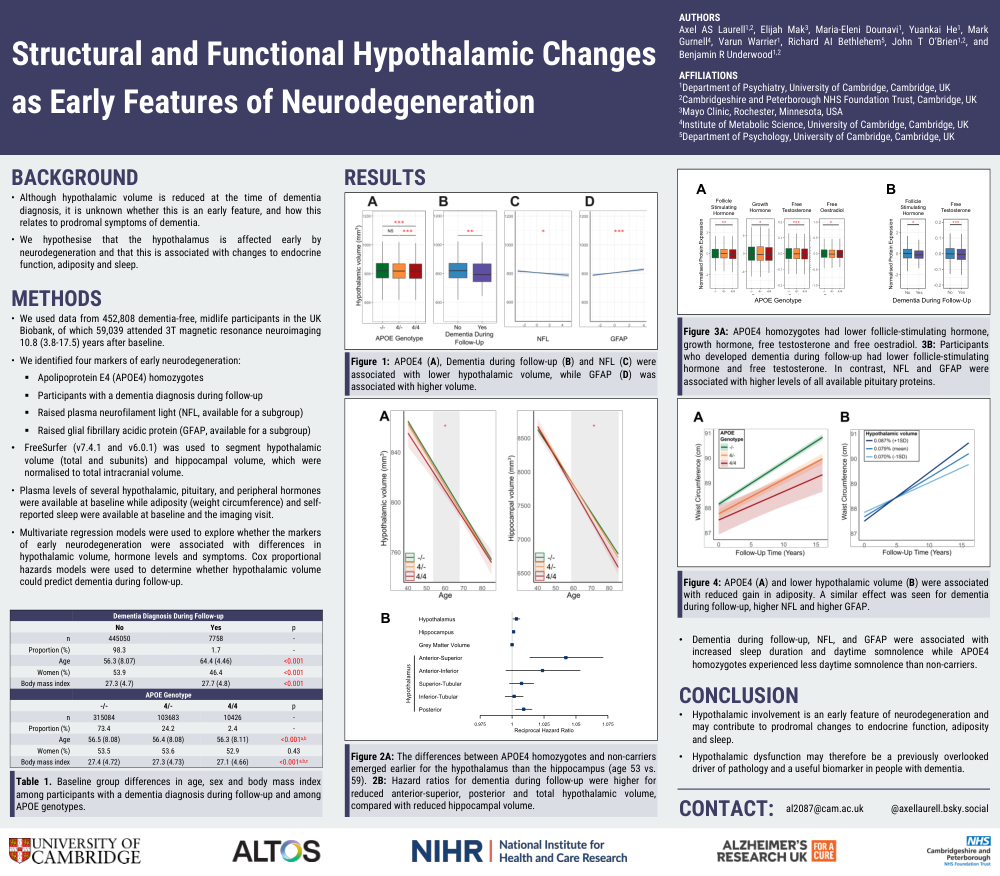
Although hypothalamic volume is reduced at the time of dementia diagnosis, it is unknown whether this is an early feature, and how this relates to changes in endocrine function, sleep and adiposity.
Methods
We used data from 452,808 dementia-free, midlife participants in the UK Biobank, of which 59,039 attended 3T magnetic resonance neuroimaging 10.8(3.8-17.5) years after baseline. Participants with a dementia diagnosis during follow-up (DDF) and carriers of the risk allele apolipoprotein E4 (APOE4) were identified through linkage to health records and whole-genome genotyping respectively. Plasma neurofilament light (NFL) and glial fibrillary acidic protein (GFAP), both associated with neurodegeneration, were available for a subgroup. FreeSurfer (v7.4.1 and v6.0.1) was used to segment hypothalamic volume (total and subunits) and hippocampal volume, which were normalised to total intracranial volume. Plasma levels of several hypothalamic and pituitary proteins were available at baseline, while adiposity (weight circumference) and self-reported sleep were available at baseline and the imaging visit.
Results
DDF, NFL and APOE4 were associated with reduced hypothalamic volume, while GFAP was associated with increased volume. The differences between APOE4 homozygotes and non-carriers emerged earlier for the hypothalamus than the hippocampus (age 53 vs. 59). Similarly, hazard ratios (HR) for DDF were higher for reduced anterior-superior (HR:1.04[95%CI:1.01-1.07]), posterior (HR:1.009[95%CI:1.003-1.02]) and total hypothalamic volume (HR:1.003[95%CI:1.001-1.006]), compared with reduced hippocampal volume (HR:1.001[95%CI:1.0009-1.001]). APOE4, NFL and GFAP were associated with elevated hypothalamic proteins, including agouti-related peptide, neuropeptide Y and pro-melanin concentrating hormone. Furthermore, participants with DDF and APOE4 homozygotes had lower follicle-stimulating hormone, while DDF, NFL and APOE4 were also associated with lower sex hormones. In contrast, NFL and GFAP were associated with higher levels of all available pituitary proteins. DDF, NFL, GFAP and lower hypothalamic volume were associated with reduced gain in adiposity, increased sleep duration and daytime somnolence. APOE4 homozygotes also gained less adiposity, but experienced less daytime somnolence than non-carriers.
Conclusions
Our findings suggest that hypothalamic involvement is an early feature of neurodegeneration and may contribute to changes to endocrine function, sleep and adiposity. Hypothalamic dysfunction may therefore be a previously overlooked driver of pathology and a useful biomarker in people with dementia.
Comments
Email is required but is not shown publicly.
Loading comments...