4,068 posters, 219 videos, 101 topics, 69 sessions, 14,365 authors, 6,128 institutions
ePostersLive by SciGen Technologies S.A. All rights reserved.
Alzheimer's Association International Conference 2026
July 12-15, 2026 | London, United Kingdom, and Online

10091
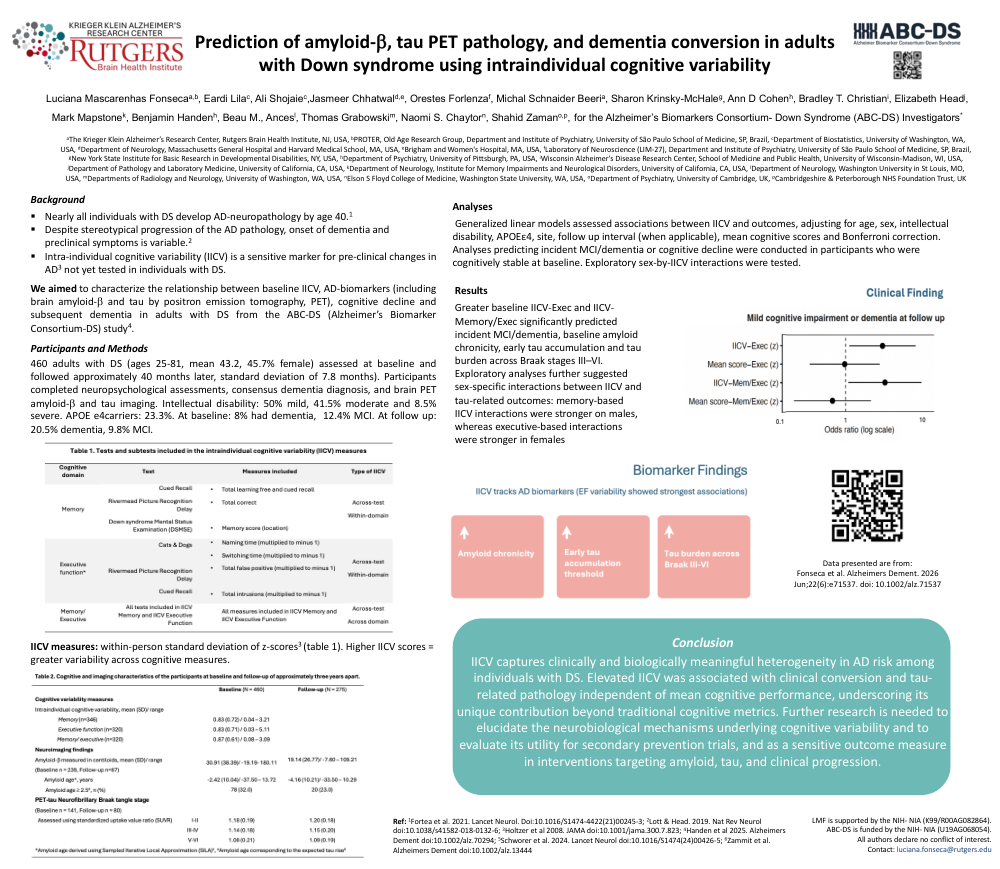
Prediction Of Amyloid-b, Tau PET Pathology, And Dementia Conversion In Down Syndrome Using Intraindividual Cognitive Variability
Poster Presenter
Authors
Luciana Mascarenhas Fonseca, Eardi Lila, Ali Shojaie, Jarmeer Chhatwal, Orestes V. Forlenza, Michal Schnaider Beeri, Sharon Krinsky-McHale, Ann D. Cohen, Bradley Christian, Elizabeth Head, Mark Mapstone, Benjamin Handen, Beau Ances, Thomas Grabowski, Naomi S. Chaytor, Shahid Zaman
Affiliations
The Krieger Klein Alzheinmer's Research Center, Rutgers Brain Health Institute, NJ, USA, Department of Biostatistics, University of Washington, WA, USA, Department of Neurology, Massachusetts General Hospital and Harvard Medical School, MA, USA, Laboratory of Neuroscience (LIM-27), Department and Institute of Psychiatry, University of São Paulo School of Medicine, SP, Brazil, New York State Institute for Basic Research in Developmental Disabilities, NY, USA, Department of Psychiatry, University of Pittsburgh, PA, USA, Wisconsin Alzheimer's Disease Research Center, School of Medicine and Public Health, University of Wisconsin-Madison, WI, USA,, Department of Pathology and Laboratory Medicine, University of California, CA, USA, Department of Neurology, Institute for Memory Impairments and Neurological Disorders, University of California, CA, USA, Department of Neurology, Washington University in St Louis, MO, USA, Departments of Radiology and Neurology, University of Washington, WA, USA, Elson S Floyd College of Medicine, Washington State University, WA, USA, Department of Psychiatry, University of Cambridge, UK, pCambridgeshire & Peterborough NHS Foundation Trust, UK
Part of Topic
Background
Individuals with Down syndrome (DS) have extremely high incidence of AD pathology, most likely linked to the amyloid pathway. They are therefore, considered an ideal target population for anti-AD therapy trials. However, accurately identifying the preclinical phase remains a major challenge. Intraindividual cognitive variability (IICV) refers to variability in an individual’s performance across cognitive measures administered at a single timepoint or over a short period, and has emerged as a potential early marker of AD-related changes, but has not yet been systematically examined in adults with DS.
Methods
Data from 460 participants in the Alzheimer’s Biomarker Consortium–DS (ABC-DS) study were analyzed (mean age, 43.3 years; 45.7% female). Using generalized linear models, we examined whether baseline IICV in memory, executive function, and a combined memory/executive domain predicted incident mild cognitive impairment (MCI) or dementia, longitudinal cognitive decline, amyloid chronicity, early tau accumulation, and tau PET uptake across Braak stages. All models were adjusted for demographics, level of intellectual disability, APOEε4 carrier status, study site, time between assessments, and mean cognitive performance, with Bonferroni correction for multiple comparisons.
Results
Greater baseline IICV in executive and combined memory/executive domains significantly predicted incident MCI/dementia, baseline amyloid chronicity, early tau accumulation and tau burden across Braak stages III–VI (p<0.003). Many associations remained significant after adjustment for mean cognitive performance, including clinical diagnosis and tau-outcomes. In predicting MCI/dementia, higher executive IICV and combined memory/ executive were associated with increased odds of diagnosis (OR = 4.632 and OR = 5.127, respectively, p < 0.05), whereas the corresponding mean cognitive scores were not (p > .05). Exploratory analyses further suggested sex-specific interactions between IICV and tau-related outcomes.
Conclusion
These findings indicate that IICV captures clinically and biologically meaningful heterogeneity in AD risk among individuals with DS. Elevated IICV was associated with clinical conversion and tau-related pathology independent of mean cognitive performance, underscoring its unique contribution beyond traditional cognitive metrics. Further research is needed to elucidate the neurobiological mechanisms underlying cognitive variability and to evaluate its utility for secondary prevention trials, and as a sensitive outcome measure in interventions targeting amyloid, tau, and clinical progression.
Comments
Email is required but is not shown publicly.
Loading comments...