4,068 posters, 219 videos, 101 topics, 69 sessions, 14,365 authors, 6,128 institutions
ePostersLive by SciGen Technologies S.A. All rights reserved.
Alzheimer's Association International Conference 2026
July 12-15, 2026 | London, United Kingdom, and Online

1640
Imaging Altered Oxidative Metabolism In The Brain Of A Tauopathy Model Using Hyperpolarized 13C MR Spectroscopy
Poster Presenter
Authors
Nicholas Vidas-Guscic, Cassandra Leo, Madison Heady, Ashley Shaw, Cornelius Von Morze, Jason Ulrich, Aisling Chaney, Caroline Guglielmetti
Affiliations
Department of Radiology, Washington University School of Medicine, St Louis, MO, United States, Department of Neurology, Washington University School of Medicine, St Louis, MO, United States
Part of Topic
Background
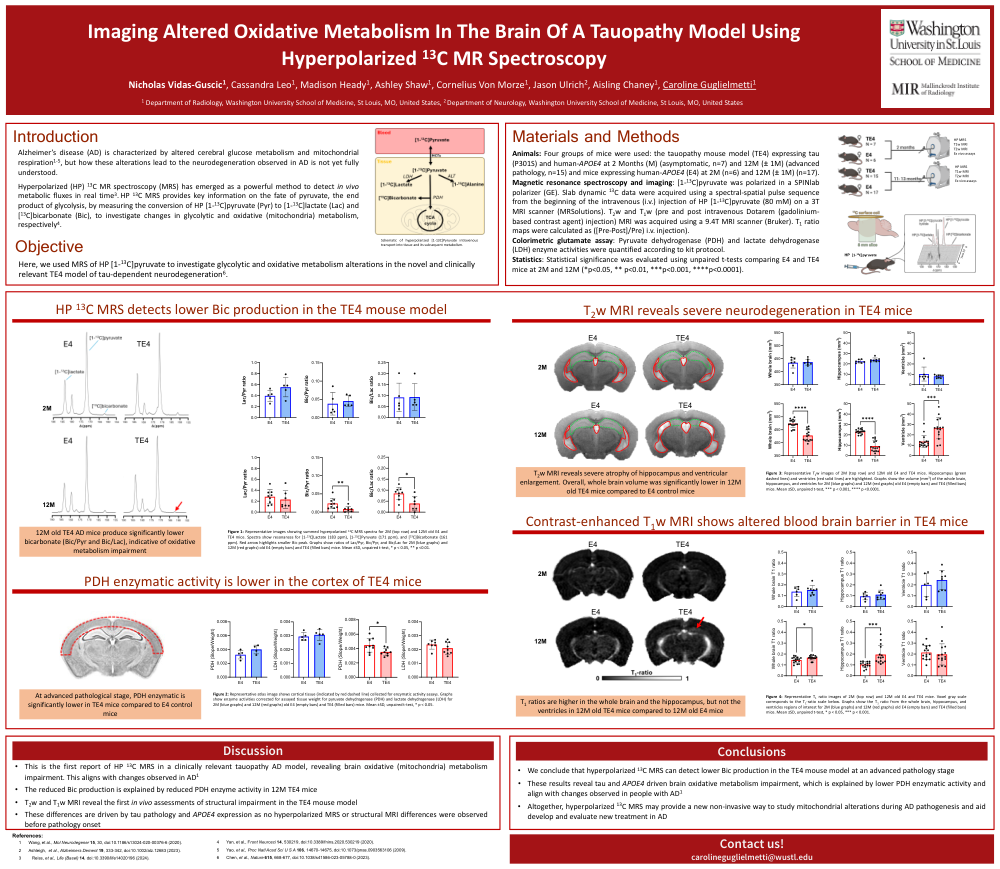
Alterations in brain metabolism and mitochondrial bioenergetics are prominent features in Alzheimer’s disease (AD). However, due to limited methods to non-invasively image mitochondrial metabolism, our understanding of the interplay between AD pathology, mitochondrial bioenergetics, and genetic risk factors contributing to AD remains incomplete. We investigated whether an innovative MR method to detect metabolic fluxes in real-time, namely hyperpolarized 13C MR spectroscopy(HP 13C MRS), could detect glycolytic and oxidative (mitochondria) metabolism changes in a mouse model of tauopathy.
Methods
We used tauopathy mice expressing P301S-tau and human-APOE4 (TE4, n=23), and mice expressing human-APOE4 (E4, n=24). Mice were scanned prior to pathology onset (2 months (M)), and at advanced pathology (11–13M). HP 13C MRS data from the brain were collected using a 3T MR system after HP [1-13C]pyruvate (Pyr) injection. HP Pyr, [1-13C]lactate (Lac) and [13C]bicarbonate (Bic) levels were calculated. T1w post-gadolinium injection and T2w MRI data were acquired on a 9.4T scanner to assess blood-brain-barrier (BBB) integrity and neurodegeneration.
Results
Following injection, HP Pyr is converted into Lac and Bic and informs on glycolytic and oxidative (mitochondria) metabolism, respectively. HP Pyr, Lac and Bic were observed in the brains of E4 and TE4 mice. Pyr delivery and Lac production were unchanged between E4 and TE4 mice. In contrast, Bic levels, Bic/Pyr and Bic/Lac ratios were decreased in TE4 compared to E4 mice at 11-13M old, but not at 2M, demonstrating impaired oxidative metabolism in the tauopathy model at an advanced pathology stage.
T2w MR images confirmed smaller hippocampal and increased ventricle volume in TE4 mice at 11-13M but not at 2M. T1w MRI revealed hyperintensities indicative of BBB leakage in the hippocampus of 11-13M TE4 mice.
Conclusions
This is the first report of HP 13C MRS in a tauopathy model, revealing brain oxidative (mitochondria) metabolism impairment at an advanced pathology stage, aligning with mitochondrial changes reported in AD. Our findings add to the growing evidence suggesting that HP 13C MRS has considerable clinical potential, and may provide a new non-invasive way to examine mitochondrial alterations during AD pathogenesis and aid new treatment development.
Comments
Email is required but is not shown publicly.
Loading comments...