4,068 posters, 219 videos, 101 topics, 69 sessions, 14,365 authors, 6,128 institutions
ePostersLive by SciGen Technologies S.A. All rights reserved.
Alzheimer's Association International Conference 2026
July 12-15, 2026 | London, United Kingdom, and Online

4281
Pupillary Dynamics Reveal Early Locus Coeruleus Dysfunction Across The Alzheimer’s Disease Continuum
Poster Presenter
Authors
Part of Topic
Pupillary Dynamics Reveal Early Locus Coeruleus Dysfunction Across The Alzheimer’s Disease Continuum
Author: Rocío Mesa Martínez, Javier Tejada García, Belén Clavera de la Gándara, Julia Francesca Barrutia Yovera.
Neurology, Complejo Asistencial Universitario de León (CAULE), León, Spain.
Abstract:
Background:
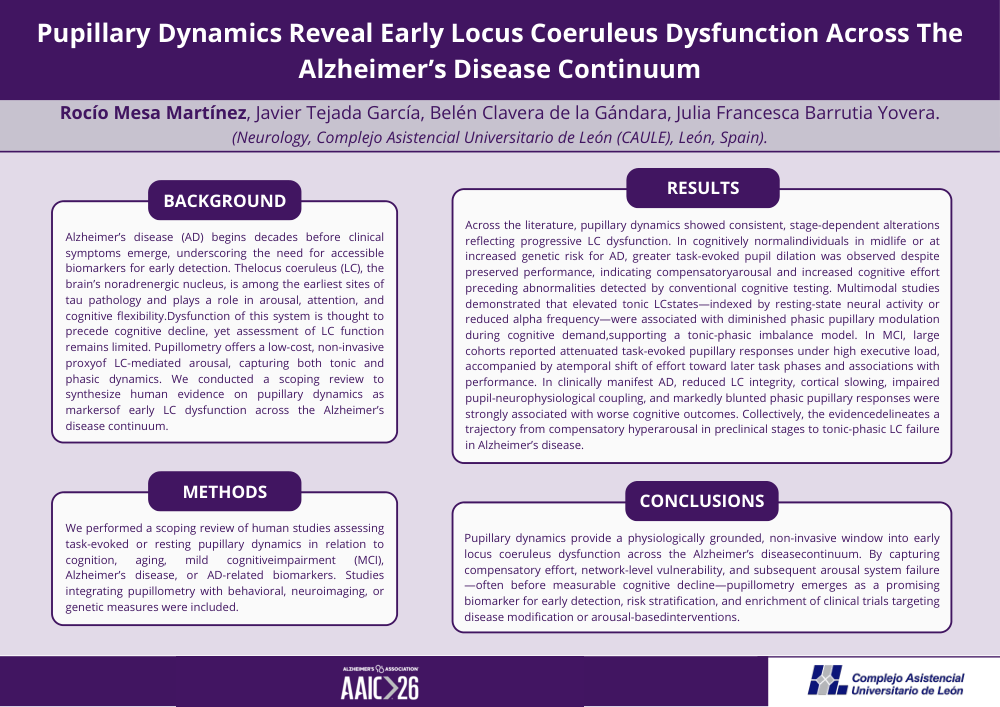
Alzheimer’s disease (AD) begins decades before clinical symptoms emerge, underscoring the need for accessible biomarkers for early detection. Thelocus coeruleus (LC), the brain’s noradrenergic nucleus, is among the earliest sites of tau pathology and plays a role in arousal, attention, and cognitive flexibility.Dysfunction of this system is thought to precede cognitive decline, yet assessment of LC function remains limited. Pupillometry offers a low-cost, non-invasive proxyof LC-mediated arousal, capturing both tonic and phasic dynamics. We conducted a scoping review to synthesize human evidence on pupillary dynamics as markersof early LC dysfunction across the Alzheimer’s disease continuum.
Methods:
We performed a scoping review of human studies assessing task-evoked or resting pupillary dynamics in relation to cognition, aging, mild cognitiveimpairment (MCI), Alzheimer’s disease, or AD-related biomarkers. Studies integrating pupillometry with behavioral, neuroimaging, or genetic measures were included.
Results:
Across the literature, pupillary dynamics showed consistent, stage-dependent alterations reflecting progressive LC dysfunction. In cognitively normalindividuals in midlife or at increased genetic risk for AD, greater task-evoked pupil dilation was observed despite preserved performance, indicating compensatoryarousal and increased cognitive effort preceding abnormalities detected by conventional cognitive testing. Multimodal studies demonstrated that elevated tonic LCstates—indexed by resting-state neural activity or reduced alpha frequency—were associated with diminished phasic pupillary modulation during cognitive demand,supporting a tonic-phasic imbalance model. In MCI, large cohorts reported attenuated task-evoked pupillary responses under high executive load, accompanied by atemporal shift of effort toward later task phases and associations with performance. In clinically manifest AD, reduced LC integrity, cortical slowing, impaired pupil-neurophysiological coupling, and markedly blunted phasic pupillary responses were strongly associated with worse cognitive outcomes. Collectively, the evidencedelineates a trajectory from compensatory hyperarousal in preclinical stages to tonic-phasic LC failure in Alzheimer’s disease.
Conclusion:
Pupillary dynamics provide a physiologically grounded, non-invasive window into early locus coeruleus dysfunction across the Alzheimer’s diseasecontinuum. By capturing compensatory effort, network-level vulnerability, and subsequent arousal system failure—often before measurable cognitive decline—pupillometry emerges as a promising biomarker for early detection, risk stratification, and enrichment of clinical trials targeting disease modification or arousal-basedinterventions.
Comments
Email is required but is not shown publicly.
Loading comments...