4,068 posters, 219 videos, 101 topics, 69 sessions, 14,365 authors, 6,128 institutions
ePostersLive by SciGen Technologies S.A. All rights reserved.
Alzheimer's Association International Conference 2026
July 12-15, 2026 | London, United Kingdom, and Online

794
The gut phageome is associated with healthy brain ageing
Poster Presenter
Authors
Affiliations
Part of Topic
Video
Background: While there is expanding interest on the role of the gut microbiome on human health, this study aims to determine the specific influence of bacteriophages within the gut microbiome on neurodegenerative diseases and brain aging.
Methods: We conducted a population-based study analyzing metagenomic gut virome profiles from 1,655 participants in the SHIP-TREND-0 cohort. Brain age scores (BAS) were calculated from structural MRI data. Multiple linear regression models, adjusted for relevant covariates, were used to examine associations between phage presence and BAS. Microbiome-wide association analyses investigated interactions between BAS-associated phages and bacterial/archaeal species using semi-parametric fractional regressions for abundance analyses and logistic regressions for presence analyses.
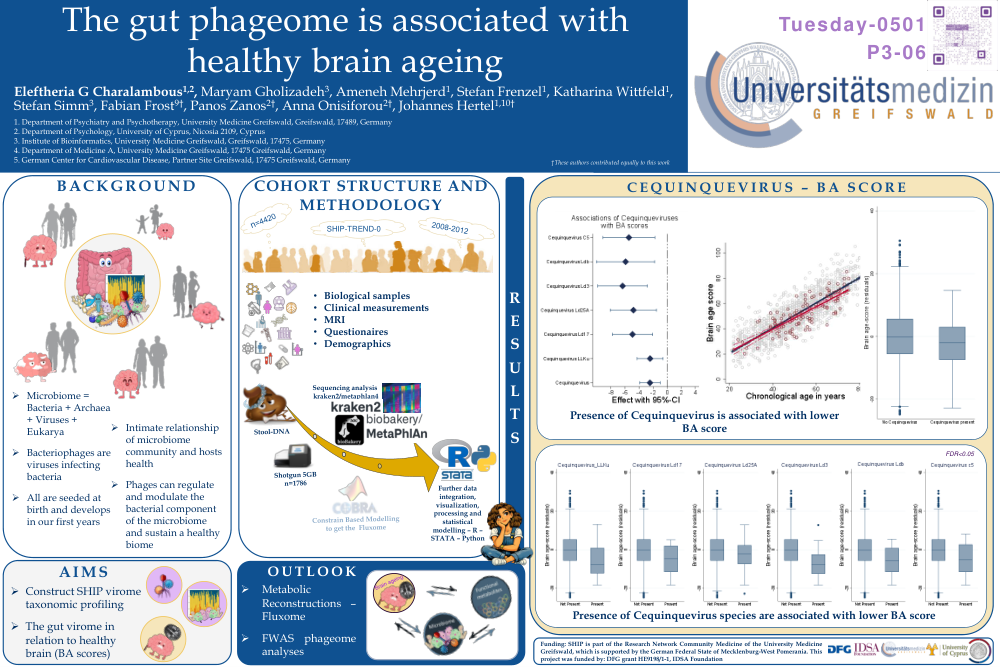
Results: Following assessment of 124 virus genera, the presence of Cequinquevirus was significantly linked to a decrease in estimated FSBA by -2.53 years (95%-confidence interval (CI): (-4.16-0.91), p=3.42e-04, FDR=0.04). Additionally, Cequinquevirus was found to shift the microbial composition and co-occur with L.Delbrueckii and L.Caseii. The presence of L.Delbrueckii was also associated with lower FSBA on a nominally significant level. An independent analysis confirmed that the presence of Lactobacillus Delbrueckii was linked to lower FSBA (p=0.008), suggesting a potential mechanistic pathway for this relationship. In parallel, the Yautsimvirus presence was associated with an increase of 0,13 on the FSAD score (95%-confidence interval (CI):(-.04,.29), p=1.79e-04, FDR=0.002). Importantly, Yautsimvirus presence associated strongly with the increased presence of Enterobacteria genera, Escherichia, Klebsiella and Shigella (FDR<0,05).
Conclusion: While there is expanding interest on the role of the gut microbiome on human health, this study aims to determine the specific influence of bacteriophages within the gut microbiome on neurodegenerative diseases and brain aging. We conducted a population-based study analyzing metagenomic gut virome profiles from 1,655 participants in the SHIP-TREND-0 cohort. Brain age scores (BAS) were calculated from structural MRI data. Multiple linear regression models, adjusted for relevant covariates, were used to examine associations between phage presence and BAS. Microbiome-wide association analyses investigated interactions between BAS-associated phages and bacterial/archaeal species using semi-parametric fractional regressions for abundance analyses and logistic regressions for presence analyses. After assessing 124 virus genera, the presence of Cequinqueviruswas significantly linked to a decrease in estimated brain age scores (FSBA) by -2.53 years (95%-confidence interval (CI): (-4.16-0.91), p=3.42e-04, FDR=0.04). Additionally, Cequinquevirus was found to alter microbial composition and co-occur with L.Delbrueckii and L.Caseii. The presence of L.Delbrueckii was also associated with lower FSBA on a nominally significant level. An independent analysis confirmed that the presence of Lactobacillus Delbrueckii was linked to lower BAS (p=0.008), suggesting a potential mechanistic pathway for this relationship. In parallel, the Yautsimviruspresence was associated with an increase of 0,13 on the Alzheimer´s score (FSAD) score (95%-confidence interval (CI):(-.04,.29), p=1.79e-04, FDR=0.002). Importantly, Yautsimvirus presence associated strongly with the increased presence of Enterobacteria of Escherichia, Klebsiella and Shigella genus (FDR<0,05). This large-scale metagenomic analysis provides novel evidence for the involvement of specific bacteriophages in healthy brain aging, particularly through phage-bacterial interactions with Cequinquevirus or Yautsimvirus. These findings suggest new therapeutic targets for promoting healthy brain aging and highlight the importance of considering phage-bacterial dynamics in gut-brain axis research. Future studies should investigate the causal mechanisms underlying these associations and their therapeutic potential.
Comments
Email is required but is not shown publicly.
Loading comments...