4,068 posters, 219 videos, 101 topics, 69 sessions, 14,365 authors, 6,128 institutions
ePostersLive by SciGen Technologies S.A. All rights reserved.
Alzheimer's Association International Conference 2026
July 12-15, 2026 | London, United Kingdom, and Online

7306
Feasibility Of A Multimodal Sleep Intervention For Community-dwelling Dyads Of People Living With Dementia And Their Caregivers
Poster Presenter
Authors
Melinda Jackson, Sumedha Verma, Aimee Brown, Eleni Kavaliotis, Prerna Varma, Jingling Huang, Rosemary Gibson, Ly Nguyen, Bei Bei, Tom Valenta, Ann Pietsch, Marina Cavuoto, Michael Woodward, Susan McCurry
Affiliations
, University of Washington, Monash University, Massey University, National Ageing Research Institute, Austin Health
Part of Topic
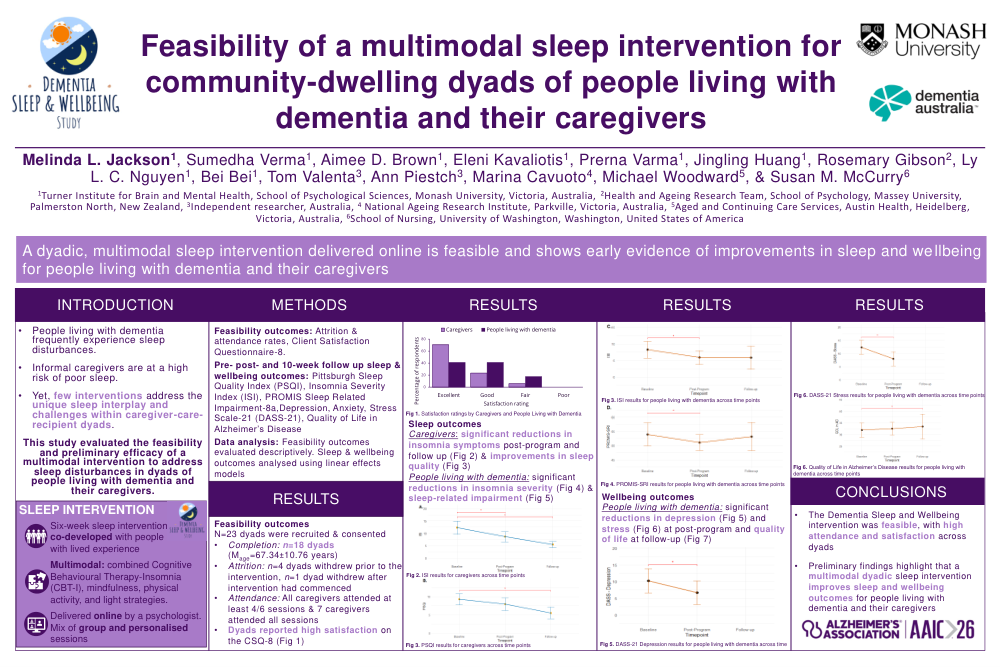
Background. People living with dementia frequently experience sleep disturbances, and their informal caregivers are also at high risk of poor sleep. Few sleep interventions consider the unique sleep interplay and challenges within caregiver-care-recipient dyads. This study evaluated the feasibility and preliminary efficacy of a multimodal intervention to address sleep disturbances in dyads of people living with dementia and their caregivers in Australia and New Zealand.
Methods. Community-dwelling dyads (caregivers Pittsburgh Sleep Quality Index (PSQI) score >4, providing care >3 nights/week) were recruited via social media and dementia support services. Eligible dyads completed the Dementia, Sleep and Wellbeing Program, a six-week online sleep intervention, co-developed with people with lived experience. The program included group-based and personalised sessions, combining Cognitive Behavioural Therapy for Insomnia, mindfulness, physical activity, and light, delivered by psychologists. Feasibility was evaluated by attrition, attendance and satisfaction. Sleep (PSQI, Insomnia Severity Index, PROMIS Sleep-Related Impairment-8a) and wellbeing (Depression Anxiety Stress Scale-21, Quality of Life in Alzheimer’s Disease) were assessed at baseline, post-program and 10-week follow-up. Feasibility outcomes were summarised using descriptive statistics; sleep and wellbeing outcomes were analysed using linear mixed models.
Results. Twenty-three dyads enrolled in the study. Four dyads withdrew before the program, and one dyad withdrew during, resulting in 18 dyads completing the study (Mage=67.34±10.76 years). All caregivers attended at least three of the six sessions, with seven caregivers attending all sessions. Dyads reported high satisfaction with the program. For caregivers, significant reductions were observed in insomnia symptoms post-program (p=.003, Cohen’s d=-1.05) and follow-up (p<.001, d=-1.97), and improvements in sleep quality at follow-up (p<.001, d=-1.69; Fig. 1). For people living with dementia, reductions in insomnia severity (p=.003, d=-0.96, Fig. 1c), sleep-related impairment (p=.048, d=-0.69, Fig. 1d), depression (p=.002, d=-1.23) and stress (p=.005, d=-1.11) were observed post-program, and quality of life at follow-up (p=.01, d=0.71; Fig. 2).
Conclusions. These findings support multimodal, dyadic approaches to address sleep disturbances among community-dwelling people with dementia and their caregivers, demonstrating high engagement and satisfaction, and early indications of improved sleep and wellbeing. Results highlight the potential efficacy of digital interventions to improve sleep and quality of life in this population
Comments
Email is required but is not shown publicly.
Loading comments...