4,068 posters, 219 videos, 101 topics, 69 sessions, 14,365 authors, 6,128 institutions
ePostersLive by SciGen Technologies S.A. All rights reserved.
Alzheimer's Association International Conference 2026
July 12-15, 2026 | London, United Kingdom, and Online

9161
Plasma Proteomic Biomarkers of Alzheimer’s Disease and Related Dementias in Older Adults with Late-life Depression and Associations with Cognitive Performance
Poster Presenter
Authors
Part of Topic
Plasma Proteomic Biomarkers of Alzheimer’s Disease and Related Dementias in Older Adults with Late-life Depression and Associations with Cognitive Performance.
Swathi Gujral, PhD1 Ana Paula Costa, PhD1, Helmet T. Karim, PhD1, Amrita Sahu, PhD2, Thomas K Karikari, PhD1, Alejandro Leon Romero, BS1, Sumer Ziady, MS1, Audrey Corbet, MA1, Meryl A Butters, PhD1.
(1) University of Pittsburgh School of Medicine Department of Psychiatry, Pittsburgh, PA, USA
(2) University of Pittsburgh Department of Physical Medicine and Rehabilitation
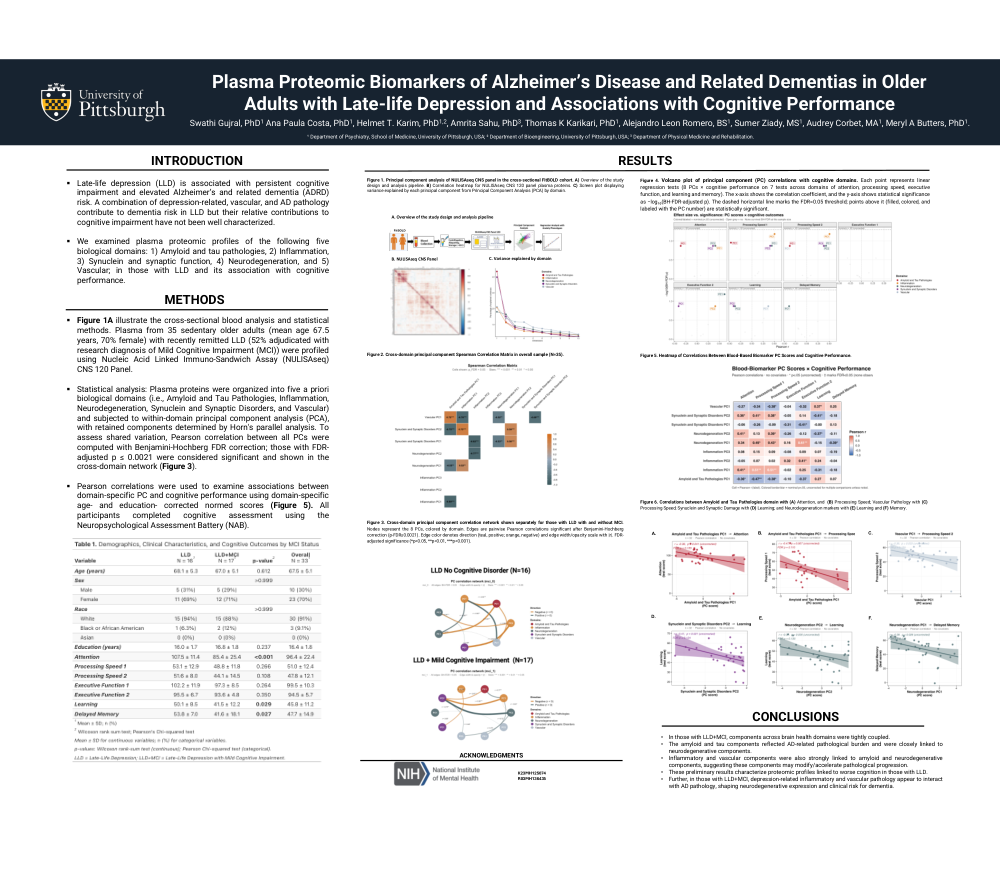
Background: Late-life depression (LLD) is associated with persistent cognitive impairment and elevated Alzheimer’s and related dementia (ADRD) risk. A combination of depression-related, vascular, and AD pathology contribute to dementia risk in LLD but their relative contributions to cognitive impairment have not been well characterized. We examined plasma proteomic profiles of the following brain health domains: 1) amyloid and tau 2) inflammation 3) synuclein and synaptic function 4) neurodegeneration, and 5) vascular health in those with LLD and associated them with cognitive performance.
Method: Plasma from 34 sedentary older adults (mean age=67.5; 70% female) with recently remitted LLD (52% adjudicated with research diagnosis of Mild Cognitive Impairment (MCI)) were used. Nucleic Acid Linked Immuno-Sandwich Assay (NULISA) was used to perform plasma proteomics. Principal components analysis (PCA) was conducted on biomarker data in the overall sample and in MCI-stratified subgroups to derive components representing the five brain health domains. All participants completed cognitive assessment using the Neuropsychological Assessment Battery. Pearson correlations were used to examine associations between principal component scores and cognitive performance across domains.
Result: Overall, higher amyloid and tau pathology was associated with worse attention and processing speed. Worse synaptic function related to worse executive function. Higher vascular pathology related to worse learning and greater neurodegeneration related to worse delayed memory performance. MCI-stratified PCA analyses revealed differential biomarker architecture for those with remitted LLD + MCI relative to those with no cognitive impairment. In those with LLD+MCI, components across brain health domains were tightly coupled. The amyloid and tau components reflected AD-related pathological burden and were closely linked to neurodegenerative components. Inflammatory and vascular components were also strongly linked to amyloid and neurodegenerative components, suggesting these components may modify/accelerate pathological progression.
Conclusion: These preliminary results characterize proteomic profiles linked to worse cognition in those with LLD. Further, in those with LLD+MCI, depression-related inflammatory and vascular pathology appear to interact with AD pathology, shaping neurodegenerative expression and clinical risk for dementia.
Comments
Email is required but is not shown publicly.
Loading comments...