4,068 posters, 219 videos, 101 topics, 69 sessions, 14,365 authors, 6,128 institutions
ePostersLive by SciGen Technologies S.A. All rights reserved.
Alzheimer's Association International Conference 2026
July 12-15, 2026 | London, United Kingdom, and Online

2942
Ai-empowered Retinal Imaging Analysis For Brain Health Assessment And Management In Real World Settings
Part of Topic
Background:
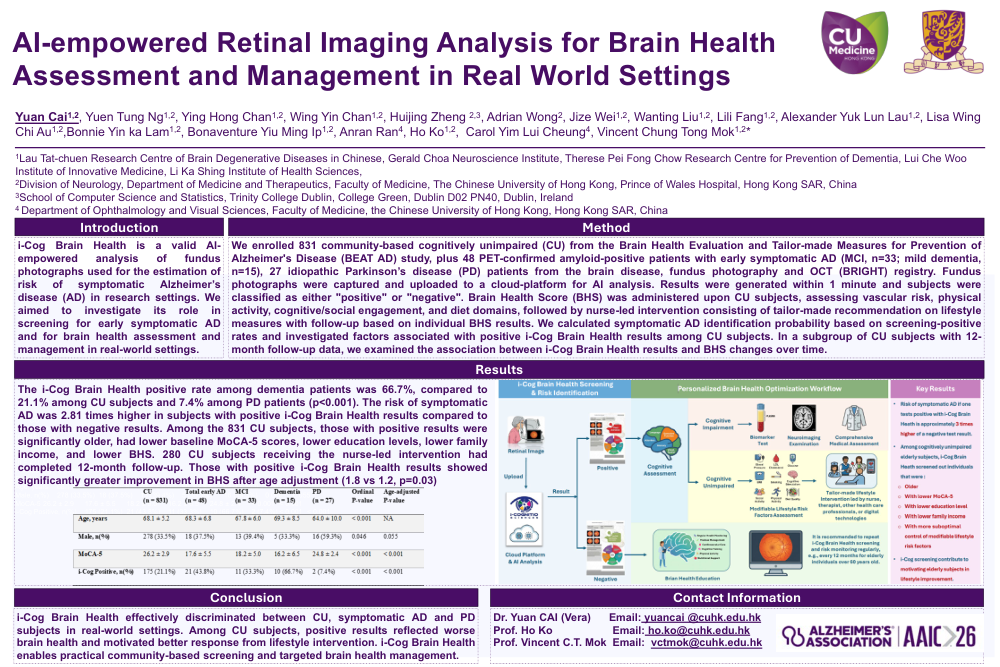
i-Cog Brain Health is a valid AI-empowered analysis of fundus photographs used for the estimation of risk of symptomatic Alzheimer’s disease (AD) in research settings. We aimed to investigate its role in screening for early symptomatic AD and for brain health assessment and management in real-world settings.
Methods:
We enrolled 831 community-based cognitively unimpaired (CU) from the Brain Health Evaluation and Tailor-made Measures for Prevention of Alzheimer's Disease (BEAT AD) study, plus 48 PET-confirmed amyloid-positive patients with early symptomatic AD (MCI, n=33; mild dementia, n=15), 27 idiopathic Parkinson’s disease (PD) patients from the brain disease, fundus photography and OCT (BRIGHT) registry. Fundus photographs were captured and uploaded to a cloud-platform for AI analysis. Results were generated within 1 minute and subjects were classified as either "positive" or "negative". Brain Health Score (BHS) was administered upon CU subjects, assessing vascular risk, physical activity, cognitive/social engagement, and diet domains, followed by nurse-led intervention consisting of tailor-made recommendation on lifestyle measures with follow-up based on individual BHS results. We calculated symptomatic AD identification probability based on screening-positive rates and investigated factors associated with positive i-Cog Brain Health results among CU subjects. In a subgroup of CU subjects with 12-month follow-up data, we examined the association between i-Cog Brain Health results and BHS changes over time.
Results:
The i-Cog Brain Health positive rate among dementia patients was 66.7%, compared to 21.1% among CU subjects and 7.4% among PD patients (p<0.001). The risk of symptomatic AD was 2.81 times higher in subjects with positive i-Cog Brain Health results compared to those with negative results. Among the 831 CU subjects, those with positive results were significantly older, had lower baseline MoCA-5 scores, lower education levels, lower family income, and lower BHS. 280 CU subjects receiving the nurse-led intervention had completed 12-month follow-up. Those with positive i-Cog Brain Health results showed significantly greater improvement in BHS after age adjustment (1.8 vs 1.2, p=0.03).
Conclusions:
i-Cog Brain Health effectively discriminated between CU, symptomatic AD and PD subjects in real-world settings. Among CU subjects, positive results reflected worse brain health and motivated better response from lifestyle intervention. i-Cog Brain Health enables practical community-based screening and targeted brain health management.
Comments
Email is required but is not shown publicly.
Loading comments...