4,068 posters, 219 videos, 101 topics, 69 sessions, 14,365 authors, 6,128 institutions
ePostersLive by SciGen Technologies S.A. All rights reserved.
Alzheimer's Association International Conference 2026
July 12-15, 2026 | London, United Kingdom, and Online

406
Dietary Interventions And Neurocognition Across The Dementia Disease Continuum: A Systematic Review, Meta-regression, And Call To Action
Poster Presenter
Authors
Affiliations
Part of Topic
Video
Abstract
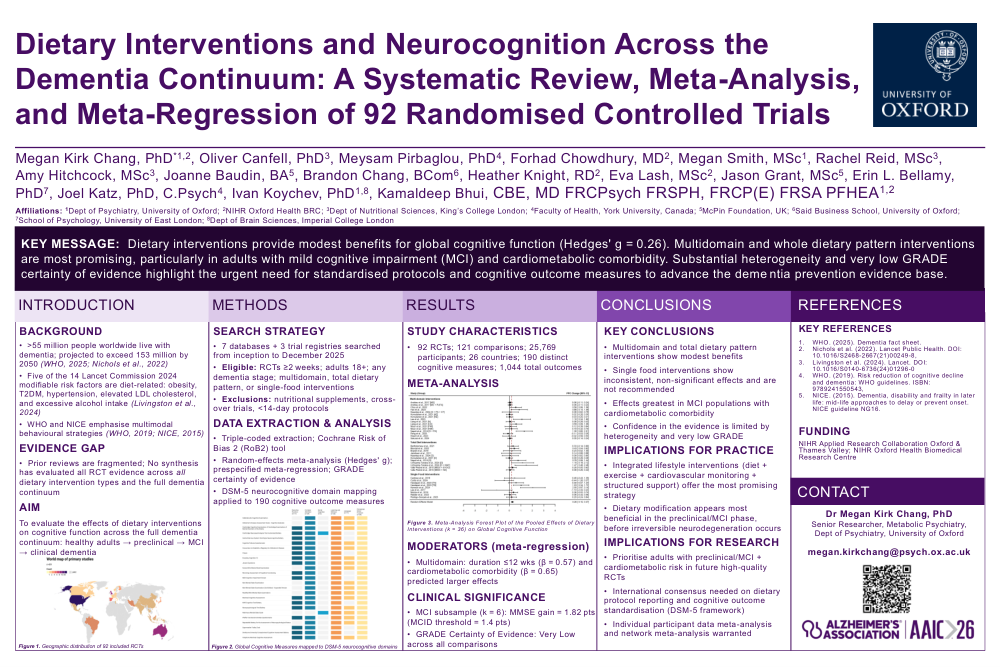
Background: Dementia is projected to affect 153 million worldwide by 2050. Diet is a modifiable risk factor for cognitive decline, yet randomised controlled trials (RCTs) has not been synthesised across the dementia continuum, from cognitively healthy adults to clinical dementia.
Objective: To evaluate the effects of dietary interventions on cognitive function across the dementia continuum and identify factors associated with intervention effectiveness.
Methods: This systematic review and meta-analysis followed PRISMA guidelines. Seven databases and three trial registries were searched from inception to 5 December 2025. Eligible RCTs evaluated multidomain (e.g., diet plus exercise), whole dietary pattern, or single whole food interventions of ≥2-weeks duration in adults ≥18 years. Data were triple coded. Risk of bias was assessed using the Cochrane Risk of Bias 2 tool. Certainty of evidence was evaluated using GRADE. Narrative synthesis was complemented by exploratory random-effects meta-analysis. Prespecified meta-regression and sensitivity analyses explored heterogeneity.
Results: Ninety-two RCTs (121 comparisons; n=25,769 participants) were included. Dietary interventions modestly improved global cognition (k=36, Hedges’ g=0.24, 95%CI:0.14-0.34). Significant benefits were observed for multidomain (g=0.23, 95%CI:0.08-0.38) and whole diet (g=0.27, 95%CI:0.10-0.43) interventions, whereas single food interventions were non-significant. Heterogeneity was substantial, and prediction intervals crossed zero in all analyses. Greater effects were associated with shorter multidomain interventions ≤12 weeks (β=0.57), cardiometabolic comorbidity (β=0.65), and lower risk of bias (β=0.53) in total diet interventions. Neuroimaging outcomes suggested benefits in mild cognitive impairment. Certainty of evidence was very low.
Conclusions: Dietary interventions may provide modest cognitive benefits, particularly multidomain and total diet interventions, although confidence in these findings is limited by substantial heterogeneity and very low certainty of evidence. The findings support future high-quality RCTs targeting adults in the preclinical stages of dementia, especially those with cardiometabolic risk factors, and using standardised dietary intervention and cognitive outcome measures.
Funding: NIHR Applied Research Collaboration Oxford and Thames Valley, NIHR Oxford Health Biomedical Research Centre (BRC)
Registration: NIHR PROSPERO (https://www.crd.york.ac.uk/PROSPERO/view/CRD42023488336)
Statement of Significance: This systematic review and meta-analysis is the first to synthesise evidence from RCTs of dietary interventions across the full dementia continuum, integrating multidomain, whole dietary pattern, and single whole food interventions. It also introduces a DSM-5 mapping framework for classifying cognitive outcome measures and identifies methodological priorities to support more rigorous RCTs for dementia prevention and care.
Comments
Email is required but is not shown publicly.
Loading comments...