4,068 posters, 219 videos, 101 topics, 69 sessions, 14,365 authors, 6,128 institutions
ePostersLive by SciGen Technologies S.A. All rights reserved.
Alzheimer's Association International Conference 2026
July 12-15, 2026 | London, United Kingdom, and Online

4036
Elevated Endogenous Glp-1 As A Novel Alzheimer's Disease Biomarker Linking Neuroinflammation And aί Pathology
Poster Presenter
Authors
Part of Topic
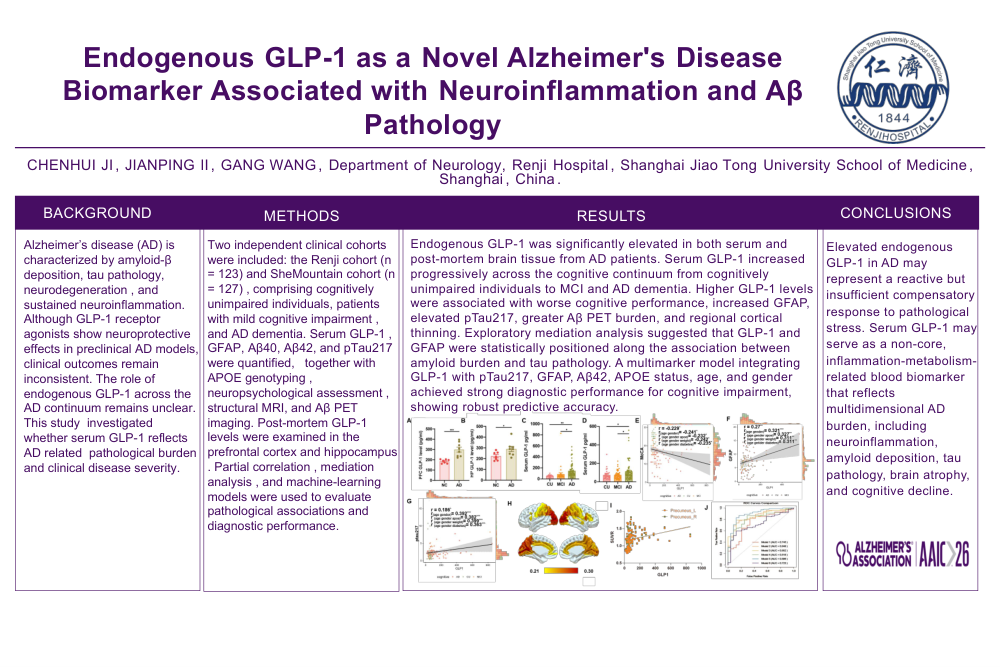
Endogenous GLP-1 as a Novel Alzheimer's Disease Biomarker Associated with Neuroinflammation and Aβ Pathology
Abstract
Alzheimer’s disease (AD) is characterized by amyloid-β deposition, tau pathology, neurodegeneration, and sustained neuroinflammation. Although GLP-1 receptor agonists show neuroprotective effects in preclinical AD models, clinical outcomes remain inconsistent. The role of endogenous GLP-1 across the AD continuum remains unclear. This study investigated whether serum GLP-1 reflects AD-related pathological burden and clinical disease severity.
Methods
Two independent clinical cohorts were included: the Renji cohort (n = 123) and SheMountain cohort (n = 127), comprising cognitively unimpaired individuals, patients with mild cognitive impairment, and AD dementia. Serum GLP-1, GFAP, Aβ40, Aβ42, and pTau217 were quantified, together with APOE genotyping, neuropsychological assessment, structural MRI, and Aβ PET imaging. Post-mortem GLP-1 levels were examined in the prefrontal cortex and hippocampus. Partial correlation, mediation analysis, and machine-learning models were used to evaluate pathological associations and diagnostic performance.
Results
Endogenous GLP-1 was significantly elevated in both serum and post-mortem brain tissue from AD patients. Serum GLP-1 increased progressively across the cognitive continuum from cognitively unimpaired individuals to MCI and AD dementia. Higher GLP-1 levels were associated with worse cognitive performance, increased GFAP, elevated pTau217, greater Aβ PET burden, and regional cortical thinning. Exploratory mediation analysis suggested that GLP-1 and GFAP were statistically positioned along the association between amyloid burden and tau pathology. A multimarker model integrating GLP-1 with pTau217, GFAP, Aβ42, APOE status, age, and gender achieved strong diagnostic performance for cognitive impairment, showing robust predictive accuracy.
Conclusions
Elevated endogenous GLP-1 in AD may represent a reactive but insufficient compensatory response to pathological stress. Serum GLP-1 may serve as a non-core, inflammation-metabolism-related blood biomarker that reflects multidimensional AD burden, including neuroinflammation, amyloid deposition, tau pathology, brain atrophy, and cognitive decline.
Comments
Email is required but is not shown publicly.
Loading comments...