4,068 posters, 219 videos, 101 topics, 69 sessions, 14,365 authors, 6,128 institutions
ePostersLive by SciGen Technologies S.A. All rights reserved.
Alzheimer's Association International Conference 2026
July 12-15, 2026 | London, United Kingdom, and Online

5154
Prognostic Value Of Plasma p-Tau217 And Amyloid PET For Predicting Clinical Progression
Poster Presenter
Authors
Raphael de Luca e Tuma, Pamela C.L. Ferreira, Matheus Scarpatto Rodrigues, Guilherme Bauer-Negrini, Alvaro De Oliveira Franco, Bruna Bellaver, Guilherme Povala, Firoza Z. Lussier, Markley Silva Oliveira Jr., Pampa Saha, Douglas T. Leffa, Helmet T. Karim, Chang Hyung Hong, Hyun Woong Roh, Jessica Z.K. Caldwell, Nathaniel A. Chin, Henrik Zetterberg, Thomas K. Karikari, Eduardo R. Zimmer, Pedro Rosa-Neto, Dana L. Tudorascu, Artur Martins Coutinho, Sang Joon Son, Sid O’Bryant, Sterling C. Johnson, Sonia M.D. Brucki, Tharick A. Pascoal
Affiliations
Department of Psychiatry, School of Medicine, University of Pittsburgh, Pittsburgh, PA, USA, Department of Psychiatry, Ajou University School of Medicine, Suwon, Republic of Korea, Wisconsin Alzheimer’s Disease Research Center, University of Wisconsin–Madison, Madison, WI, USA, Graduate Program in Biological Sciences: Biochemistry, Universidade Federal do Rio Grande do Sul, Porto Alegre, RS, Brazil, Department of Neurology & Neurosurgery, Psychiatry, and Pharmacology & Therapeutics, McGill University, Montreal, QC, Canada, Nuclear Medicine Section, Department of Radiology, Diagnostic Center, Hospital Sírio-Libanês, São Paulo, Brazil, University of North Texas Health, Institute for Translational Research, Fort Worth, Texas, Wisconsin Alzheimer’s Disease Research Center, University of Wisconsin–Madison, Madison, WI, USA., Department of Neurology, Faculdade de Medicina da Universidade de São Paulo (FMUSP), São Paulo, Brazil, Department of Psychiatry, School of Medicine, University of Pittsburgh, Pittsburgh, PA, USA.
Part of Topic
Introduction:
Amyloid-β (Aβ) positron emission tomography (PET) often fails to predict near-term cognitive decline, limiting its prognostic value in Alzheimer’s disease (AD).
In line with AD’s proposed pathophysiological cascade of an Aβ-triggered tau phosphorylation response, plasma p-tau217 is more closely linked to subsequent cognitive decline than Aβ burden.
Incorporating this cascade into disease progression models, rather than treating p-tau217 as an interchangeable proxy for Aβ, may therefore improve AD risk stratification.
Aim: to investigate the combined prognostic value of plasma p-tau217 and Aβ PET in predicting cognitive decline.
Methods:
Multicohort longitudinal study: n = 2,902; 5 cohorts (ADNI, A4, HABS-HD, BICWALZS, and WRAP).
822 cognitively impaired and 2,080 cognitively unimpaired at baseline.
Baseline: Aβ PET Centiloid scale, plasma p-tau217 and clinical dementia rating scale (CDR).
Impairment defined as CDR sum of boxes (CDR-SB) > 0 and no impairment as CDR-SB = 0.
Follow-up (up to 6 years): progression defined as any increase in CDR-SB or worsening diagnosis.
Sensitivity analysis for Mild Cognitive Impairment (MCI) conversion to dementia, using Global CDR of 0.5 converting to 1.0.
Cox proportional hazards models and Kaplan-Meier analyses of progression-free survival.
Biomarker positivity thresholds: Aβ PET Centiloid ≥ 20; p-tau217 z-score ≥ 1.
Results:
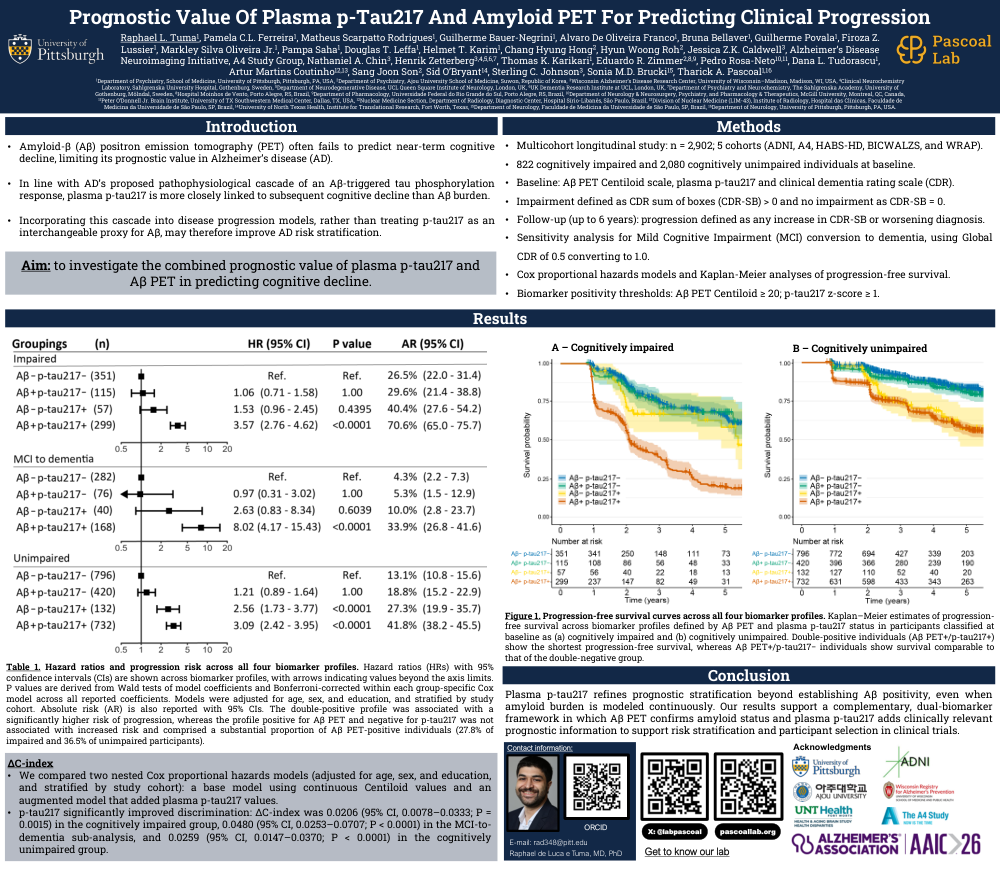
Table 1. Hazard ratios and progression risk across all four biomarker profiles. Hazard ratios (HRs) with 95% confidence intervals (CIs) are shown across biomarker profiles, with arrows indicating values beyond the axis limits. P values are derived from Wald tests of model coefficients and Bonferroni-corrected within each group-specific Cox model across all reported coefficients. Models were adjusted for age, sex, and education, and stratified by study cohort. Absolute risk (AR) is also reported with 95% CIs. The double-positive profile was associated with a significantly higher risk of progression, whereas the profile positive for Aβ PET and negative for p-tau217 was not associated with increased risk and comprised a substantial proportion of Aβ PET-positive individuals (27.8% of impaired and 36.5% of unimpaired participants).
ΔC-index
We compared two nested Cox proportional hazards models (adjusted for age, sex, and education, and stratified by study cohort): a base model using continuous Centiloid values and an augmented model that added plasma p-tau217 values.
p-tau217 significantly improved discrimination: ΔC-index was 0.0206 (95% CI, 0.0078–0.0333; P = 0.0015) in the cognitively impaired group, 0.0480 (95% CI, 0.0253–0.0707; P < 0.0001) in the MCI-to-dementia sub-analysis, and 0.0259 (95% CI, 0.0147–0.0370; P < 0.0001) in the cognitively unimpaired group.
Figure 1. Progression-free survival curves across all four biomarker profiles. Kaplan–Meier estimates of progression-free survival across biomarker profiles defined by Aβ PET and plasma p-tau217 status in participants classified at baseline as (a) cognitively impaired and (b) cognitively unimpaired. Double-positive individuals (Aβ PET+/p-tau217+) show the shortest progression-free survival, whereas Aβ PET+/p-tau217− individuals show survival comparable to that ofthe double-negative group
Conclusion:
Plasma p-tau217 refines prognostic stratification beyond establishing Aβ positivity, even when amyloid burden is modeled continuously. Our results support a complementary, dual-biomarker framework in which Aβ PET confirms amyloid status and plasma p-tau217 adds clinically relevant prognostic information to support risk stratification and participant selection in clinical trials.
Comments
Email is required but is not shown publicly.
Loading comments...