4,068 posters, 219 videos, 101 topics, 69 sessions, 14,365 authors, 6,128 institutions
ePostersLive by SciGen Technologies S.A. All rights reserved.
Alzheimer's Association International Conference 2026
July 12-15, 2026 | London, United Kingdom, and Online

8896
Salivary Nitric Oxide Biomarkers Are Reduced In People Living With Alzheimer’s Disease: Preliminary Findings From Ongoing Research.
Poster Presenter
Authors
Affiliations
Part of Topic
Title
Salivary nitric oxide biomarkers are reduced in people living with Alzheimer’s disease: preliminary findings from ongoing research.
Background
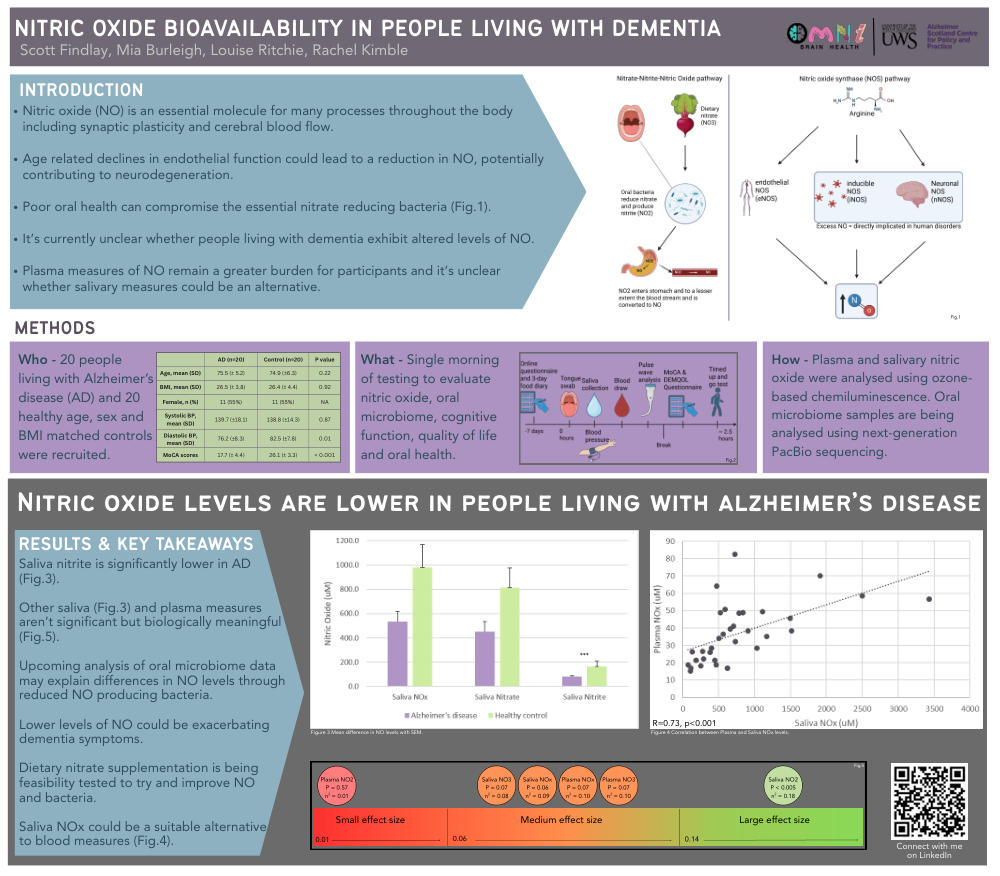
Nitric oxide (NO) is gaining interest in dementia due to its role in synaptic plasticity, vasodilation and inflammatory regulation. NO can be produced both endogenously, as well as via bacterial reduction of dietary nitrate within the oral microbiome. It’s been proposed that insufficient levels of NO could compromise these essential functions and contribute to cognitive decline. Previous studies have reported both higher and lower levels in people living with dementia. However, methodological issues have been highlighted with these studies including delays in processing time and have typically been limited to blood samples. This study aimed to investigate blood and saliva NO levels in people living with dementia with more precise, high sensitivity analysis.
Methods
Fifteen individuals living with Alzheimer’s disease (46.7% female; mean BMI 25.87 ±3.88 kg/m2 and age 75.8 ±4.7 years) and healthy controls (matched for sex, BMI 25.79 ±4.25 kg/m2, and age 74.2 ±6 years) were studied. Fasted blood and unstimulated saliva samples were collected from participants before completing cognitive function (Montreal Cognitive Assessment), quality of life (DEMQOL) and oral health questionnaires. Blood plasma and saliva were analysed for nitrate and nitrite levels using ozone based chemiluminescence.
Results
Saliva nitrite (p<0.05), Nitrate (p=0.04) and NOx (combined nitrate and nitrite) (p=0.03) were significantly lower in Alzheimer’s disease, while plasma NOx, nitrate and nitrite did not differ between groups. Saliva NOx correlated with plasma NOx (r = 0.54, p=0.005) and plasma nitrate (r=0.54, p=0.005), but not with cognitive function or quality of life. Plasma NOx correlated with saliva nitrate (r=0.46, p=0.03).
Conclusions
The higher salivary NOx and nitrite in healthy controls may reflect differences in the oral microbiome. Given that the participants were fasted, this suggests either greater nitrite production or recycling of endogenous stores. Oral health parameters were similar among groups however greater disease associated bacteria could impair the Alzheimer’s disease groups ability to produce NO. The positive association between Saliva NOx and plasma NOx suggests salivary measures may reflect systemic NOx status. Given the comparative ease of saliva collection and processing this could help to enhance quality of future data while reducing the participant burden.
Comments
Email is required but is not shown publicly.
Loading comments...