4,068 posters, 219 videos, 101 topics, 69 sessions, 14,365 authors, 6,128 institutions
ePostersLive by SciGen Technologies S.A. All rights reserved.
Alzheimer's Association International Conference 2026
July 12-15, 2026 | London, United Kingdom, and Online

8761
A Network Analysis Of Cardiometabolic Disease, Cerebral Small Vessel Disease, And Alzheimer’s Disease Biomarkers Across Clinical Stages
Poster Presenter
Authors
Veerle van Gils, Luna Al-Qudsi, Betty Tijms, Charlotte Teunissen, Frederik Barkhof, Everard Vijverberg, Anouk den Braber, Stephanie Vos, Kay Deckers, Sebastian Köhler, Pieter Jelle Visser, Willemijn Jansen
Affiliations
Alzheimer Center Limburg, Department of Psychiatry and Neuropsychology, Maastricht University, Alzheimer Center Amsterdam, Neurology, Vrije Universiteit Amsterdam, Amsterdam UMC location VUmc, Department of Radiology & Nuclear Medicine, Amsterdam UMC, Vrije Universiteit Amsterdam
Part of Topic
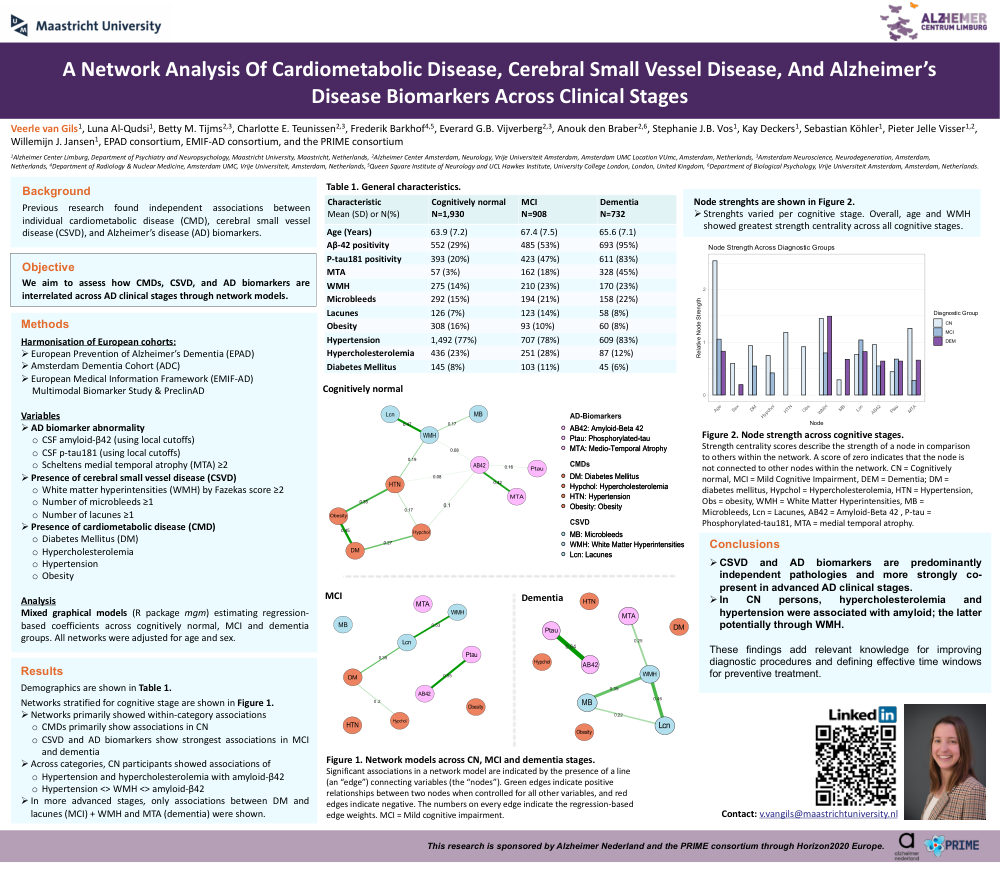
Background: Previous research found independent associations between cardiometabolic disease (CMD), cerebral small vessel disease (CSVD), and Alzheimer’s disease (AD) biomarkers. Yet, it remains unclear how these disease markers are interrelated across AD clinical stages, which is important for improving diagnostic procedures.
Methods: We included 1,919 cognitively normal (CN), 888 mild cognitive impairment (MCI), and 727 dementia participants from three European ageing cohorts as part of the PRIME consortium (Amsterdam Dementia Cohort; ADC, European Prevention of Alzheimer’s Dementia; EPAD, and European Medical Information Framework; EMIF-AD). Through cross-sectional network analyses using mixed graphical models (R package mgm), we estimated regression-based coefficients across all individuals within each clinical stage between variables in three categories: CMDs (presence of diabetes, hypertension, obesity, hypercholesterolemia), CSVD markers (presence of lacunes, microbleeds, white matter hyperintensities; WMH), and AD biomarkers (positivity of cerebrospinal fluid amyloid-β42, p-tau181, and medial temporal atrophy; MTA). We adjusted for age and sex, applied bootstrapping to estimate edge weights, and explored strength centrality measures.
Results: Demographics are shown in Table 1 and estimated networks in Figure 1. Among the variables of interest, WMH was the most central factor across all AD clinical stages. The networks primarily showed within-category associations, with strongest associations in advanced AD clinical stages for the CSVD and AD biomarker (especially amyloid-β42 and p-tau) categories. CMDs did not show any associations in MCI and dementia. Across categories, associations were predominantly present in CN participants. Both hypertension and hypercholesterolemia were associated with amyloid-β42 (edge weight=0.08 and 0.1, respectively), hypertension with WMH (edge weight=0.19), and WMH with amyloid-β42 (edge weight=0.08). In MCI and dementia, WMH was associated with MTA (edge weight=0.1 and 0.17, respectively).
Conclusion: Network associations suggest that CSVD markers and AD biomarkers are predominantly independent pathologies and more strongly co-present in advanced AD clinical stages. In CN persons only, hypercholesterolemia and hypertension were associated with amyloid; the latter potentially through WMH. CMDs did not show any associations in AD clinical stages. WMH was associated with MTA but not with AD-specific pathologies in AD clinical stages. These findings add relevant knowledge for improving diagnostic procedures and defining effective time windows for preventive treatment.
Comments
Email is required but is not shown publicly.
Loading comments...