Loading...

4,068 posters, 219 videos, 101 topics, 69 sessions, 14,365 authors, 6,128 institutions

ePostersLive by SciGen Technologies S.A. All rights reserved.

Alzheimer's Association International Conference 2026

July 12-15, 2026 | London, United Kingdom, and Online

Alzheimer's Association International Conference 2026 banner

5296

Evaluating The Diagnostic Utility Of Csf Protein 14-3-3 For Prion Disease In The Modern Era
Part of Topic

INTRODUCTION

CSF protein 14-3-3 has long been included within diagnostic criteria for prion disease endorsed by major international organizations1,2. Advances in MRI and the advent of RT-QuIC assays capable of detecting prions in CSF have enabled detection of prion disease at earlier stages, when markers of neuronal injury such as 14-3-3 may be undetectable3. However, the clinical utility of this diagnostic biomarker amidst improvements MRI markers and RT‑QuIC testing for prion disease is unclear.

OBJECTIVE

To evaluate the real-world diagnostic utility of cerebrospinal fluid (CSF) protein 14-3-3 for prion disease in the modern diagnostic era.

METHODS

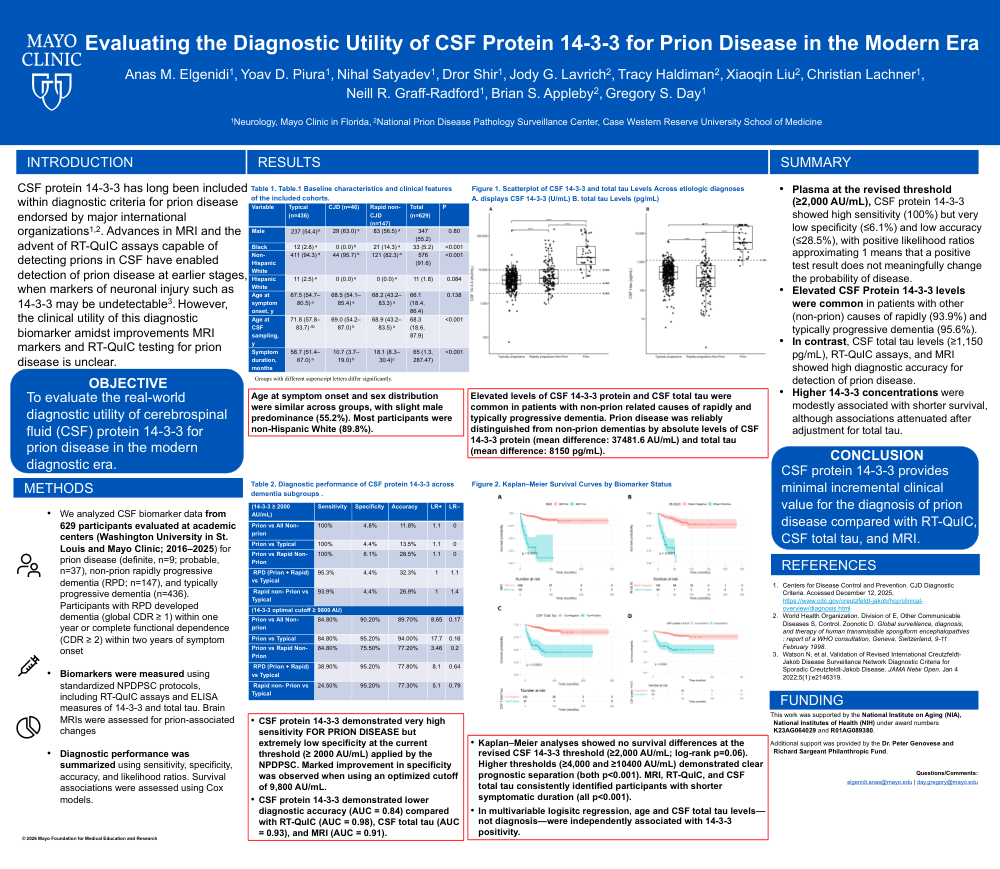
•We analyzed CSF biomarker data from 629 participants evaluated at academic centers (Washington University in St. Louis and Mayo Clinic; 2016–2025) for prion disease (definite, n=9; probable, n=37), non-prion rapidly progressive dementia (RPD; n=147), and typically progressive dementia (n=436). Participants with RPD developed dementia (global CDR ≥ 1) within one year or complete functional dependence (CDR ≥ 2) within two years of symptom onset
•
•Biomarkers were measured using standardized NPDPSC protocols, including RT-QuIC assays and ELISA measures of 14-3-3 and total tau. Brain MRIs were assessed for prion-associated changes
•
•Diagnostic performance was summarized using sensitivity, specificity, accuracy, and likelihood ratios. Survival associations were assessed using Cox models.

RESULTS

•CSF protein 14-3-3 demonstrated very high sensitivity FOR PRION DISEASE but extremely low specificity at the current threshold (≥ 2000 AU/mL) applied by the NPDPSC. Marked improvement in specificity was observed when using an optimized cutoff of 9,800 AU/mL.
•CSF protein 14-3-3 demonstrated lower diagnostic accuracy (AUC = 0.84) compared with RT-QuIC (AUC = 0.98), CSF total tau (AUC = 0.93), and MRI (AUC = 0.91).
•Kaplan–Meier analyses showed no survival differences at the revised CSF 14-3-3 threshold (≥2,000 AU/mL; log-rank p=0.06). Higher thresholds (≥4,000 and ≥10400 AU/mL) demonstrated clear prognostic separation (both p<0.001). MRI, RT-QuIC, and CSF total tau consistently identified participants with shorter symptomatic duration (all p<0.001).
•In multivariable logisitc regression, age and CSF total tau levels—not diagnosis—were independently associated with 14‑3‑3 positivity.

SUMMARY

•Plasma at the revised threshold (≥2,000 AU/mL), CSF protein 14-3-3 showed high sensitivity (100%) but very low specificity (≤6.1%) and low accuracy (≤28.5%), with positive likelihood ratios approximating 1 means that a positive test result does not meaningfully change the probability of disease.
•Elevated CSF Protein 14‑3‑3 levels were common in patients with other (non-prion) causes of rapidly (93.9%) and typically progressive dementia (95.6%).
•In contrast, CSF total tau levels (≥1,150 pg/mL), RT‑QuIC assays, and MRI showed high diagnostic accuracy for detection of prion disease.
•Higher 14‑3‑3 concentrations were modestly associated with shorter survival, although associations attenuated after adjustment for total tau. 

CONCLUSION

CSF protein 14-3-3 provides minimal incremental clinical value for the diagnosis of prion disease compared with RT-QuIC, CSF total tau, and MRI.

Comments

Email is required but is not shown publicly.

Loading comments...

aaic2026 banner
Copyright © 2015-2026, ePostersLive® SciGen is a registered trademark of SciGen Technologies S.A. Patent pending.

This website and third-party tools we use rely on cookies for the best user experience. By selecting "I agree", you agree to cookie usage as described in our Privacy Policy.