4,068 posters, 219 videos, 101 topics, 69 sessions, 14,365 authors, 6,128 institutions
ePostersLive by SciGen Technologies S.A. All rights reserved.
Alzheimer's Association International Conference 2026
July 12-15, 2026 | London, United Kingdom, and Online

6687
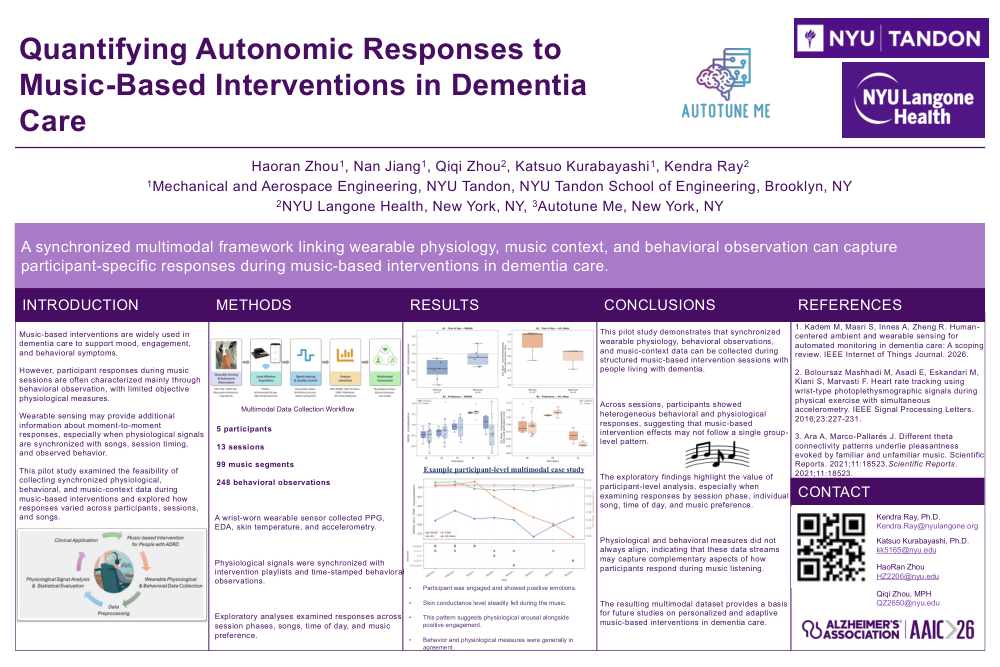
Quantifying Autonomic Responses To Music Intervention In Dementia
Poster Presenter
Part of Topic
Kendra Ray1, Haoran Zhou2, Katsuo Kurabayashi2, Nan Jiang3, Qiqi Zhou4.
1New York University, BROOKLYN, NY, USA, 2Mechanical and Aerospace Engineering, New York University, BROOKLYN, NY, USA, 3Electrical and Computer Engineering, Carnegie Mellon University, Pittsburgh, PA, USA, 4Langone Health, New York University, New York, NY, USA.
Abstract:
Background: Music-based interventions are widely used as non-pharmacological approaches to reduce agitation and anxiety in individuals with Alzheimer’s Disease and Related Dementias (ADRD). While their clinical benefits are well documented, the underlying physiological mechanisms and real-time autonomic responses to music remain insufficiently characterized. A practical framework that enables continuous, quantitative, and interpretable monitoring of physiological responses during music interventions is needed to support personalized dementia care.
Methods: We present a patient-friendly physiological monitoring framework that enables near real-time streaming and recording of biosignals during music-based intervention sessions. Using this system, we collected and analyzed a pilot dataset comprising wearable physiological signals, music playlists, and observational notes from one individual with ADRD across 4 sessions. We further developed an analytic pipeline that integrates heart rate variability (HRV) features from time, frequency, and nonlinear domains with electrodermal level (EDL) measures to characterize autonomic nervous system (ANS) dynamics. Physiological responses were compared across contextual and temporal conditions, including time of day, song preference, and repeated session exposure.
Results: Quantitative analyses indicate that the music-based intervention modulates autonomic function in this individual through both immediate effects and modest short-term residual responses, consistent with regulated arousal rather than stress-related activation. Diurnal comparisons suggest more stable autonomic regulation during morning sessions. In addition, longitudinal analysis reveals improvements in autonomic function across repeated intervention exposures. Preference-dependent modulation further highlights pronounced person-specific physiological responses.
Conclusion: This pilot study demonstrates the feasibility of real-time, physiology-informed analysis of music interventions in ADRD. Continuous autonomic monitoring offers quantitative guidance for personalized scheduling of music interventions, adaptive pacing, and music selection in dementia care.
Comments
Email is required but is not shown publicly.
Loading comments...