4,068 posters, 219 videos, 101 topics, 69 sessions, 14,365 authors, 6,128 institutions
ePostersLive by SciGen Technologies S.A. All rights reserved.
Alzheimer's Association International Conference 2026
July 12-15, 2026 | London, United Kingdom, and Online

1424
Reactive Eeg Biomarkers For Diagnosis And Prognosis Of Alzheimer’S Disease
Poster Presenter
Authors
Soonhyouk Lee, Eunyoung Seong, Ji Won Han, Ki Woong Kim, Hak Soo Choi
Affiliations
Megnosis Co. Ltd., Center for Integrated Smart Sensors, Korea, Megnosis Co. Ltd., Korea, Department of Neuropsychiatry, Seoul National University Bundang Hospital, Seongnam, Korea, Department of Radiology, Harvard Medical School, Boston, MA 02129, USA
Part of Topic
[Introduction]
Background: We previously introduced reactive electro-encephalography(rEEG), a novel approach for the early diagnosis and prognostic evaluation of Alzheimer's disease (AD) and mild cognitive impairment (MCI), based on the ionic resilience of neural cells in response to externally applied electrical perturbations. rEEG measures brain voltage responses to controlled electrical perturbations, revealing distinct electrochemical response patterns in healthy and pathological neural tissues.
Objective: To validate our previous findings, we assessed the diagnostic performance of rEEG in an independent cohort.
[Methods]
Participants: 105 elderly participants were enrolled (45 AD, 30 MCI, 30 NC; mean age 76.57 ± 6.63 years).
Clinical Assessment: Diagnoses were established at Seoul National University Bundang Hospital using MMSE, CERAD-K, CDR, K-IADL, SGDS, and MRI.
rEEG Acquisition: rEEG was recorded using the Diastim20 system (Megnosis Co., Ltd., Korea) with 20 electrodes positioned according to the international 10–20 system. Scalp voltages were measured during controlled current injection (<20 kHz, <100 µA).
Analysis: Responses were analyzed in low-frequency (<100 Hz) and high-frequency (1–20 kHz) bands. Under current-controlled conditions, rEEG voltages reflect brain impedance, denoted as Z-LFB and Z-HFB.
Statistics: Group differences were evaluated using two-way ANOVA
[Results]
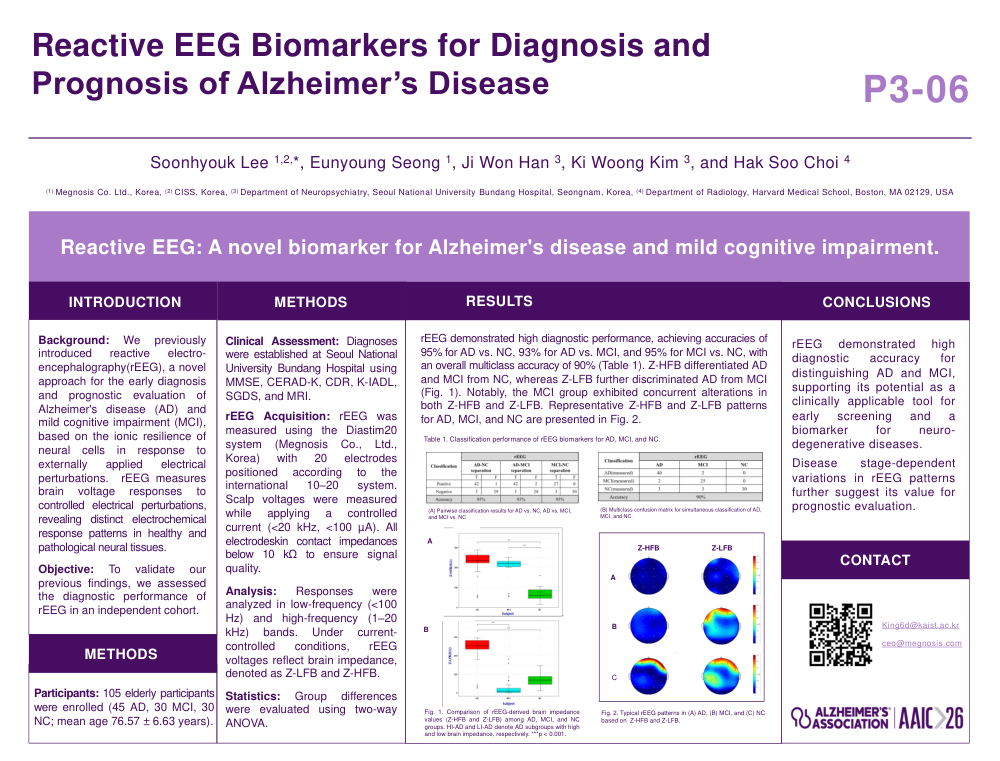
rEEG demonstrated high diagnostic performance, achieving accuracies of 95% for AD vs. NC, 93% for AD vs. MCI, and 95% for MCI vs. NC, with an overall multiclass accuracy of 90% (Table 1). Z-HFB differentiated AD and MCI from NC, whereas Z-LFB further discriminated AD from MCI (Fig. 1). Notably, the MCI group exhibited concurrent alterations in both Z-HFB and Z-LFB. Representative Z-HFB and Z-LFB patterns for AD, MCI, and NC are presented in Fig. 2.
[Conclusions]
rEEG demonstrated high diagnostic accuracy for distinguishing AD and MCI, supporting its potential as a clinically applicable tool for early screening and a biomarker for neurodegenerative diseases. Disease stage-dependent variations in rEEG patterns further suggest its value for prognostic evaluation.
Comments
Email is required but is not shown publicly.
Loading comments...