4,068 posters, 219 videos, 101 topics, 69 sessions, 14,365 authors, 6,128 institutions
ePostersLive by SciGen Technologies S.A. All rights reserved.
Alzheimer's Association International Conference 2026
July 12-15, 2026 | London, United Kingdom, and Online

5932
Blood-Based Biomarker Adoption Across US Practice Settings
Poster Presenter
Authors
Hannah Brown, Simone Gabriele, Georgia Giannakopoulou, Amber King, Isabel Arrusi, Joseph Vindici, Sandra Teoh, Nazira Jainis, Abel Teh
Affiliations
Part of Topic
BLOOD-BASED BIOMARKER ADOPTION ACROSS US PRACTICE SETTINGS
Hannah Brown1, Simone Gabriele1, Georgia Giannakopoulou1, Amber King1 , Isabel Arrusi1, Joseph Vindici2, Sandra Teoh3, Nazira Jainis3, Abel Teh3
1Ipsos, London, United Kingdom, 2Ipsos, New York, NY, 3Ipsos, Kuala Lumpur, Malaysia
Introduction:
Blood-based biomarker (BBBM) tests are emerging as
accessible diagnostic tools for Alzheimer’s disease (AD), yet
their real-world adoption patterns and relationship to diseasemodifying
therapy (DMT) prescribing remain unclear.
Objective:
This study evaluated BBBM utilization across different
US practice settings and their association with treatment
decisions.
Methods:
A multi-centre online survey was conducted among US
neurologists, geriatricians, geriatric psychiatrists and
internists specialising in geriatrics (October-December
2025). De-identified patient charts were collected from
the physicians for patients with mild cognitive impairment,
mild or moderate AD seen in the last 3 months. 123
HCPs recorded diagnostic test use, biomarker status, and
treatment decisions for 677 patients. Participating HCPs
were screened for specialty duration and AD caseload.
Results:
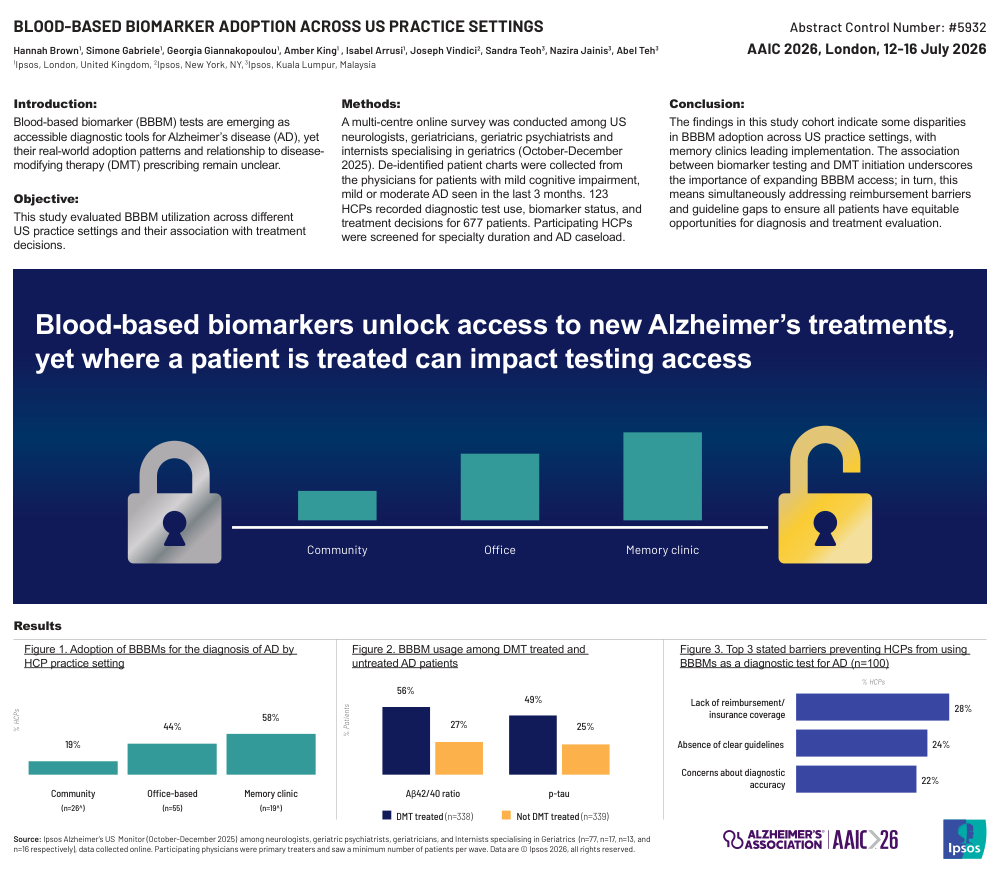
BBBM adoption varied by practice setting, with regular use reported by 58.0% of HCPs based in a memory clinic, 44.0% among office-based HCPs, and 19.0% among those primarily working in a community/hospital. Among DMT-treated patients, Aβ42/40 ratio was tested in 55.9% versus 27.1% of untreated patients, while p-tau was tested in 49.4% versus 25.1% respectively.
Key barriers to BBBM adoption, as recorded by HCPs, included lack of reimbursement/insurance coverage (28.0%), absence of clear guidelines (24.0%), and concerns about diagnostic accuracy (22.0%). Notably, 71.0% of HCPs reported experience with BBBMs and 69.0% of occasional/regular users (n=71) expressed confidence in result interpretation. Reported patients receiving advanced diagnostics (CSF/PET/BBBM, n=233) were more likely to be DMT-treated (35.6%) compared to those with traditional testing only (8.0%, n=201).
Conclusion:
The findings in this study cohort indicate some disparities
in BBBM adoption across US practice settings, with
memory clinics leading implementation. The association
between biomarker testing and DMT initiation underscores
the importance of expanding BBBM access; in turn, this
means simultaneously addressing reimbursement barriers
and guideline gaps to ensure all patients have equitable
opportunities for diagnosis and treatment evaluation.
Key Takeaway: Blood-based biomarkers unlock access to new Alzheimer’s treatments,
yet where a patient is treated can impact testing access
Comments
Email is required but is not shown publicly.
Loading comments...